Categories
Covid

Post Covid

“Individual commitment to a group effort – that is what makes a team work, a company work, a society work, a civilization work”, Vince Lombardi

Blog 5 on Post Covid disruption, resilience and innovation

In earlier blogs, we have explored how this pandemic will affect consumer behaviour and how businesses and governments need to respond to build back better to create a ‘new normal’.  This final blog of the series will take a macro level view of the way forward and how a coordinated response needs to come together.  The Covid crisis does not sit on its own, it is surrounded and complicated by all the other pressures that need to be addressed simultaneously including employment and economic recovery, climate, inequality and geopolitical tensions.

Unfortunately, the end of the crisis is not just around the corner as Donald Trump likes to tout.  We are now deep again into the Covid crisis.   According to WHO as of 30 October, we are now approaching 1.2m deaths and 45m confirmed cases.  Many countries are now going back into a deeper level of lockdown.  This looks like we will continue with uncertainty for at least another few months, at which point we will have gone past a year of Covid.  The scale of this crisis dwarfs the ‘great recession’ which started in 2008.  No organisation should be passively watching what is happening; rather, the focus should be on ensuring survival and then coming out stronger for a ‘new normal’.

One of the critical things that must happen for the post-Covid period, or living with Covid period, is that all the actors necessary for a strong recovery (public, companies, government, 3rd sector) need to participate and move in the same direction.  This alignment needs to also work on a multi-lateral basis. 

Summarising from previous blogs, at the macro level there are 5 areas where there needs to be a strong aligned response to create a ‘new normal’ (Figure 5-1).
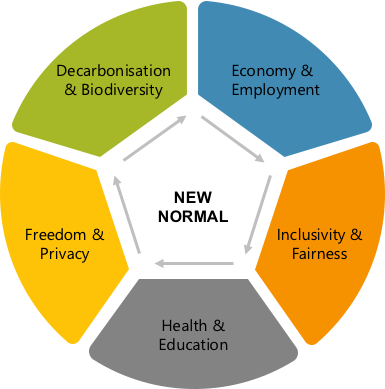
Figure 5-1

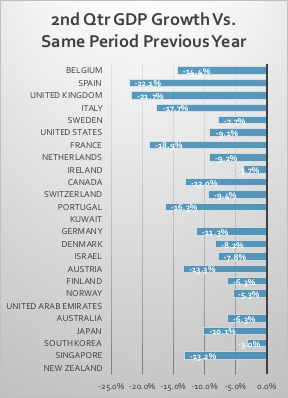
Assuming we come out of this period either learning to live with Covid in a relatively normal way or with a massive vaccination program, the most vital area of focus will be economic and employment recovery.  In the second quarter, virtually every economy had significant year on year negative growth with Spain and the UK having in excess of a 20% year on year decline.  The third quarter will be better than the second quarter, but it will still be substantially down year on year.  The ILO (International Labour Organization) at the end of June 2020 had a baseline global scenario of a 4.9% loss of working hours in this second half of 2020 which equates to an equivalent of 140 million jobs.  This assumed no second wave of Covid!  All predictions involve a massive task to restore the economy to restore employment to previous levels.  

The economic damage and loss of employment have hurt the lower income sectors of all economies the most.  This crisis has also more adversely affected women vs. men and the younger groups in employment.  Addressing this imbalance is essential as well as dealing with all the overall issues of inequality.  

What is clear from our current experience, is that there is also significant work to do in both the health and education sectors to create fit for purpose capabilities that can deal with the challenges of repeat disruptive events and move forward providing higher quality and more reliable day to day services going forward.  Across all sectors of the government, especially in health and education, digital innovation or the delivery of ‘fourth industrial revolution’ capabilities are vital.

One of the large controversial areas that has significant attention in many countries is the right of governments to impinge on constitutional rights of citizens during the Covid crisis.  These rights include, key rights of movement, ability to gather, rights of free speech, rights to gather and use information.  There have been a number of situations in several countries, particularly in Germany, where the courts have stepped in on government interventions and defined them as overreaching, unenforceable and unconstitutional.  Restoration of these rights will be a critical part of restoring social balance.  There are some more insidious things that need to be dealt with that I will cover off with respect to privacy, freedom and democracy in my next blog series on ‘The individual, the market economy and the state’.  There will also need to be a restoration of the rights and abilities of companies to do business without the restrictions that have been imposed on them.  

The final area and the largest looming challenge, that has not taken a break, is the urgent need to address climate warming and biodiversity.  Decarbonisation and recovering biodiversity must be integrated into creating a ‘new normal’ for the living with Covid or post-Covid world.

To create alignment against these factors, ideally requires 4 key components.  Multi-lateral coordination, public-private alignment, financing and frameworks and a strong focus on innovation (Figure 5-2).
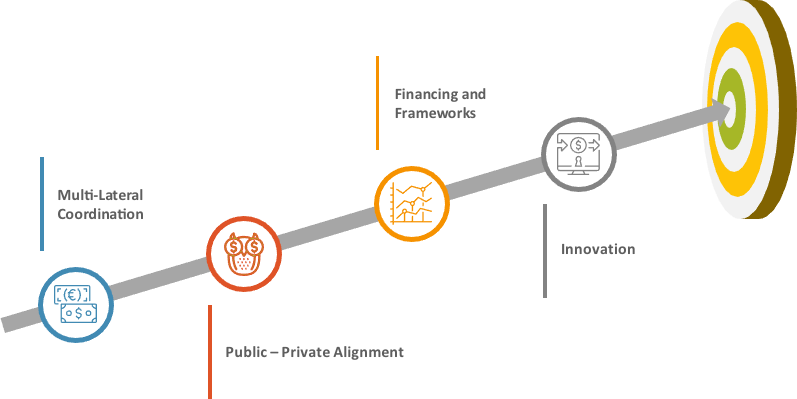
Figure 5-2

When I first started writing this blog at the beginning of the year, my biggest concern regarding the climate and fairness global challenges was the lack of global coordination and response to these issues.  This was then exacerbated by the pandemic.  Since the end of the second world war, the US has shown the leadership to help coordinate and bring together the countries necessary to address key multi-lateral challenges across the full range of issues from health challenges such as HIV/Aids and Ebola, to security and nuclear threats, to the need to address the erosion of the ozone layer.  They were one of the leaders to set up the UN Nations post World War II. 

Unfortunately, under the misguided leadership of Donald Trump, the US has turned inward, moved to an “America First” win-lose focus and escalated geo-political tensions.  Let’s see what happens in the elections and the post-election response.  The first signal will be whether or not the US finalises their withdrawal from the Paris Climate Accord which was targeted for November 4.  For the sake of global progress in dealing with these urgent issues of the pandemic, climate, inequality, and the recovery of a proper democratic process in the US, let’s hope that this is the last we see of Donald Trump in the political arena!  

Multi-lateral coordination is often seen primarily as coordination between countries to drive different agendas.  The scope of these challenges will require responses well beyond just the political sphere.  It needs the involvement of the 3rd sector including of some of the great foundations, such as the Gates Foundation which is working on some of the big issues around health, education and gender equality.  And, most importantly, it needs the productive involvement of the private sector (investors and corporations) with their scale, reach, investment capacity and innovation capabilities.  After all, in the advanced economies most of the wealth lies with the private sector and this investment capability must be tapped into to help solve these challenges with urgency.   

Even deeper alignment of public and private sectors are required at the national level.  The pandemic has seen a much higher inward focus than we have seen for decades.  Local economies are inextricably linked to the health of the private sector and the support of the government, especially in these Covid times.  We should also not forget that the full multiplier effect of the role and services of the government is a substantial part of any countries employment base.  This inward focus, and also the self centered national response to the Covid crisis such as the control of PPE, suggests that governments and companies need to rethink their global supply chains and identify where there needs to be more local sourcing.  Public-private alignment and partnerships are also required in order to have any chance of achieving progress in meeting the Paris Climate Agreement targets and to make progress against inequality.  

The alignment and working together of the public and private sectors requires proactive and productive involvement of the government, key leaders in business and key influential investment groups.  It is in the interest of all parties to contribute to the ‘new normal’.  It does mean that investors and companies have to be thinking in a longer term context and from a multi-stakeholder perspective.  The good thing is that there has been a growing movement in this direction linked to climate change, inequality and the United Nations Sustainable Development Goals.  The integration also requires the convening power of groups such as the World Economic Forum, who this summer initiated such an initiative called ‘The Great Reset’.

The need for financing and improving of market frameworks is substantial and of an unseen scale since the rebuilding post the second World War.  This includes the recovery of employment and repositioning of economies to meet the needs of the future not the past.  We have already invested over 10% of annual gdp in the advanced economies to weather the pandemic storm and substantial new rules, regulations, emergency measures have been put in place to deal with the storm.  A lot more money will be required to restore economies, and there will be a need to remove the often oppressive pandemic related rules, regulations, and collection of personal information.  And, even more financing and framework adjustments are needed to make sure we can prosper and de-risk our future.

The rebooting of our way of life needs to result in a world that is inclusive, multi-stakeholder oriented, more long term focused and aligned to an environmentally sustainable world.  It also need to make a step change in its preparedness for large disruptive events – pandemics, cyber, climate related.  To this extent the frameworks (legislation, regulatory frameworks, reporting requirements, etc.) need to be fit for purpose and future oriented.  This does not have to be more layers of rules and regulations; hopefully, it will be new frameworks replacing or updating old frameworks and not the further layering of bureaucracy.

The financing requirements of the recovery and the setting of a new normal will be vast.  This is going to require the combined financing and investment power of the public and private sectors.  As well as further debt financing, governments will need to look carefully at their taxation programs to not only finance the needs for public services going forward but also to ensure that the right frameworks and incentives are in place to drive private investment in the right places with the right urgency.  In a number of countries, this would also involve a rethink about the focus of some of the current subsidies; such as agricultural subsidies in the US that are driving mono-crop farming in the US vs. regenerative farming.  

Finally, the ‘new normal’ way of life should look and feel very different to the pre-Covid normal.  The driver of achieving this is private and public innovation.  This is accelerated digitisation of the economy and all its sectors including building remote and hybrid working capabilities, hybrid medical and education delivery.  It needs to result in countries predominately driven by clean energy, that have heavily shifted to the electrification of mobility and have significantly changed through the use of AI, sensing and other digital capabilities. Companies need to shift to ‘circular’ strategies and innovation will help them achieve their Net Zero targets.  Innovation is also needed to drive large shifts in food production and consumption and the move towards regenerative farming and rewilding. Increasing carbon sequestration on land and in the oceans is a fundamental part of dealing with climate change and biodiversity.

With the convergence of all these challenges, we are fortunate that we have never been better equipped to meet them head on. We already have the technological know how to drive massive change and new technologies and capabilities are well underway to help us complete this shift.

This is a challenging but also exciting time. As Barack Obama said in a UN General Assembly in 2016, “if you had to choose any moment in history to be born, you would choose right now. The world has never been healthier, or wealthier or better educated…” Obama then called on the audience to look with optimism to the future. “Not blind optimism, but hard-earned optimism, rooted in very real progress.”

#Covid #pandemic #WHO #UN #Donald Trump #economy and employment #inclusivity and fairness #health and education #freedom and privacy #decarbonisation and biodiversity #inequality #climate change #net zero #Barack Obama # sustainable development goals #multi-lateral #public-private # frameworks and financing #innovation

Categories
Covid REBOOT

Post Covid

‘Learn the past, watch the present, and create the future”,
Jess Conrad

Blog 2 on Post Covid disruption, resilience and innovation.

Covid 19 is raising lots of questions about the future.  The most prescient questions are related to solving this health crisis. Most importantly, is when will there be a vaccine ready for use and/or how can we live with Covid 19 and have a relatively normal way of life without economic disruption.  The second set of questions relate to what life might look like when it gets more normalised, and in what way will this Covid experience have changed our environment and changed us to create a ‘new normal’.  The third set of questions are related to how companies need to adjust what they are doing to manage through the crisis and be successful going forward. Finally, how must the government adjust their priorities to help the people and the economy recover and be ready to effectively face the challenges going forward.  

The debate is well underway and will continue for many years on how each country has dealt with the crisis, what was successful, what was not and what are the critical lessons that we must address to be more effective in future pandemic situations.  At the end of the day each country has chosen a path heavily based on ‘science’, as they claim, and this had resulted in a mix of responses in terms of the level of lockdown, the rate and approach to opening up, the response to new outbreaks, the use of masks and highly variable economic responses.  Clearly, the science is not clear and nor are the appropriate responses health wise, economically or politically.  We can only hope that through the diversity of responses that we will take advantage of this, look at the facts, compare the outcomes from multiple perspectives and do a dramatically better job next time.

So how have our lives changed and what are the components of a ‘new normal’ way of life for living with Covid or post Covid?

To think about consumer behaviour, it is useful to start by looking generally at consumer segmentation and then we can explore how behaviour might change against those segmentations as a result of the current Covid experience.  

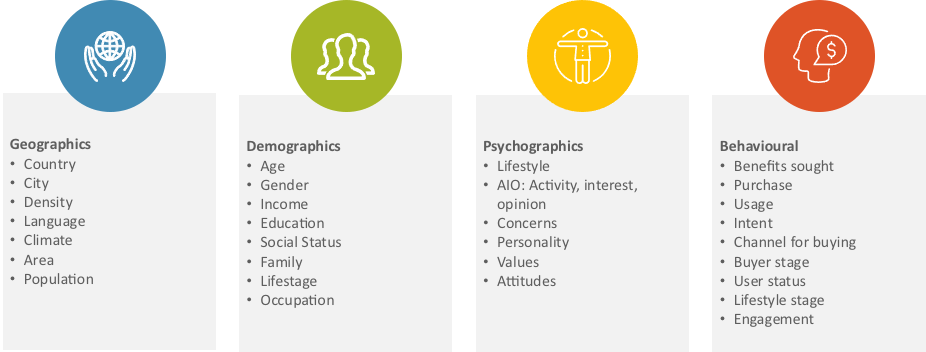
As an initial context, it is worth quickly visiting what components make up and drive consumer segmentation.  There are four categories of factors that drive consumption and buying behaviour (Figure 2-1) – geographics, demographics, psychographics, behavioural. From analysing customer behaviour with data on these factors, clusters of common behaviours can be identified and then used to target and market to the relevant customers for a consumer business.  There are equivalent techniques that are used in business to business.  

Figure 2-1

If you just look at these factors and reflect on your Covid experience you will see that there are inevitable changes to consumer behaviour post Covid.  There will have been changes in a broad cross section of areas including:

  • the income of many people 
  • the potential need to look at alternative occupations
  • changes in attitudes to health and economic risk
  • adjustments to lifestyle priorities 
  • changes to how you work and the level of commuting you do
  • changes to where and how you buy for different product categories, eg. in-store vs. on-line

Many of these changes are not temporary adjustments where customers will fully revert to previous behaviour.  To explore this, it is useful to start with customer segmentation from two perspectives. Firstly, understanding basic generational differences and secondly having a look at customer segmentation based on combinations of the four dimensions that generate understandable clusters of consumers. I will then overlay the Covid experience and then talk about post Covid behaviour.

Starting with generational segmentation, McKinsey has put together a simple comparison of generational differences (Figure 2-2).  Each generation has been brought up in a different contextual environment – political, economic, social, environmental and technological.  That new context added to the specific context of our upbringing drives our behaviour and consumption patterns all other things being equal.  Clearly, this representation in Figure 2-2 is very much a ‘Western’ or ‘industrialised’ world representation and applies less so to the developing world which live in very different socio-economic and political contexts.

Figure 2-3

Each of the generations are different in size and at any point in time have very different levels of overall consumption.  Gen Z, although the smallest economic segment, are critical to understand as they are the generation most in tune with the current world.  They are influencers that affect the direction of travel of the other segments with the closest segment, the Millennials, that will shift the most from their influence.  The retired generation will shift the least.  

Key components of Gen Z behaviour include:

  • Adoption of technology – including the extensive level of home shopping and use of social networks. They are the first generation of truly digital natives.
  • Social conscience – ‘Me Too’, ‘Black Lives Matter’, fair trade, ethical sourcing
  • More experience oriented vs. product oriented 
  • Responsibility to the planet

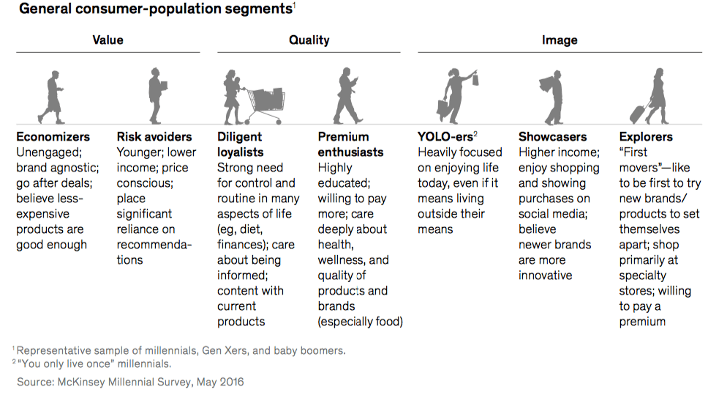
Obviously, there are many other factors that affect consumer behaviour and as a result everyone in a generation does not behave in the same way.  There are many different sources of analysis from all the consulting firms on how consumers segment in general; however, I chosen to pick some analysis that McKinsey has done that identifies 7 segments that group into the three themes of value, quality and image (Figure 2-3).  

Figure 2-3

These segments mix attitudes with the practical links to individual situations including income/affluence, education and life stage. Within each segment here will be mixes of all generations; but, each generation will mix differently across the segments.   The mix of these segments will also vary across countries.  

Many companies will have done their own analysis and defined segments in a way that is relevant to their business and helps them successfully attract and acquire new customers.   The more detailed and specific your understanding of your customers, the better you will be equipped to rapidly respond to changes in behaviour and be on the winning side of changes.  

Let’s now look at the impact of Covid.  For most of us there has been a big change in our behaviour, for many there has been a change in the current economics or future prospects of their household and for everyone they have had to take views (implicitly or explicitly) on their risk attitudes towards health and economic uncertainty (See Figure 2-4).  These changes effectively add overlays onto any segmentation which will cause changes in clusters around key attributes and therefore create a new segmentation of customers.

Figure 2-4

Behaviourally, there has been a massive shift to on-line working, where possible, and on-line education that has been decided by others.  In addition, there have been requirements to stay at home, limit time outside, and curb social get togethers.  As a result, most people have adapted how they live in terms of solving how to work at home, being home educated, significantly increasing their at home eating and home fitness, etc.   They have also gained time from the reduction in commuting time and other transportation time.   The sum of these changes have driven new behaviours including home cooking, home fitness, remote shopping, on-line entertainment and on-line socialisation.  These new behaviours are in turn also linked to a reprioritisation of where and how we spend our money and of course linked to changes in economic circumstances.    

For most of us, we have now reached the 6 month level of changed behaviours and we are not back to a normal life with no restrictions, such as a return to commuting every day, in-person education, high levels of socialisation, visiting the gym and taking holidays in other countries without lockdown requirements on return.  Shops, restaurants, offices, transportations systems etc. have not been adapted fully to accommodate a full return to our previous lives. 

Economically, levels of unemployment have grown dramatically, and with those countries with furlough schemes growing levels of unemployment have to a large extent just been delayed.   The increased unemployment is not spread evenly across the market; rather, it has hit the high street, the leisure and entertainment sector, the travel and tourism sector and parts of the health sector. It has also disproportionately affected women and the young.  With uncertainty on the recovery of many businesses, especially in these sectors, many consumers face a period of economic uncertainty.

This overall experience has created heightened levels of both health and economic trauma.  The health trauma will tend to be higher with the elder populations and those at risk.  Although, there is large range of impact by country (using deaths per million as a measure, Figure 2-5), the trauma has also come from the level of measures imposed on a population by the government and the fear based media coverage on Covid.  The perceived health risk is almost certainly higher than the actual risk on average; however, perception is reality for most people.  

Figure 2-5

The economic trauma, which leads to uncertainty, has been pervasive with effectively all of the top 25 countries, based on GDP per Capita, seeing unprecedented declines in their second quarter year on year GDP growth (Figure 2-6).  The economic declines are not necessarily linked to the health outcome of the Covid crisis; rather, they are much more related to the prevention and lock down steps taken by governments.   

Figure 2-6

Although many countries are trying to move back towards normal, this is a slow process.  There is pressure to maintain certain behaviours such as distancing; and, on and off lock downs are regular occurrences in countries as new pockets of Covid appear.  We are a long way from being post Covid as there is no clarity on a vaccine, and therefore no clarity on the timing of the distribution of a vaccine.  Finally, we are entering the flu season with a likely increased risk of further Covid challenges.  

Moving on to how to think about changes in consumer behaviour going forward which will either be in a ‘living with Covid’ or a ‘post Covid’ world.  The question is not will behaviours change but rather to what extent will they change.  There are already clear structural drivers of change which include a significant economic impact to a large number of people from much higher unemployment in most countries and large permanent adjustments to working arrangements with many companies. 

Analytically, consumer behaviour in a product or service sector or with a particular company are highly predictable by looking at four core variables – recency, frequency, monetary value and channel affinity.  Here are the variable definitions:

  • Recency – time since last purchase
  • Frequency – number of purchases made over time
  • Monetary value – total spend
  • Channel affinity – preferred channel for purchases, which shops and in-person vs. on-line

Intuitively, these variables make sense as people to a large extent are habitual.  They have routines, they repeat buy products or experiences they like, they become brand loyal as they build trust and become emotional engaged, and their choice of where to buy from is linked to their routines and convenience.  On the flip side of these behaviours, is a general reluctance for many people to try something new, to buy in a different way, to try a different brand, and if you are in routines you expose yourself less to alternative products or choices.  Clearly, there will be segments of people where these generalisations are less relevant; however, they are very relevant when looking at broad shifts in behaviour across segments of consumers. 

The experience of the Covid lockdown has impacted all these variables.  Restrictions on what we can do, where we can buy from and how we work coupled with health and economic uncertainty has significantly changed the behaviour of many people.  As with all behavioural changes they can be positive, in total or for parts of the experience, or negative.  The key to long term behavioural change is whether or not the Covid induced behavioural changes have provided rational or emotional benefits going forward.  In the case of permanent structural changes (eg. your company moves to part-time remote work vs. all in person), the change in behaviour will naturally become the norm , with benefits being realised in different ways such as cost, time, convenience and performance.  

The other part of behavioural change is to what extent the new valued behaviours have repeated and become habitual.  Going back to the metrics of recency, frequency, monetisation and channel affinity, the longer the period of new behaviours being experienced, the stickier and more long lasting they will become.

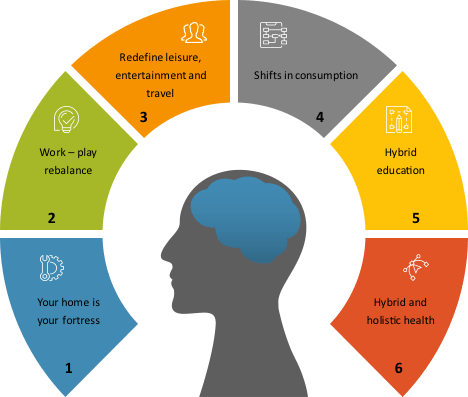
So, what does a review of available Covid related consumer research into behaviour change from either structural changes to markets, health and economic stresses and uncertainties, or new personal preferences indicate on potential behaviour change going forward – see the 6 themes identified in Figure 2-7.

On a personal level, what has happened for most people, perhaps excluding some Gen Z and some of the aged, is the increased pervasiveness and use of technology within our lives.  Technology significantly impacts all of the 6 areas identified above.  Many consumers have to some extent been forced to increase the rate of their adoption of technology across their lives.  Consumer who only bought food in person are now doing a weekly shop online.  Workers at home are more comprehensively using technologies (e.g. Zoom) for meetings and interactions and they are then using the same technologies for remote socialisation.  Home fitness apps are being used as gyms have been closed.  Core education is being conducted remotely. Higher levels of use of on-screen interactive games are being used as well as the use of services such as Netflix and Amazon Prime.  Large numbers of consumers have now overcome their reluctance to use technology and experienced its benefits.  

Looking now at each of the 6 themes:

‘Your home is your fortress’ – This is a place of safety in times of health risk.  We should expect there is now a higher appreciation of home time and a clearer definition of what people want from their homes.  Consumers have been increasing their investments in the technologies to be able to work, play and be educated at home.  There are also some trends emerging of disproportionate DIY growth and I would expect that overtime there may well be higher levels of purchasing of other in-home products.

‘Work-play rebalance’  – With remote working now and clear trends towards more remote working going forward, this will free up significant amounts of commuting time for alternative use, e.g. fitness, entertainment, home cooking, etc.

‘Redefine leisure, entertainment and travel’ – Almost certainly there will be changes in the consumption mix of leisure, entertainment and travel; but how it plays out is very hard to predict.  During lockdown and the subsequent restrictions there have been major short-term changes linked to home entertainment, reduction of the use of restaurants and bars, and minimisation of, or closer to home, travelling.

‘Shifts in consumption’ – Driven initially by lockdown there has a been a massive shift in consumption to on-line purchasing.  A significant portion of this will have gone through Amazon who, in many countries, is involved in about 50% of all home shopping.  It can be expected that not all of this will revert back to in person shopping.  In a McKinsey study (“Understanding and shaping consumer behavior in the next normal.”, McKinsey & Company, July 2020) on consumers who tried grocery delivery for the first time during the Covid 19 crisis, more than 80 percent say they were satisfied with the ease and safety of the experience; 70 percent even found it enjoyable and 40 percent said they intended to continue to get their groceries delivered after the crisis.  In many countries, such as the UK, for a period of time almost all clothing stores were closed and so there was also a dramatic shift to on-line purchasing of this product category.

Consumers have now bought products from new stores (on-line and in-person) so loyalties will have started to change, and new loyalties/habits will have started to occur after 6 months of the Covid 19 crisis.  With hygiene, or health safety, now also being part of the purchasing decision, traditional large and crowded stores will tend be lower in the consumer choice of where to shop.  In addition, with on-line purchasing, especially through Amazon, a traditional limited choice in a store has been replaced by massive selection options, and research is indicating that this is affecting historic brand loyalties.  Another factor that will affect historic brand loyalty are the Covid induced economic stresses and uncertainty which is driving swathes of consumers towards more cost-value product selection.  Finally, the combination of visible local economic turmoil coupled with growing climate and social responsibility concerns is expected to accelerate a shift to local produce and green and ethical products.  

‘Hybrid Education’ – Almost all children, with involvement of their parents, and university students have been forced to try some form of on-line education.  Some of it will have been successful and some unsuccessful; nevertheless, it will have built further comfort with the use of technology for education.  Many will have looked beyond their schools to supplement their learning and tried what has been available on-line for a number of years and provides a more advanced and appropriate technology based educational experience.  For K-12 (Kindergarten to grade 12) education they may have tried the Khan Academy or for university or further education they may have tried edXCoursera, or Udacity. New and improved on-line experiences are arriving on the internet continuously and will challenge poor face to face experiences or augment this traditional learning mode.  Enhancing its continued adoption will be the low cost or free use access to these quality educational applications.  

‘Hybrid and holistic health’ – This pandemic has brought a strong awareness to our health.  The linkage of Covid 19 risks to those with ongoing health problems (e.g. heart, diabetes, asthma, etc.) has brought to light the importance of wellness.  There has been dramatically increased use of digital wellness apps (yoga, circuit training, etc.) and also increases in the purchase of at home fitness equipment.  More people are walking or riding bicycles and reducing their use of public transport.  In traditional medical health, we have been forced to have on-line medical appointments as in many countries doctors will not initially see you in person.  Once again, with the 6 months of new habits forming supplemented by the high levels of media identifying concerns with the upcoming flu season, an increased focus on wellness and prevention and further growth of on-line medical should be expected. 

I have not seen any in-depth research that provides real insights into the scale of change to a ‘new normal’ and there is more to learn as we continue to live in this pandemic.  The consulting companies through their sampling have pulled together their sense of segmentation of post Covid customers which I think is useful to consider but each company needs to pull together its own views and then though ongoing analytics refine their own segmentation. Just as an example here are the segment names defined by three consulting companies – Accenture, McKinsey, EY. The names help you visualise the segments and you can see the overlap between the alternative segmentations.

  • Accenture – ‘the Worrier’, ‘the Individualist’, ‘the Rationalist’, ‘the Activist’, ‘the Indifferent’
  • McKinsey – ‘Affluent and unaffected’, ‘Uprooted and ‘unemployed, ‘Financially secure but anxious’, ‘Out trying to make ends meet’, ‘Disconnect retirees’
  • EY – ‘Get to normal’, ‘Cautiously extravagant’, ‘Stay frugal’, ‘Keep cutting’, ‘Back with a bang’

What we do know is that the longer restrictions and forced changes in behaviour last, the more likely future behaviours will at least reflect the positive experiences of the changed behaviours.   It is also clear that the rate of adoption of new technologies across the generations has accelerated and this will stimulate further investments to improve the related experiences.  Cycles of innovation and adoption will accelerate as a result of this pandemic. For many consumers, usually of an older age, they may not have bee able to delay the adoption of certain technology applications; and therefore, will likely be more comfortable trying new applications going forward.

For business, the pandemic disruption has now caused us to go into a period of non-linear change across many parts of our lives.  This means business need timely data and analytics to identify changes in demand and the growth of new opportunities. They will also need the agility and flexibility to respond and take advantage of new market opportunities or to minimise the costs of current activities that will no longer be profitable.  As noted earlier, these non-linear changes will be driven by a combination of:

  • Structural responses by businesses to Covid.  For example, policy shifts by companies towards remote working will make changes to consumer spending and ripple through to the retail and service sector around offices.  
  • Structural responses by governments. For example, rules and regulations on crowds and distancing, or adjustments related to public transport and other types of infrastructure.
  • The overlaying onto customer segmentation of behavioural changes linked to actual and perceived health risks of consumers
  • The additional overlaying of economic changes and uncertainties to large sets of consumers 
  • Changes in the attitudes of sets of people with respect to buying locally as a response to seeing local economic distress in combination with a sense of social responsibility and increased climate change concerns
  • Responses by the government to address potential future health challenges and alleviate the economic recession we have entered.  As an example, this would include accelerated investment in moving a country towards ‘greening’ the economy and society.   
  • The rate of change of adoption of existing technology applications and introduction of new technology applications

I will talk more about some of these factors in the next blogs.  These blogs will get into more detail on how businesses can be more effective at responding to this changing situation and also the role of the government.  

#Covid 19 #pandemic #post Covid #strategy #disruption #resilience #innovation #consumer segmentation #consumer behaviour #GenZ #millenials #baby boomers #WHO #sustainable development goals #McKinsey #Accenture #EY #UN SDGs #WEF #blacklivesmatter #metoo #DoughnutEconomics @Kate Raworth

Categories
Covid REBOOT

Post Covid

Blog 1 on Post Covid Disruption, Resilience and Innovation

Sept 2020 – We have not yet emerged from the Covid 19 pandemic.  Depending on whose narrative you are listening to and where you live, we are either towards the end of the first wave or at the beginning of the second wave.  Most countries in the northern hemisphere are expecting it to come back stronger as we move into the autumn and winter season.  Vaccine progress is encouraging and treatments are apparently improving as we learn more.  We are starting to build our experience on how to live with Covid and some countries are doing better than others at this.  In any event, we will be at the least learning to live with Covid 19 until we have a vaccine that has been widely distributed. If we solve Covid 19, we will need to hope a mutation or other virus does not show up for a long period of time.

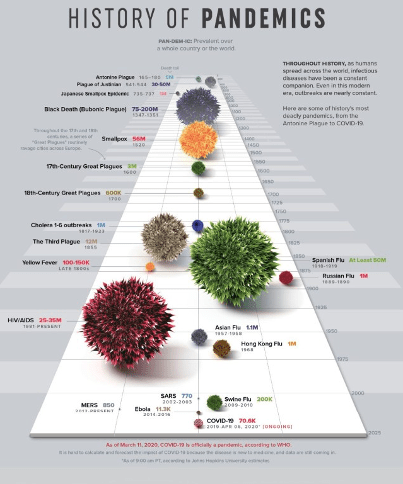
In my view, we need to expect that we will be living with periodic disruptions from pandemics. Just look at our past as illustrated in Figure 1-1  .  Of course, the data shown on Covid 19 is not up to date; as of 6 September there were over 887 thousand deaths (www.worldometers.info/coronavirus/). Since 2000, we have had SARS, Swine Flu, MERS, Ebola and now Covid 19.

Source: Visual Capitalist,
Figure 1-1

What we do need to do is dramatically improve our management of viruses through being prepared, responding quickly by understanding the difference between exponential and linear, track and trace, have a coordinated multi-country response to manage and cure the virus, and have much better coordinated social and economic responses.  We can only hope that there will be proper analysis of our current situation so that lessons will be learnt; and, the learnings will be applied to continuously improve how we manage pandemics. 

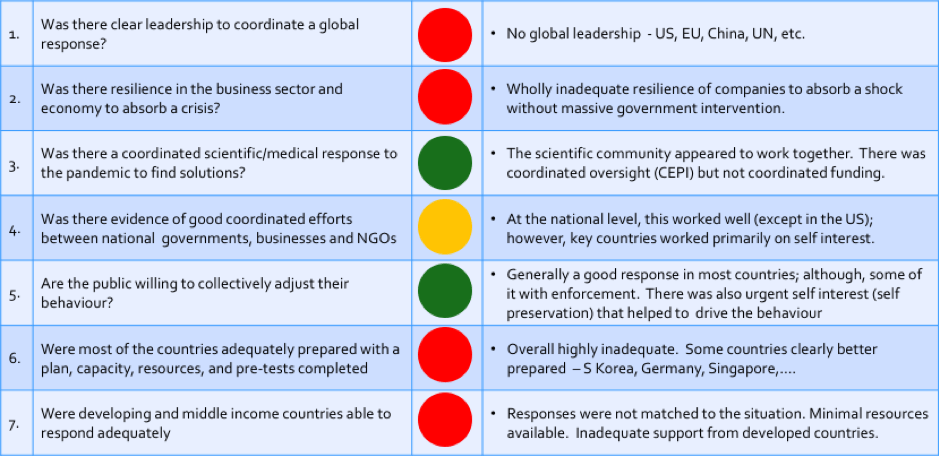
In my second blog on Business Strategy, I provided an early view on how we were doing globally, and this was my assessment (Figure 1-2).

Figure 1-2

I would have hoped that over time the assessment on how we have been managing would potentially have underestimated how we were doing; unfortunately, if anything, the rating is generous.  We have seen the US fully withdraw from the WHO (World Health Organisation) and not work as part of a coordinated medical response. On the other hand, we have seen the EU agree to a €750m recovery fund to help EU countries respond to the pandemic. Both the virus management, including overall health management, and economic management analysis of our performance at the global, national, and local levels will provide a lot of lessons for the future!  Few nations have escaped unscathed and our interconnectedness economically has affected all nations.  

So what will change going forward in how we live our lives, how we work, how we socialise, how we learn, what we consume and what we do for entertainment?

New experiences, new realities, new understandings and new real or perceived fears change us.  For many our economics have also changed. Millions of jobs have been lost or are at risk.  Tens of thousands of companies have collapsed and more will collapse from shortage of financing and a too slow rebound of busines.  As with most challenging situations, there have also been some winners who have been in the right place at the right time, or responded and were able to benefit from the situation.

Once again, as with most crisis, inequality comes up as a major issue.  Those who can work remotely – office workers, financial sector workers, those in the technology sectors, managers, executives – can largely isolate themselves from the health risks; whereas, those on the front line – doctors, nurses, transport workers, home delivery workers and those in essential sectors – take on the health risks and allow many of us the ability to isolate.  It is also a group of people that have a lower overall income profile to those who stay at home and they do not have the same financial capacity to live through a lock down.   Even worse, in the lower income countries the governments do not have the capacity to respond with relevant financial assistance to workers and companies as well as having inadequate health care systems for the majority of the population.  We know that in many of these countries significant proportions of the population survive day to day or week to week and lockdowns put themselves and their families in front of other health risks such as starvation.   

The important role of technology has been made even more visible.  Whether for home working, home schooling, home shopping or for entertainment we have seen the power of technology.  We have all witnessed the accelerated adoption of technology in each of these areas.  Some say that we have moved forward 5 years in the last 6 months in terms of technology adoption.  We have moved into a position where the perceived risk of not adopting certain new technologies, and new ways of doing things, is more risky to our livelihood than sticking to status quo.  This is new!  

Our life of living with Covid 19, or post Covid 19, does not sit in isolation.  Integrated with this situation is the financial crisis, evolving geo-political tensions and challenges, other man-made challenges, and most importantly the need to address climate change and biodiversity, and the challenges of inequality.  The way forward needs to incorporate all these realities.

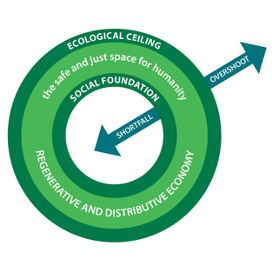
To add a bit more context to the two key longer term challenges, it is useful to refer to Kate Raworth and her book Doughnut Economics which is looking at economics for the 21st Century.  The basic premise of a long term sustainable world is that society must sit between a minimum basic social foundation for all and live within an ecological ceiling as depicted in Figure 1-3.  This is the Doughnut.

Kate Raworth, Doughnut Economics
Figure 1-3

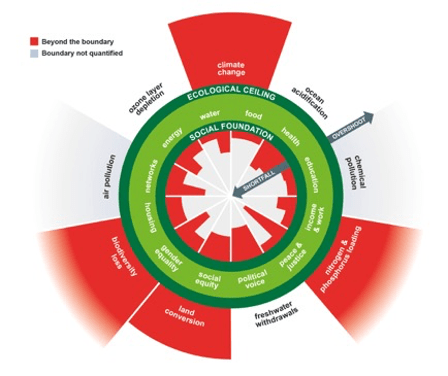
If you then evaluate where we are across a set of dimensions for the social foundation and the ecological ceiling, you find that we have a lot of work to do to establish a fair social foundation for all and live within our environmental boundaries.  From Kate Raworth’s Doughnut Economics she has reflected the situation within Figure  1-4.  This depiction is linked to and consistent with the 17 UN Sustainable Development Goals, which I have discussed in earlier blogs as the best Global consensus of what we need to accomplish by 2030 and then beyond.  

Kate Raworth, Doughnut Economics
Figure 1-4

The climate and environmental issues will be familiar; although, perhaps not the extent to which we are well beyond the science based limits of climate change, biodiversity loss, land conversion and nitrous and phosphorous loading.  

In my view the social foundation components all link into the theme of inequality.  The inadequate access to minimum acceptable levels of food, shelter, water, energy, health and peace and justice for all.  The inequality of access to quality education and networks (internet, etc.).  The inequality of opportunity in terms of income and work, gender equality (#MeToo), social equity (#Black Lives Matter) and political voice.  

This set of blogs although focused on living with Covid 19, and post Covid 19, necessarily has to incorporate these other pressures and disruptions that we are facing.   The blogs will explore likely shifts in consumer behaviour, the impact on businesses and certain sectors and how they need to react, and some views on the role of the government and how it needs to change. Overall, the topics are covering managing in disruptive times, creating resilience and the critical requirement for continuous innovation.

Once again, please share this material, share your views, push forward the discussion.

#Covid 19 #pandemic #post Covid #strategy #disruption #resilience #innovation #WHO #sustainable development goals #UN SDGs #WEF #Doughnut Economics @Kate Raworth