Categories
REBOOT Strategy

REBOOT Business Strategy

“You cannot avoid the responsibility of tomorrow
by evading it today”, Abraham Lincoln

Blog 15 of the Business Strategy Series

This is the final blog on the strategic framework and of the Business Strategy Series.  I will be continuing to write on related subjects.  I am also working on another series that will look at the roles and linkages of the market economy and the state – another critical subject as we work through these turbulent and challenging times.  A coordinated response between the market economy and governments is mission critical for solving our climate crisis and we can see how vital it is for other disruptions such as the pandemic we have now lived with for 6 months.  

The components in the strategic framework (Figure 15-1) that have been introduced are focused on helping business executives and their boards create a long term sustainable business that has a true purpose in society by delivering both economic returns to investors and impact to other stakeholders.  
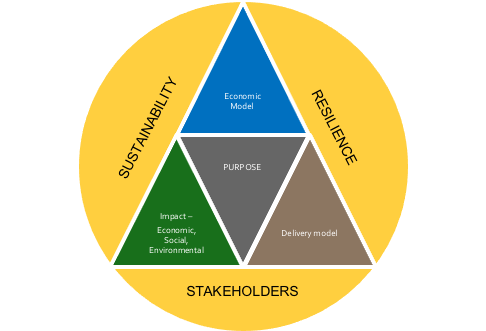
Figure 15-1

To date we have discussed purpose and the delivery model.  In this blog, I want to talk a bit more about impact, strategic timeframes, sustainability and resilience.  I will then complete the discussion with a short piece on portfolio strategy.  

Starting with environmental/climate impact.   Through the ESG reporting requirements (Environmental, Social, Governance), companies are being asked to look at the environmental at both level 1 impact, which is the company’s direct impact, and level 3 impact which considers the full supply chain impact including product use.  Clearly, at the environmental level the specifics of each sector, and its supply chain, will have different environmental dependencies and different opportunities to create impact.  Key sectors such as energy, food, packaging, retail, manufacturing and fashion which have high resource use, significant energy and water usage, and large supply chains will have high environmental impact unless they have already taken action (Figure 15-2). The urgency to create full circular strategies and lead the way is most vital for these high dependency companies; although, that should not stop all companies from moving forward as well.  
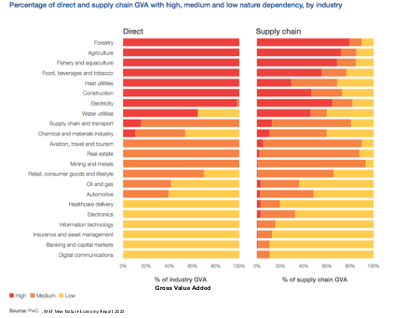
Figure 15-2

Taking the view at the societal level, that the climate problem can be solved by just focusing on the major companies that are contributing to climate change, reduced bio-diversity, high water use, etc. is definitely insufficient if you look at the science.   Part of the solution is for the public to be also looking at their consumption and making it more in tune with the needs for environmental sustainability. So the full and necessary challenge is to create a major shift in how we all live and how businesses, the government and NGOs operate. 

As I noted in Blog 14, for companies delaying this shift to a societally responsible strategy will only result in an increasingly challenging shift for each year of delay as the need to hit targets by certain dates will not shift.  Each company in each sector needs to set ambitious and timely targets to make its contribution to this.  It is management’s, and the Board’s, challenge to ensure that the strategy they set meets both its economic needs and its responsible level of impact.  

In addition to the sector, the geographic footprint of a business has implications for the impact focus and targets that it sets (Figure 15-3).  For example, companies that have large supply chain footprints in the developing world need to be thinking much harder about its specific social impact goals that it wants to achieve.  Truly exploring the UN Sustainable Development Goals will help define these.  Business as usual in many parts of the world will perpetuate the fundamental environmental, social and economic challenges that need to be overcome.
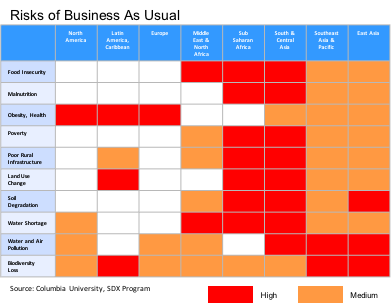
Figure 15-3

A helpful approach to thinking about how to incorporate impact programs and goals into the business is to look at the leading companies that are already a long way into this journey to be a responsible company.  

One of the companies leading the way is Unilever, who have been focusing on this now for over 10 years.  They now report on their progress against their goals each year (Figure 15-4). 

Source: Unilever Website,
Figure 15-4

From their website, you will see that they have created specific time based targets that roll up to overall ambitious goals, they have linked them to the Sustainable Development Goals, they are tracking their performance over time and they are publishing their performance publicly.

Other good examples covering different sectors are IKEAPatagoniaInterfaceOrstedTata and Microsoft.

As noted in Blog 12, strategic timeframes need to be extended vs. the typical 3 to 5 year timeframe (Figure 15-5).  A longer term time frame needs to be added to consider fundamental impacts such as climate, major changes in technology adoption and putting in place the right components for resilience.  3 to 5 year thinking and short term ROI horizons will not ensure adequate thinking on the sustainability of a strategy.  
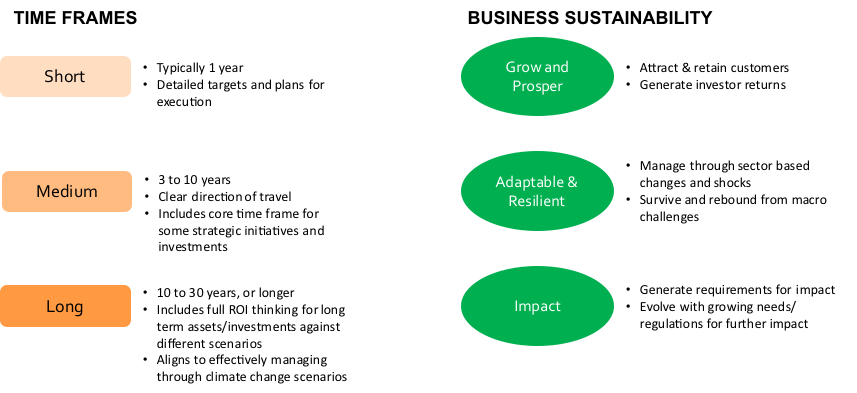
Figure 15-5

Linked to this, it is critical that there is a proper review of the potential activities and events that change markets and/or generate new opportunities (See Figure 15-6 for examples).  These events will range from changing views on environmental responses required, SDG compliance, new regulations, a changing geo-political environment and of course the potential for massive impact from new and converging technologies.
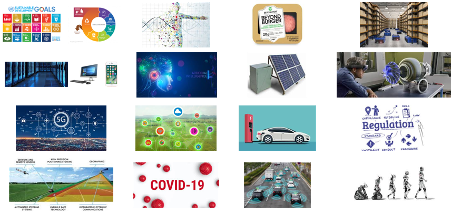
Figure 15-6

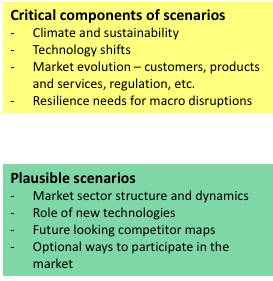
More important than ever is to develop strategic scenarios that would be effective based on different views of what could happen in short, medium and longer term horizons (Figure 15-7).  The approach for doing this is to pressure test strategic options against different externalities and come up with some plausible scenarios to evaluate.  These scenarios need to be developed holistically and need to be comparable. The components of the scenarios should cover off customers, products/services and supply chains, investment, metrics, people, processes and technology. 

Figure 15-7

With a real analysis of alternative scenarios, the comparison should provide further clarity around the performance opportunities for the business as well as the risk parameters.  The true strategic options can be explored along the key dimensions of profitability/ROI, impact, implementation risk, meeting of key stakeholder needs, sustainability and resilience.  

This moves strategic thinking significantly on from a pure profit and shareholder only focus.  In the short run, realigning the business to survive this pandemic and be able to prosper in the post Covid world, having an organisation that is proactively progressing on gender and race issues, as highlighted by the ‘black lives matter’ and ‘me too’ movements, and making a real contribution to the global climate/environmental targets that need to be met are big topics in most board rooms, and with investors, employees and customers.  These challenges need much more than tactical reactions, they are strategic and structural challenges that will inevitably require some major changes to most businesses in terms of how they operate, who they do business with, where they invest, and what performance targets can be expected.  

The overall strategy and each of the components should fit coherently into the strategic framework (Figure 15-8). Continuous evaluation of the components of the strategy over time and looking for ways to continuously improve and refine the strategy is equally as vital as the initial setting of the strategy. As the rate of change in the world accelerates, dynamically adjusting/refining the strategy and improving execution is mission critical. Speed and agility are much more important than a singled minded short to medium term focus on efficiency.

Figure 15-8

The final subject, I want to touch on is the implications of this in a company with a portfolio of businesses. Investors and stakeholders will be looking at the overall economic and impact performance of the business. Non-performing business units within the portfolio will have an overall effect on the attractiveness of the business to investors, employees and other key stakeholders.

The proposed approach to evaluate a portfolio of businesses is a four step process (Figure 15-9). Firstly, evaluate the portfolio of businesses from an economic perspective. Secondly, overlay the environmental impact of the businesses on to the economic performance of each of the businesses. Thirdly, look at the full alignment of the set of businesses against sustainability impact which will include social and economic impact. Finally, look at the portfolio options from a resilience perspective. This review should be done considering the realistic potential scenarios of each of the businesses.
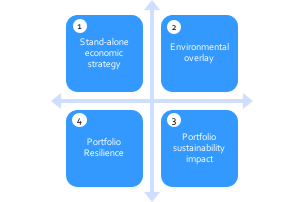
Figure 15-9

Now looking at each of these components in a little more depth. Starting with the stand-alone economic strategy, we have the traditional grid looking at business position vs market attractiveness (Figure 15-10). Both components of the strategy should be looked at from a short, medium and longterm perspective. Business position is the combination of profitability, market position, and ability to maintain performance over time as markets change and evolve. Market attractiveness is the combination of size, growth and the economic attractiveness of the market. The grid should be fairly self explanatory. If you have a strong market position in an attractive market then you ideally want to stay in the market and should be willing to invest and grow your position. Whereas, if you have a weak position in an unattractive you would rather manage the business for cash or divest from the market and reinvest the capital in more attractive businesses.

Figure 15-10

Moving on to the Environmental overlay (Figure 15-11), this takes the overall position from the economic strategy grid in Figure 15-10, Business Attractiveness, and matches it against the Environmental Attractiveness of the business. High environmental attractiveness has a low or positive environmental footprint within the timeframe of meeting the targets set by the Paris Climate Agreement and the environmental focused SDGs. For many businesses, the key target is the year the company will achieve a Net Zero carbon emissions equivalent level 3 footprint (ie. including the full supply chain of the business).

Overall, unattractive businesses, unless you have clear sight on how to transform them, should be harvested and/or sold. If an unattractive business is also very unattractive from an environmental perspective, such as a coal business, it is more likely that this should be divested as attracting investors and raising funds in your overall business will tend to be more challenging. In an equivalent way, if you have a small business with real potential in an environmentally attractive sector it may well be that you should be diverting your investment capacity into this business to build it. An interesting set of companies to watch on these dimensions will be BP, Shell and Exxon. Both BP and Shell have committed to reach a Net Zero CO2 emission target by 2050. It is not yet clear that they have strategies set out on how to achieve this; but, what is clear is that they will be redirecting their cash generation to the renewables sector where they have much smaller strategic positions. It has been a broad set of stakeholder pressures, including collapsing share prices, that have driven the adoption of these strategic commitments.
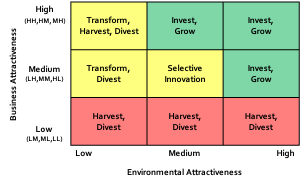
Figure 15-11

The third component of a portfolio review is the review of the alignment of impact overall with the business portfolio options (Figure 15-12). Although, climate impact tends to get the lion share of the attention from the press, economic and societal impact are vital components of the SDGs, and in many business and geography combinations, as you can see in Figure 15-3, they may be more important than climate impact. The food sector, including food retailers, are a great example of this with their broad geographically spread supply chains.

Figure 15-12

Finally, having evaluated the businesses, and their strategic options, in an overall and comparative context, the final step is to compare realistic combinations of businesses from a portfolio perspective. In particular, given the businesses have been evaluated against the three areas of impact, the portfolio options should be looked at from an economic return vs. a risk diversification perspective (Figure 15-13). The risk assessment is against the longterm sustainability and resilience of the portfolio scenarios. Adjusting a portfolio to reduce risk has real value, as we have seen in this pandemic. The potential benefits of a tight focus of businesses in terms of sector, geography, supply chain, efficiency and commonality of disruption risks may not be justified from a sustainability and resilience perspective. As I have noted before flexibility, adaptability, and diversification can provide real value to the business overall.
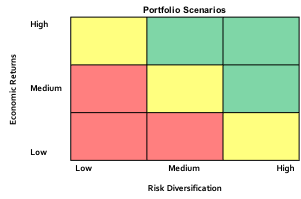
Figure 15-13

This brings to a conclusion, the series on Business Strategy. I hope you have found it thought provoking and useful; and hopefully, it will help you make a difference in your business and create a deeper impact in the world around you.

I will continue to write blogs to delve in deeper to sectors and subjects that will explore strategy and sustainability in a deeper context. As noted in the about section of my blog, REBOOT is not just about business, it is about the need for structural changes, or a new operating system, across all areas connected to our lives and our world.

Please continue to follow, share, engage in conversation, contribute and also reach out to me if you want to talk about this further. I can be reached through LinkedIn.
Categories
REBOOT Strategy

REBOOT Business Strategy

“It always seems impossible until it is done”, Nelson Mandela

Blog 14 of the Business Strategy Series

In this second blog describing the strategic framework (figure 14-1), I will cover off talking about the delivery model which is the strategic component behind the purpose of the business that drives both the economic and impact model of the business.

Figure 14-1

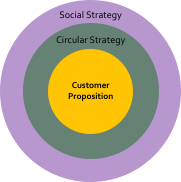
The delivery model aligns the customer proposition with the delivery components that are comprised in a circular strategy, to address climate and environmental impact, and the social strategy that focuses on economic and social impact (Figure 14-2).

Figure 14-2

Behind all businesses are the dimensions of customer – product fit.  The three key strategic pieces of this comprise a powerful proposition to the customer, ensuring the proposition is differentiated from its competitors, and focusing on a market segment that is attractive or ideally large and growing. 

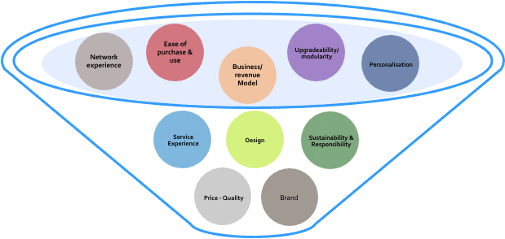
Achieving and sustaining a differentiated customer proposition is critical to success.  To this end, having an intense and ongoing understanding of a business’ existing and potential customers in terms of purchasing decision making and behaviours, usage and post-usage behaviours, and the factors that will drive emotional engagement are vital.  We can see the potential components of a proposition (Figure 14-3) and the ways to differentiate are growing over time. The newer dimensions include differentiating over environmental sustainability and responsibility, the business model as discussed in Blog 9 of this series including channels to market, and a number of technology based dimensions.

Potential Components of a Value Proposition,
Figure 14-3

In many ways, the bigger challenge is sustaining differentiation vs. the initial achievement of a differentiated proposition.  Success attracts copycats.  New technology or technology convergence invites disruption.

There are a number of components businesses need to have in place to succeed in sustaining differentiation.  Firstly, superior customer knowledge of existing and potential customers.  Secondly, and closely associated, is superior CRM (customer relationship management) capabilities.  The purchasing and usage experience of a product or service drives customer retention, which results in repeat buying and referrals.  Relentlessly improving this experience will be even more critical going forward as the environmental movement drives longer life products and higher levels of service.  Thirdly, the collection and use of data, including competitive information.  Fourthly, having innovation capabilities and agility to continuously improve, react to problems and opportunities, and to integrate major changes as new technological capabilities. Speed and agility in many sectors are mission critical for success.  Finally, none of the other dimensions matter if you do not have the financial capacity to progress on these factors and withstand competitive pressures.  

Now let’s move on to look at environmental impact.  To truly embrace environmental impact and set ambitious targets from an attitudinal, operational and strategic perspective you need to look at your business through the eyes of a circular strategy.  My first exposure to this concept was over 15 years ago when I read ‘Cradle to Cradle: Remaking the Way We Make Things’ by William McDonough and Michael Braungart, where they presented an integration of design and science that provides enduring benefits for society from safe materials, water and energy in circular economies and eliminates the concept of waste.

The book put forward a design framework characterized by three principles derived from nature.  Firstly – “Everything is a resource for something else. In nature, the “waste” of one system becomes food for another. Everything can be designed to be disassembled and safely returned to the soil as biological nutrients, or re-utilized as high quality materials for new products as technical nutrients without contamination”. Secondly – “Use clean and renewable energy. Living things thrive on the energy of the solar system. Similarly, human constructs can utilize clean and renewable energy in many forms – such as solar, wind, geothermal, gravitational energy and other energy systems being developed today – thereby capitalizing on these abundant resources while supporting human and environmental health.”  Thirdly – “Celebrate diversity. Around the world, geology, hydrology, photosynthesis and nutrient cycling, adapted to locale, yield an astonishing diversity of natural and cultural life. Designs that respond to the challenges and opportunities offered by each place fit elegantly and effectively into their own niches.”  

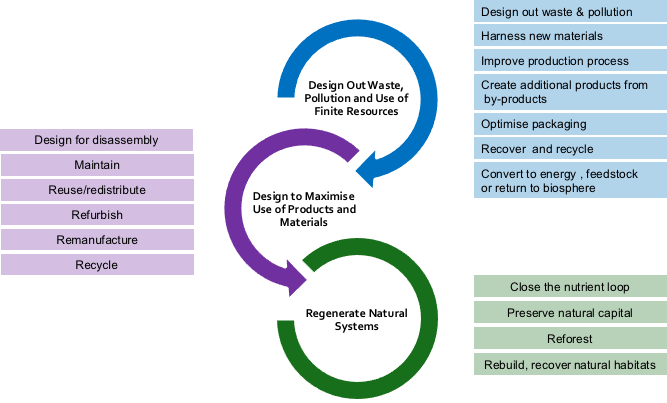
The circular economy is most easily visualised by Figure 14-4 below.

Figure 14-4

One of the real champions of this approach are the Ellen MacArthur Foundation who have been working with major corporations to rapidly and dramatically reduce the carbon footprint and environmental impact they are having on the planet.  Their mission is to accelerate the transition to a circular economy. The Ellen MacArthur Foundation works with business, government and academia to build a framework for an economy that is restorative and regenerative by design.  Figure 14-5 identifies the main components of the thinking within a circular strategy.

Figure 14-5

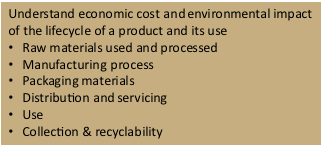
The starting point for developing a circular strategy is to know where you currently stand in terms of both economic cost and environmental impact (Figure 14-6). This sets the business’ starting point.

Figure 14-6

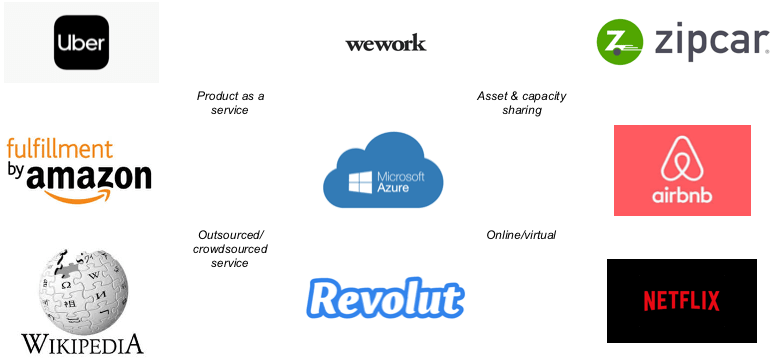
Secondly, explore ways that you can add value and revenue growth by making changes to your business model.  Getting the right business model is critical to align with a circular strategy.  As I noted in Blog 9 of the series there are many alternative business models that can be explored.  Below in Figure 14-7 are some examples of business models of some newer businesses.

Figure 14-7

Achieving a full circular strategy in product based businesses is a major commitment of time, energy and resources.  This also requires full alignment across all parts of the business and its supply chain.  Defining the end point allows the business to define the journey and time frame to achieving it in order to deliver on the financial performance and meet the impact requirements of a responsible business.

Integrated with the circular strategy, a business needs to overlay a social strategy, which includes economic impact.  I believe the acid test of a strong social strategy is whether or not, or to what extent, the company is contributing in its own way to reducing inequality, ensuring inclusivity, and contributing to future generations of all children being better off.  This is positive impact.

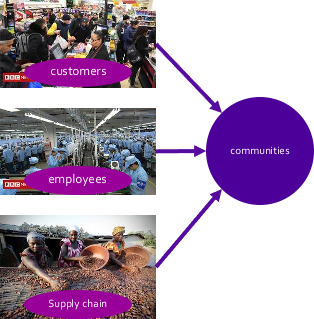
The constituents of a social strategy are the customers, employees, people within the supply chain and communities which are touched by the business (Figure 14-8).

Figure 14-8

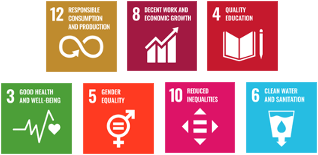
The social strategy can impact on many of the SDG’s (Figure 14-9) including ‘responsible consumption and production’, decent work and economic growth’, ‘quality education’, ‘good health and well-being’, ‘gender equality’, ‘reduced inequalities’, and ‘clean water and sanitation’.

Figure 14-9

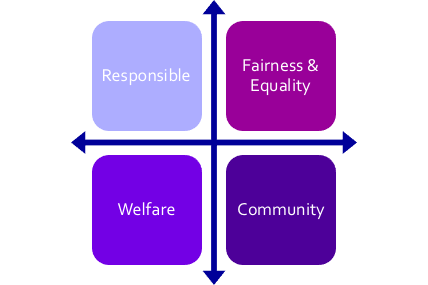
The impact focus of the social strategy will range from compliance with core principles such as anti-slavery, fair trade and gender equality, to specific proactive stances against behaviour that violates the core values of the businesses, or finding areas where the business can add some real specific value (Figure 14-10).

Figure 14-10

Most recently, we have seen the incident with Patagonia who removed its advertising on Facebook in a “Stop Hate for Profit’ campaign.  Alex Weller, Patagonia’s marketing director for Europe said, “It’s no secret that social media platforms have been profiting from the dissemination of hate speech for too long.  Facebook continues to be the most resistant of all the social media platforms to addressing this critical issue and so that’s why we decided to take action against it specifically.” Since Patagonia’s stance others like Adidas, Verizon, Coca-Cola and Unilever made similar moves.  Patagonia has said that it will stay the course and stand by this commitment for as long as it takes.  We will see the strength of the stance of other companies as time passes.

Overall, companies need to think about what their social balanced score card should look like (Figure 14-11).  

Figure 14-11

Just as with the other components of the thinking requiring short, medium and long term views, so does the organisational thinking.  This organisational thinking for the organisational components per the McKinsey 7S model (Figure 14-12) needs to be matched against both the time horizons and the alternative strategic scenarios in order to be properly assessed.

Figure 14-12

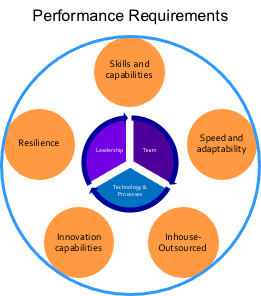
Critically, to get each of the organisational components right there needs to be clarity on the performance requirements (Figure 14-13) of the organisation.  Arguably, if there are some big strategic shifts in the business as a result of also needing to drive impact, then there will likely be some material changes required to the organisational needs of the business and linked to this the incentive structure to drive alignment. 

Figure 14-13

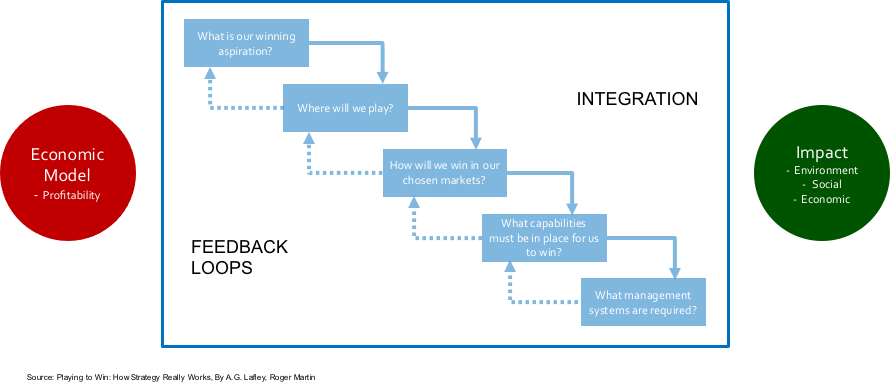
Finally, as the environment changes, the sector evolves and the company learns, there will need to be continuous adjustments to the strategy and the components of delivery in order the achieve both the economic and impact goals of the business.  Integration and alignment of these components is critical as well as continuous feedback across the cascade of components with appropriate adjustments (Figure 14-14).

Figure 14-14

In final blog of this series, I want to talk in more depth about impact, strategic time frames, sustainability and resilience. I will also finish off with a short discussion on portfolio strategy for companies with multiple businesses.

Categories
REBOOT Strategy

REBOOT Business Strategy

Blog 13 of the REBOOT Business Strategy Series

This is the first blog discussing a new strategic framework relevant for the world we now live in.  To date, I have covered off some background on how the world is getting increasingly complex from a societal, environmental, technological and disruption perspective; and the implication of this is a need to look at business strategies from a system based perspective so that business are aligned with economic, society and environmental goals.  Critically, linked to this are that the general consensus on these goals globally are best defined by the 2015 UN Sustainable Development Goals for 2030, which also link in with the 2015 Paris Climate Agreement.

The next section then went on to cover off 8 gaps in traditional strategic thinking that need to be covered off for a strategy in the 21st century.  These gaps were driven by deep interconnections of a business with their environment, which is not just their business sector.  These interconnections are vital to understand as there is continuous change and ongoing disruptions that are and will be affecting a business.  These factors include societal and economic factors as we can see now with the Covid 19 pandemic and ‘Black Lives Matter’ movement, the impact of new technologies, and most importantly the need to globally address the challenges of climate change and other key environmental issues. 

This new framework tries to create a shift in how we think about our business, away from just profitability for shareholders to goals that are also aligned other stakeholders including the public, consumers, suppliers, communities and governmental interests.  It is worth noting that investors are now requiring this shift given that the long term interests of businesses are for a sustainable world and they can see real business risks on the horizon from climate change.

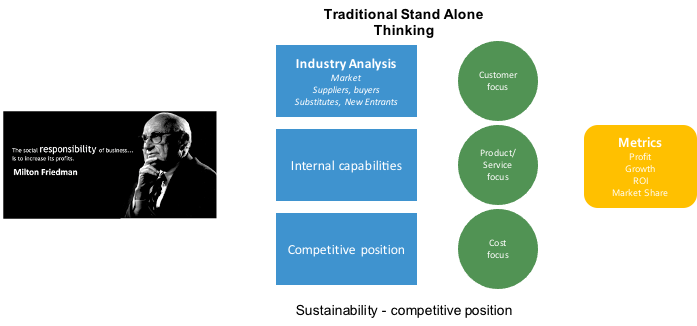
The traditional stand alone thinking (Figure 13-1) can be summarised by, firstly, a virtually exclusive focus on the shareholder as Milton Friedman had summarised,”the social responsibility of business is to increase its profits”. Secondly, an industry and competitor analysis as defined by Michael Porter’s five forces analysis matched to an understanding of the business’ internal capabilities.  Thirdly, profit and market based key metrics.

Figure 13-1

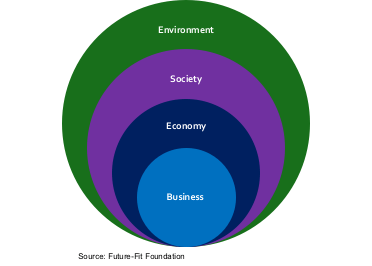
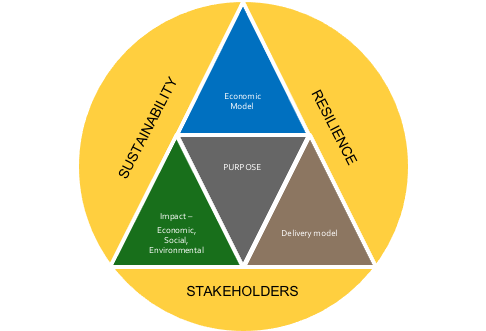
A  new system based framework needs alignment from the business through to the economy, society and to the environment (Figure 13-2).

Figure 13-2

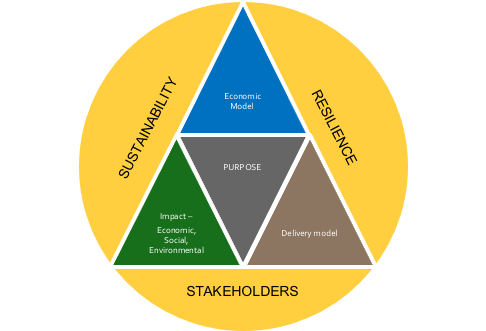
To create alignment a business needs meaningful purpose that aligns with the business on delivering against both its own economic goals as well as creating impact (Figure 13-3).  This is the challenge of strategy design, to cover the needs of both profitability and impact.  

Figure 13-3

Clearly, this can add complexity as the performance measures are now broader; however, it also creates opportunity and new ways of differentiating and competing.  For deeply entrenched players in the market who have adverse impact on the climate/environment, they are going to have to think about how they will use their resources and market position to evolve to a new sustainable strategic position and focus.  For the younger and nimbler companies, they will need to think about how to use their speed and flexibility to create a stronger positioning ahead of their key competitors.  If you are already there, then take advantage of your position.

A key part of this system-based framework is that it is relevant for all types of organisations whether in business, government or as an NGO.  Clearly, each type of organisation, as with each business, has to be clear on their economic model and what their impact targets are in order to get clear on what delivery model they need.  In the government and with NGO’s, they will have very different sources of funds; but, in any event they need to solve a sustainable financial model to survive rather than to make a profit.  A governments whole raison d’être should be impact; although, for many of us it may well be that their targets and metrics of achievement are unclear!  

Surrounding these triangles are three components that need to be full addressed within a strategy (Figure 13-4).  Firstly, having a clear view of the key stakeholders of the business.  Secondly, the business must be built to last – it must be sustainable.  This means the business must be able to continuously deliver value to it customers, it must deliver the right economic performance for investors, and it must provide the appropriate impact for other stakeholders. And, the business must be able to adjust, adapt and move forward in a way that this continues over time.

Thirdly, the business must be resilient and thus have the capability to withstand and manage through different scenarios of disruption from the 5 types of macro forces – societal, environmental, economic, technological, and geo-political – to the core challenges specific to the   

Strategic Framework
Figure 13-4

There are six tests of a business strategy:

  1. Is the business Purpose Driven?
  2. Can the business create real differentiated value for its target customers over time?
  3. Can the business perform at a level to attract and retain investors?
  4. Does the strategy integrate generating economic, social and environmental impact at ambitious levels for key stakeholders?
  5. Does the business strategy create sustainability and resilience?
  6. Does the strategy have ambitious and achievable triple bottom line metrics covering profit and impact targets?

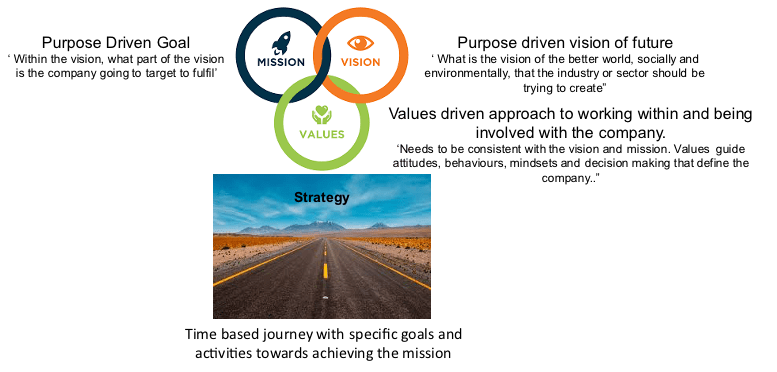
At the heart of a business lies its purpose.  It is the driving force and acid test of all business decisions.  It is what attracts and retains employees, customers, other participants in the supply chain and investors.  Sitting above the strategy are three components Vision, Mission and Values.  There are a lot of different views about how to define vision and mission, and sometimes they are combined; so to clarify, I have created definitions that fit with this strategic framework.

Figure 13-5

Within this strategic framework, the purpose defines how the world will be a better place as a result of the business.  The first component of the purpose is the Vision.  The Vision is the business’ view of the better world that the industry or sector will contribute to.  The Mission is the part of the vision that the company is targeting to fulfil.  I like to describe the Mission as the North Star that the company wants to be continuously moving towards.  Finally, the Values defines behaviourally how the Company‘s operates – what drives it, what motivates it, and how it will behave with its employees, customers, suppliers, communities, society and environment.  The combination of the vision and mission should be something that engages, and gains agreement from, all key stakeholders.

Here are some examples of the vision and mission, or a combined statement, for purpose driven companies.  

Orsted

Our vision is a world that runs entirely on green energy.

Mission: “We want to be a company that provides real, tangible solutions to one of the worlds most difficult and urgent problems.”

This is a Danish Company that started life as a state owned organisation focused on coal and oil.  Most recently it has been recognised as ….

Within this strategic framework, the purpose defines how the world will be a better place as a result of the business.  The first component of the purpose is the Vision.  The Vision is the business’ view of the better world that the industry or sector will contribute to.  The Mission is the part of the vision that the company is targeting to fulfil.  I like to describe the Mission as the North Star that the company wants to be continuously moving towards.  Finally, the Values defines behaviourally how the Company‘s operates – what drives it, what motivates it, and how it will behave with its employees, customers, suppliers, communities, society and environment.  The combination of the vision and mission should be something that engages, and gains agreement from, all key stakeholders.

Here are some examples of the vision and mission, or a combined statement, for purpose driven companies.  

Orsted

Vision: “Let’s create a world that runs entirely on green energy.

This is a Danish Company that started life as a state owned organisation focused on coal and oil.  Their current primary focus is on offshore and on shore wind farms. Most recently it has been recognised as the most sustainable company in the world in the Corporate Knights 2020 Global 100 Index.

Novo Nordisk

Our purpose is to drive change to defeat diabetes and other serious chronic diseases such as obesity and rare blood and endocrine disorders. We do so by pioneering scientific breakthroughs, expanding access to our medicines and working to prevent and ultimately cure disease.

How many other pharmaceutical companies have a missions to ultimately cure diseases where it derives all its revenues from?

Unilever

Vision – “to make sustainable living commonplace.

Mission – “To add vitality to life. We meet everyday needs for nutrition, hygiene and personal care with brands that help people feel good, look good and get more out of life.” 

Tesla

Mission: “To accelerate the world’s transition to sustainable energy

We all know Tesla for it’s pure electric vehicles; however, it now has a full suite of energy products that incorporate solar, storage and grid services.

Ikea

Vision: “To create a better everday life for the many people”

“Our business idea supports this vision by offering a wide range of well-designed, functional home furnishings products at prices so low that as many people as possible will be able to afford them.”

Microsoft

Mission: “To empower every person and every organization on the planet to achieve more”

“Our platforms and tools make small businesses more productive, multi-nationals more competitive, nonprofits more effective and governments more efficient. They improve healthcare and education outcomes, amplify human ingenuity, and allow people everywhere to reach higher.”

Patagonia, an outdoor clothing company, has had a sustainable mission since the beginning and has self imposed an earth tax of 1% of revenues for support activities to save the planet.  It has a very broad mission, “we’re in business to save our home planet”

It has defined it values in a different way to most companies that state the obvious ones of honesty, integrity, etc.  Their values are more action oriented, very honest,  and I think much more engaging:

Build the best product – Our criteria for the best product rests on function, repairability, and, foremost, durability. Among the most direct ways we can limit ecological impacts is with goods that last for generations or can be recycled so the materials in them remain in use. Making the best product matters for saving the planet.

Cause no unnecessary harm – We know that our business activity—from lighting stores to dyeing shirts—is part of the problem. We work steadily to change our business practices and share what we’ve learned. But we recognize that this is not enough. We seek not only to do less harm, but more good.

Use business to protect nature – The challenges we face as a society require leadership. Once we identify a problem, we act. We embrace risk and act to protect and restore the stability, integrity and beauty of the web of life.

Not bound by convention – Our success—and much of the fun—lies in developing new ways to do things.”

With a broader awakening of Boards and executive teams, as well as investor pressure, we should expect an increasingly rapid shift to much more purpose driven vision, mission and values? The companies not moving in this direction will inevitably be left behind.

The overall strategic framework tries to achieve 3 core objectives. Firstly, to ensure the business is systemically integrated into its economic, social and environmental situation context. Secondly, provide absolute clarity that the business is also focused on impact as well as profit to meet the needs of all key stakeholders. Finally, to have a true longer term perspective that considers both resilience and sustainability.

In the next two blogs, I will fill out the other components of the framework.