Categories
REBOOT World View

The Market Economy and Capitalism

“You know capitalism is this wonderful thing that motivates people, it causes wonderful inventions to be done. But in this area of diseases of the world at large, it’s really let us down.” Bill Gates

In my last blog, I tried to emphasize the importance of the role of government in society.  Its legitimacy comes from the people; and, to maintain its legitimacy it has to have a clear view of the social contract it needs to deliver against.  However, the governments ability to deliver against a credible social contract is underpinned by economic development and growth to drive its financial capacity to provide infrastructure and public services.  The main driver of all successful economies has been the market economy and capitalism.

All the strong economies in the world are market economies. The China miracle with a market economy has created consistent high levels of economic growth. It has averaged 9.45% GDP per annum growth rate from 1978 to 2019 driven by the remarkable entrepreneurial spirit and focus on wealth creation of the people. This has been supported by a real commitment to infrastructure development and a strong focus on public services by the government.

market economy is an economic system in which the decisions regarding investment, production and distribution are guided by the price signals created by the forces of supply and demand.  The major characteristic of a market economy is the existence of factor markets that play a dominant role in the allocation of capital and factors of production.  Capitalism is a concept integrated with a market economy.  It is directed towards making the greatest possible profit for private people and organisations.

Creation of a market economy is one of the key initial roles of a government.  There are 7 components to the framework for a market economy.

  1. Profit seeking companies
  2. Free market entry and competition
  3. Strong property rights and enforcement
  4. Absence of central planning, control and price setting
  5. Private ownership of most things
  6. Voluntary exchange
  7. Correction of market failures

Within this framework, there are 5 factors that drive a market economy as shown in Figure 5-1. Firstly on human consumption and wants, Alfred Marshall a leading economist captured the nature of demand, in his 1890 book, Principles of Economics, “Human wants and desires are countless in number and very various in kind….. every step in his progress upwards increases the variety of his needs together with the variety in his methods of satisfying them. He desires not merely large quantities of those things he has been accustomed, but better quality of those things. He desires a greater choice of things, and things that will satisfy new wants growing up in him”

Secondly, technological progress helps address the new and growing desires of a person and where there are new opportunities with customers there are new ways to make more money or openings for new entrants.  The profit making goal and opportunity is what drives this technological progress.  It helps make products cheaper and better, as well as driving the innovation of new products and services.  I will talk in more depth about technology and innovation in my next blog.

Figure 5-1

Thirdly, critical to underpinning the effective operation of a market economy is the efficient movement of capital to where there are opportunities to create value and provide a return to investors.  There is clearly significantly more fluidity of finance to opportunities now in the 21st century.  Although, the current financial system does have its weaknesses.  Returns and rewards are very short term focused and the prime focus of investing and lending is cycling around the financial sector rather than investing in the productive economy.  It is estimated that only about one fifth of finance in the US and UK goes into the productive economy.  In the S&P 500 today approximately 90% of profits are used for share buybacks and dividends with only 10% invested back in the business.  This extractive focus of finance does not help to drive economic growth.  

Fourthly on limits to resources, a core part of the effectiveness of a market economy is the efficient movement of factors of production towards producing the most productive goods.  The prevailing theory has been that with limits to resources, market driven pricing and the profit motive, these factors help drive the efficient use and allocation of resources.  Interestingly, we are now starting to move into a new phase of economic growth that is becoming decoupled from resource use.

Historically, technological progress helped to create more efficient use of resources for any good or service; however, rather than creating a reduced use of resource it resulted in additional consumption in other ways.  There was a direct relationship between economic growth and resource consumption.  There are now two themes emerging that affect this thinking and the conversation.  The first is that we are moving into a world of abundance away from resource scarcity; and the second, is the decoupling of economic growth and resource consumption in developed markets.  

Abundance, an idea championed by Peter H. Diamandis a leading thinker on technology and innovation, is the optimistic view that technology and innovation can make rare things plentiful.  He cites extensive research where through the use of new technologies costs are dropping 10 to a 1000x based on following innovation curves, such as Moore’s law in the digital space.  Energy is becoming more abundant and cheaper as we move to solar and wind technologies. Safe clean water is becoming more plentiful as we are able to desalinate sea water, which is 97.5 of all water, and clean polluted water cost effectively.  Food is being produced with less water, less pesticides and less fertiliser.  A smart phone is now a communications device that also give you access to the worlds information, books and music.  It provides medical diagnostics, it is a camera and video player, a calendar, an atlas and the list goes on.  And most importantly it is moving rapidly to be available to everyone.  

Linked to and associated with how technology is changing how we live, is the emerging net dematerialisation of economic growth.  Importantly, it is the combination of technology and capitalism that is driving the continuous movement of creating new and improved goods and services to sell to as many people as possible.  So many people believe the world is getting worse because our brains which are survival oriented focus on the negative things.  Yet you just have to look at almost any area and the trend lines are improving (See https://ourworldindata.org which was founded by Max Roser, or research by Peter H. Diamandis).

In research conducted by Jesse Ausubel, Iddo Wernick and Paul Waggoner, they did a detailed study of the use of 100 commodities in the US from 1900 to 2010.  Ausubel wrote, “…we found 36 have peaked in absolute size…Another 53 commodities have peaked relative to the size of the economy, though not yet absolutely (see Figure 5-2).  Most of them now seem poised to fall”.  Similar results have been found in research in the UK.  This decoupling of material consumption and economic growth is also happening in energy consumption, co2 emissions, farming and water use.  This is the power of technological progress and a market economy driven by a profit motive.  It is worth reading “More From Less” by Andrew McAfee to learn more about this.  
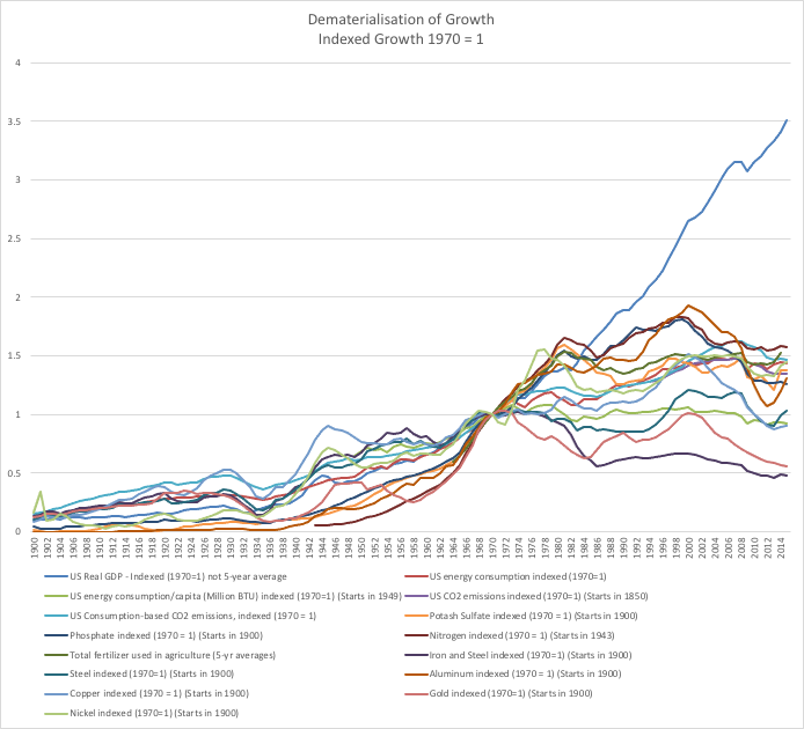
Source: https://andrewmcaffee.org – More From Less – data Figure 5-2

The combination of dematerialisation and abundance should help allay fears of the need to curb economic growth to address climate change.  In fact, driving technological progress and economic growth, which go hand in hand, will be critical contributors to addressing the combination of decarbonisation and biodiversity regeneration with inclusivity and fairness globally.  

Finally, and contrary to what many people want to think, the government has an important role in the development and maintenance of a market economy.  Capitalism alone is insufficient to ensure the well-being of all members and legitimacy of a society.  There is a good reason that there is no example of a successful society based solely on capitalism – a model with a sole profit motive cannot stand on its own in building a society. 

Material deviations in any of the first 6 components to the framework of a market economy requires the 7th component – correction of market failures by the government.  The break down of free market dynamics will inevitably happen without corrections or response. Examples include competitor concentration, restrictions on market entry, use of economic power to control resources, price fixing, imbalances in supply and demand power, taking advantage of factor labour, disregarding consumer safety and security, etc.  To date capitalism has not made moral and ethical judgements on what should and should not be done; governments and the law do have the responsibility for these judgements on behalf of society.   Capitalism has also not been concerned with inclusivity and fairness which is a fundamental part of the provision of public goods.

It is worth noting that one key area where capitalism does not work is in sectors where there is asymmetry in information and power between the supplier and the customer.  A clear example of asymmetry of power is in markets that are monopolistic in structure.  Competition laws are designed to help prevent this.  As important are markets where there is asymmetry in information, where the value of information is a critical component of decision making.  The classic examples of this are in the pharmaceuticals market and consumer financial services.  In the pharmaceuticals market, companies are able to egregiously price their drugs to take advantage of consumers who have limited medical knowledge, coupled with health fears, and limited choice because of intellectual property rights.  In the financial services’ sector there are too many examples of banks being involved in mis-selling and taking advantage of the complexity of financial products and the difficulty of many consumers in understanding them.  Finally, a new emerging area of asymmetry is in digital and social media sectors, where consumers are not able to comprehend the extent to which they are under surveillance and the ways in which their data is being used.  This is about the cost of privacy.  All sectors where the consumer is seriously disadvantaged as a result of asymmetry need attention in terms of oversight, regulation, legislation, pricing management and consideration of intellectual property rules.  

The nature of government involvement in capitalism is important.  Reducing the power of capitalism to create economic growth is not in societies interest.  Rather it is about harnessing the power of it to drive the overall well-being of society. Governments should be concerned with red tape, and they need to think carefully about the balance of incentives they provide (carrot and stick) and the mix of regulation and legislation.  Keeping government interventions as simple as possible, to achieve the desired outcome, requires continuous adjustments.  

There is growing thinking that governments need to move more from reacting and responding to market based problems to shaping outcomes proactively.  This shaping can be to ensure there is appropriate attention focused on topics such as climate and inequality, to helping the market drive progress in specific areas such as the shift to clean energy and electric mobility.  This mission oriented approach can be seen in Denmark and UK with wind power, the US with solar and the development of electric vehicles (and previously the development of the shale energy sector), and Germany with their Energiewende program to transition to a low carbon and nuclear free economy.  China has shaped multiple markets linked to their long time horizon plans ranging from the elimination of extreme poverty to being leaders in electric vehicles and wind powered electricity.  

At the same time, it is often in industry’s interest to get out ahead of the government and solve problems that if not dealt with will inevitably involve government intervention.  We are now starting  to see this more actively especially in the areas of waste management and pollution.  For example, the Alliance To End Plastic Waste is made up of nearly fifty major global companies.  They have committed over $1.0 billion with the goal of investing $1.5 billion over the next five years to develop, deploy, and bring to scale solutions that will minimise and manage plastic waste, and promote post-use solutions.  We are also seeing major groups of investors and asset managers driving ESG reporting and starting to allocate their investments aligned to climate and UN sustainable development goals.  

The intense focus on pure short term capitalism that has occurred from the 1980’s is starting to shift towards more aligned goals with society, such as climate and inequality, and creating what has to date been defined as ‘compassionate’ or ‘responsible’ capitalism.  This will intensify as corporate behaviour is held to account by stakeholder groups and by escalating government agendas on climate, biodiversity, pollution, inequality and the societal impact of technology. It is also being driven at an accelerating rate by investors and asset managers wanting not just ESG reporting but strategies that integrate action on climate and the UN Sustainable Development Goals.

I don’t believe that there is any reason to think that a longer term focused alignment of corporate objectives with those of customers and societies cannot be as profitable as the long term profit outcomes of corporates with their current short term optimization thinking.  

In my next blog, I will look more closely at the importance of technological progress and innovation.

#market economy #capitalism #dematerialisation #abundance #free markets #competition #limits to growth #technological progress #ESG #climate change #UN SDGs @Bill Gates @ Peter Diamandis #Alliance to End Plastic Waste

Categories
REBOOT Strategy

REBOOT Business Strategy

Blog 13 of the REBOOT Business Strategy Series

This is the first blog discussing a new strategic framework relevant for the world we now live in.  To date, I have covered off some background on how the world is getting increasingly complex from a societal, environmental, technological and disruption perspective; and the implication of this is a need to look at business strategies from a system based perspective so that business are aligned with economic, society and environmental goals.  Critically, linked to this are that the general consensus on these goals globally are best defined by the 2015 UN Sustainable Development Goals for 2030, which also link in with the 2015 Paris Climate Agreement.

The next section then went on to cover off 8 gaps in traditional strategic thinking that need to be covered off for a strategy in the 21st century.  These gaps were driven by deep interconnections of a business with their environment, which is not just their business sector.  These interconnections are vital to understand as there is continuous change and ongoing disruptions that are and will be affecting a business.  These factors include societal and economic factors as we can see now with the Covid 19 pandemic and ‘Black Lives Matter’ movement, the impact of new technologies, and most importantly the need to globally address the challenges of climate change and other key environmental issues. 

This new framework tries to create a shift in how we think about our business, away from just profitability for shareholders to goals that are also aligned other stakeholders including the public, consumers, suppliers, communities and governmental interests.  It is worth noting that investors are now requiring this shift given that the long term interests of businesses are for a sustainable world and they can see real business risks on the horizon from climate change.

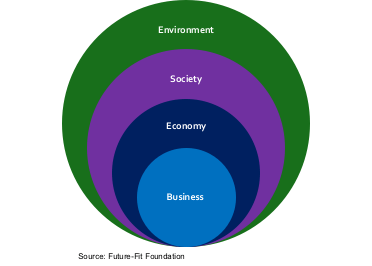
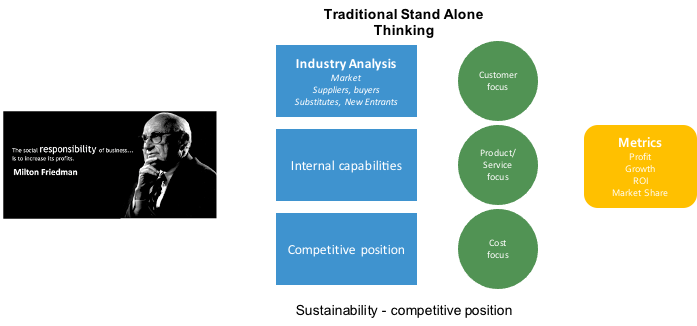
The traditional stand alone thinking (Figure 13-1) can be summarised by, firstly, a virtually exclusive focus on the shareholder as Milton Friedman had summarised,”the social responsibility of business is to increase its profits”. Secondly, an industry and competitor analysis as defined by Michael Porter’s five forces analysis matched to an understanding of the business’ internal capabilities.  Thirdly, profit and market based key metrics.

Figure 13-1

A  new system based framework needs alignment from the business through to the economy, society and to the environment (Figure 13-2).

Figure 13-2

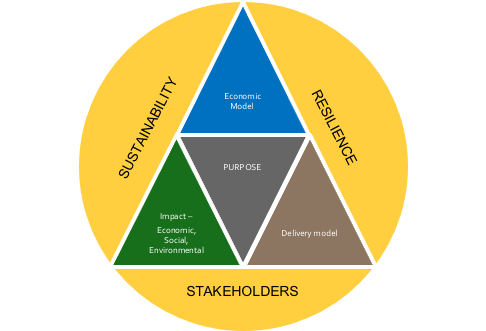
To create alignment a business needs meaningful purpose that aligns with the business on delivering against both its own economic goals as well as creating impact (Figure 13-3).  This is the challenge of strategy design, to cover the needs of both profitability and impact.  

Figure 13-3

Clearly, this can add complexity as the performance measures are now broader; however, it also creates opportunity and new ways of differentiating and competing.  For deeply entrenched players in the market who have adverse impact on the climate/environment, they are going to have to think about how they will use their resources and market position to evolve to a new sustainable strategic position and focus.  For the younger and nimbler companies, they will need to think about how to use their speed and flexibility to create a stronger positioning ahead of their key competitors.  If you are already there, then take advantage of your position.

A key part of this system-based framework is that it is relevant for all types of organisations whether in business, government or as an NGO.  Clearly, each type of organisation, as with each business, has to be clear on their economic model and what their impact targets are in order to get clear on what delivery model they need.  In the government and with NGO’s, they will have very different sources of funds; but, in any event they need to solve a sustainable financial model to survive rather than to make a profit.  A governments whole raison d’être should be impact; although, for many of us it may well be that their targets and metrics of achievement are unclear!  

Surrounding these triangles are three components that need to be full addressed within a strategy (Figure 13-4).  Firstly, having a clear view of the key stakeholders of the business.  Secondly, the business must be built to last – it must be sustainable.  This means the business must be able to continuously deliver value to it customers, it must deliver the right economic performance for investors, and it must provide the appropriate impact for other stakeholders. And, the business must be able to adjust, adapt and move forward in a way that this continues over time.

Thirdly, the business must be resilient and thus have the capability to withstand and manage through different scenarios of disruption from the 5 types of macro forces – societal, environmental, economic, technological, and geo-political – to the core challenges specific to the   

Strategic Framework
Figure 13-4

There are six tests of a business strategy:

  1. Is the business Purpose Driven?
  2. Can the business create real differentiated value for its target customers over time?
  3. Can the business perform at a level to attract and retain investors?
  4. Does the strategy integrate generating economic, social and environmental impact at ambitious levels for key stakeholders?
  5. Does the business strategy create sustainability and resilience?
  6. Does the strategy have ambitious and achievable triple bottom line metrics covering profit and impact targets?

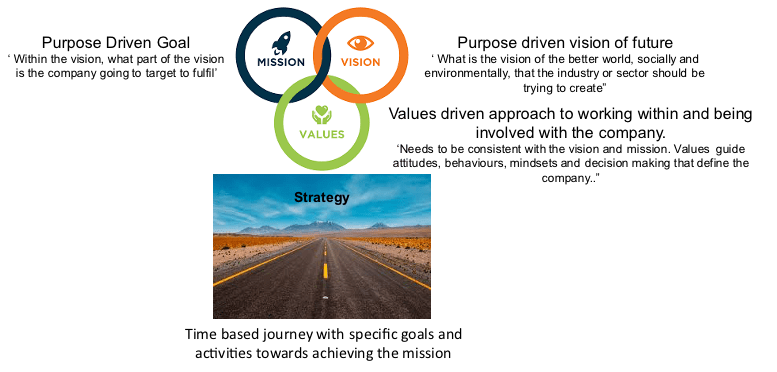
At the heart of a business lies its purpose.  It is the driving force and acid test of all business decisions.  It is what attracts and retains employees, customers, other participants in the supply chain and investors.  Sitting above the strategy are three components Vision, Mission and Values.  There are a lot of different views about how to define vision and mission, and sometimes they are combined; so to clarify, I have created definitions that fit with this strategic framework.

Figure 13-5

Within this strategic framework, the purpose defines how the world will be a better place as a result of the business.  The first component of the purpose is the Vision.  The Vision is the business’ view of the better world that the industry or sector will contribute to.  The Mission is the part of the vision that the company is targeting to fulfil.  I like to describe the Mission as the North Star that the company wants to be continuously moving towards.  Finally, the Values defines behaviourally how the Company‘s operates – what drives it, what motivates it, and how it will behave with its employees, customers, suppliers, communities, society and environment.  The combination of the vision and mission should be something that engages, and gains agreement from, all key stakeholders.

Here are some examples of the vision and mission, or a combined statement, for purpose driven companies.  

Orsted

Our vision is a world that runs entirely on green energy.

Mission: “We want to be a company that provides real, tangible solutions to one of the worlds most difficult and urgent problems.”

This is a Danish Company that started life as a state owned organisation focused on coal and oil.  Most recently it has been recognised as ….

Within this strategic framework, the purpose defines how the world will be a better place as a result of the business.  The first component of the purpose is the Vision.  The Vision is the business’ view of the better world that the industry or sector will contribute to.  The Mission is the part of the vision that the company is targeting to fulfil.  I like to describe the Mission as the North Star that the company wants to be continuously moving towards.  Finally, the Values defines behaviourally how the Company‘s operates – what drives it, what motivates it, and how it will behave with its employees, customers, suppliers, communities, society and environment.  The combination of the vision and mission should be something that engages, and gains agreement from, all key stakeholders.

Here are some examples of the vision and mission, or a combined statement, for purpose driven companies.  

Orsted

Vision: “Let’s create a world that runs entirely on green energy.

This is a Danish Company that started life as a state owned organisation focused on coal and oil.  Their current primary focus is on offshore and on shore wind farms. Most recently it has been recognised as the most sustainable company in the world in the Corporate Knights 2020 Global 100 Index.

Novo Nordisk

Our purpose is to drive change to defeat diabetes and other serious chronic diseases such as obesity and rare blood and endocrine disorders. We do so by pioneering scientific breakthroughs, expanding access to our medicines and working to prevent and ultimately cure disease.

How many other pharmaceutical companies have a missions to ultimately cure diseases where it derives all its revenues from?

Unilever

Vision – “to make sustainable living commonplace.

Mission – “To add vitality to life. We meet everyday needs for nutrition, hygiene and personal care with brands that help people feel good, look good and get more out of life.” 

Tesla

Mission: “To accelerate the world’s transition to sustainable energy

We all know Tesla for it’s pure electric vehicles; however, it now has a full suite of energy products that incorporate solar, storage and grid services.

Ikea

Vision: “To create a better everday life for the many people”

“Our business idea supports this vision by offering a wide range of well-designed, functional home furnishings products at prices so low that as many people as possible will be able to afford them.”

Microsoft

Mission: “To empower every person and every organization on the planet to achieve more”

“Our platforms and tools make small businesses more productive, multi-nationals more competitive, nonprofits more effective and governments more efficient. They improve healthcare and education outcomes, amplify human ingenuity, and allow people everywhere to reach higher.”

Patagonia, an outdoor clothing company, has had a sustainable mission since the beginning and has self imposed an earth tax of 1% of revenues for support activities to save the planet.  It has a very broad mission, “we’re in business to save our home planet”

It has defined it values in a different way to most companies that state the obvious ones of honesty, integrity, etc.  Their values are more action oriented, very honest,  and I think much more engaging:

Build the best product – Our criteria for the best product rests on function, repairability, and, foremost, durability. Among the most direct ways we can limit ecological impacts is with goods that last for generations or can be recycled so the materials in them remain in use. Making the best product matters for saving the planet.

Cause no unnecessary harm – We know that our business activity—from lighting stores to dyeing shirts—is part of the problem. We work steadily to change our business practices and share what we’ve learned. But we recognize that this is not enough. We seek not only to do less harm, but more good.

Use business to protect nature – The challenges we face as a society require leadership. Once we identify a problem, we act. We embrace risk and act to protect and restore the stability, integrity and beauty of the web of life.

Not bound by convention – Our success—and much of the fun—lies in developing new ways to do things.”

With a broader awakening of Boards and executive teams, as well as investor pressure, we should expect an increasingly rapid shift to much more purpose driven vision, mission and values? The companies not moving in this direction will inevitably be left behind.

The overall strategic framework tries to achieve 3 core objectives. Firstly, to ensure the business is systemically integrated into its economic, social and environmental situation context. Secondly, provide absolute clarity that the business is also focused on impact as well as profit to meet the needs of all key stakeholders. Finally, to have a true longer term perspective that considers both resilience and sustainability.

In the next two blogs, I will fill out the other components of the framework.

Categories
REBOOT Strategy

REBOOT Business Strategy

“Talent wins games, but teamwork and intelligence wins championships ” – Michael Jordan

Blog 10 of the Business Strategy Series

From product to company technology, innovation and design.

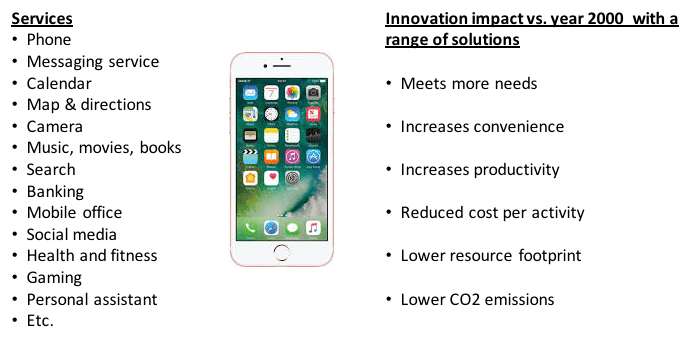
Just think about the smart phone – the i-phone – that was introduced to the market in 2007 and closely followed by the Android phone.  The previous generations of the phone included the fixed location home phone, then we moved to rather bulky mobile phones where you could only talk, then on to phones with messaging and some functions such as calendar, etc. And now we have the i-phone and what does it do with all its apps?  It is a phone, it lets you manage your emails, it is your console for social media, it can access and play any music, it can access and play videos, it can track and help you manage your health, it is a camera, it is a library, it is a research assistant, it’s a games console, it can let you do all your banking, it has Siri your assistant, it’s your mobile office, and the list goes on and on!  How much more will you be able to do when you add IoT, 5G and AI technologies?  That is the power of technology, innovation and design (Figure 10-1).

Figure 10-1

What are some of the interesting lessons that the smart phone illustrates in terms of the role of technology, innovation, and design (TID)? Just think back to the pre-smart phone era as to what it would take to do the same things – how much would it cost, how much space would it take, how much more time would it take to do the same task and switch between tasks, how does the performance of each task compare in terms of productivity, what level of physical resources would you have depleted, what would be the energy foot print of having all those capabilities and using them.  Across virtually every relevant dimension you can think of there is a learning curve from innovation.  

What do I mean specifically by learning curve?  With time, volume and experience a task or set of tasks has the potential to improve across a set of key dimensions including output quality and productivity, cost, resource use and breadth of capabilities provided.  This is progress –  continuous improvement – in key dimensions of performance over time.  It won’t all be a in a straight line.  There will be a combination of incremental improvements, step changes, setbacks; but, overtime there will be progress.  The smart phone in combination with broadband, computing power, big data, battery life has now made a significant change to the lives of billions of people.  

This concept of the learning curve has the potential to replicate across virtually all aspects of our life if we focus on learning and innovation.  Here are some examples of improvements that are being seen in the world in Figures 10-2 to 10-7.

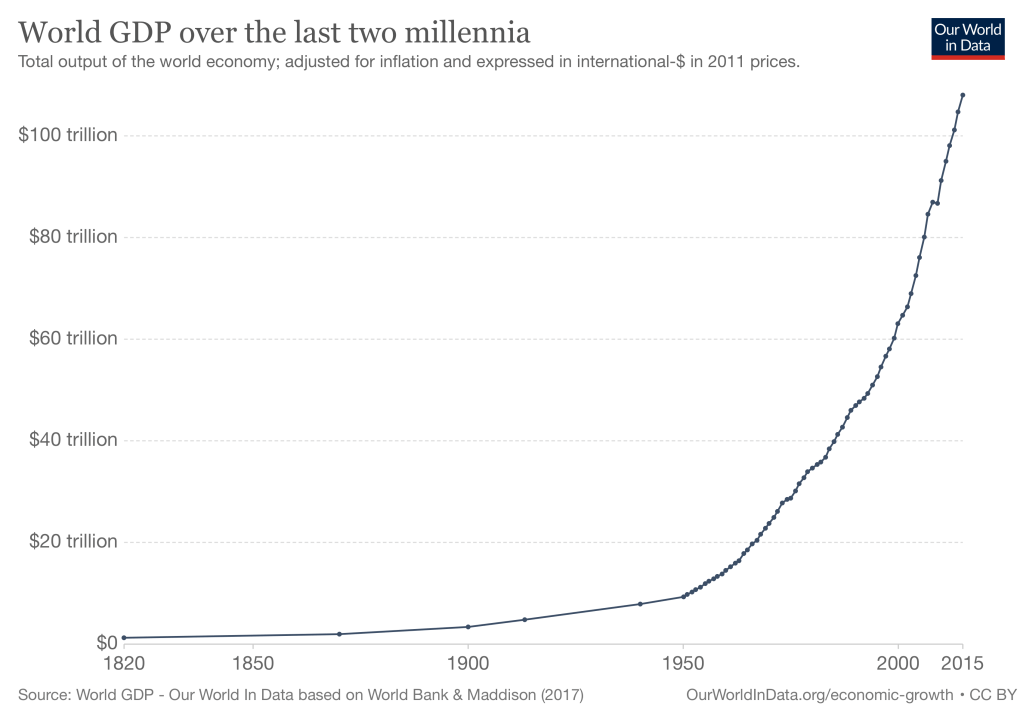
Since 1820, World GDP has grown by about 100 times while population growth has been 8 times.

Figure 10-2

Since 1800, life expectancy at birth has increased from below 30 years to over 80 years in some countries.

Figure 10-3

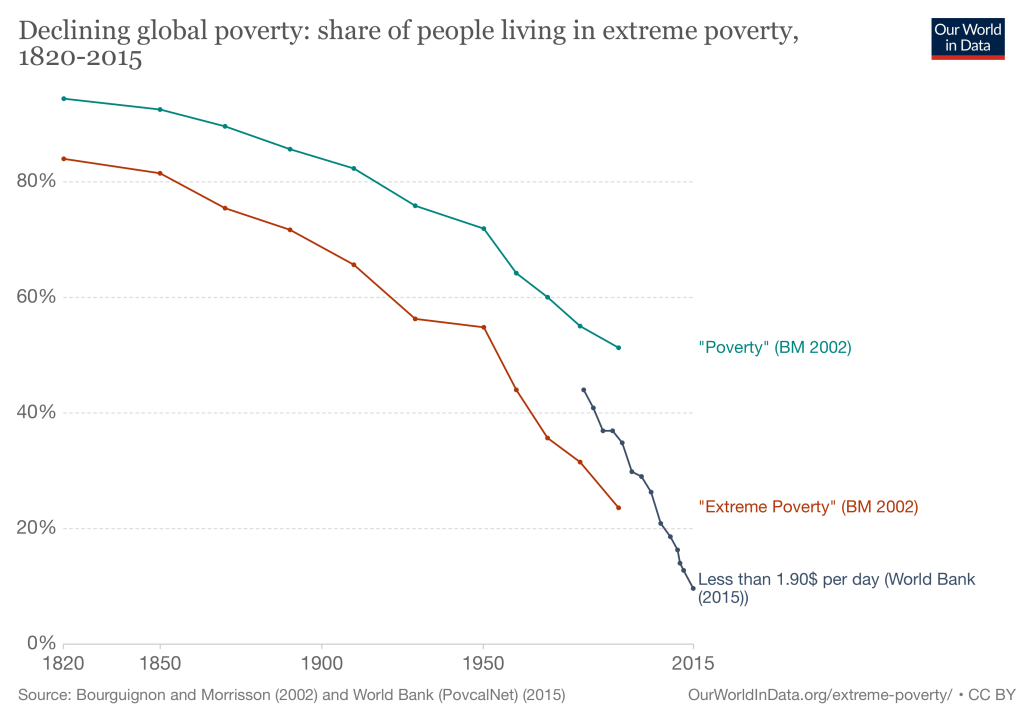
The share of the world population in absolute poverty has dropped from about 90% in 1820 to now under 10% of the population.  Even since 1980, it has dropped from about 44% of the population to below 10%.

Figure 10-4

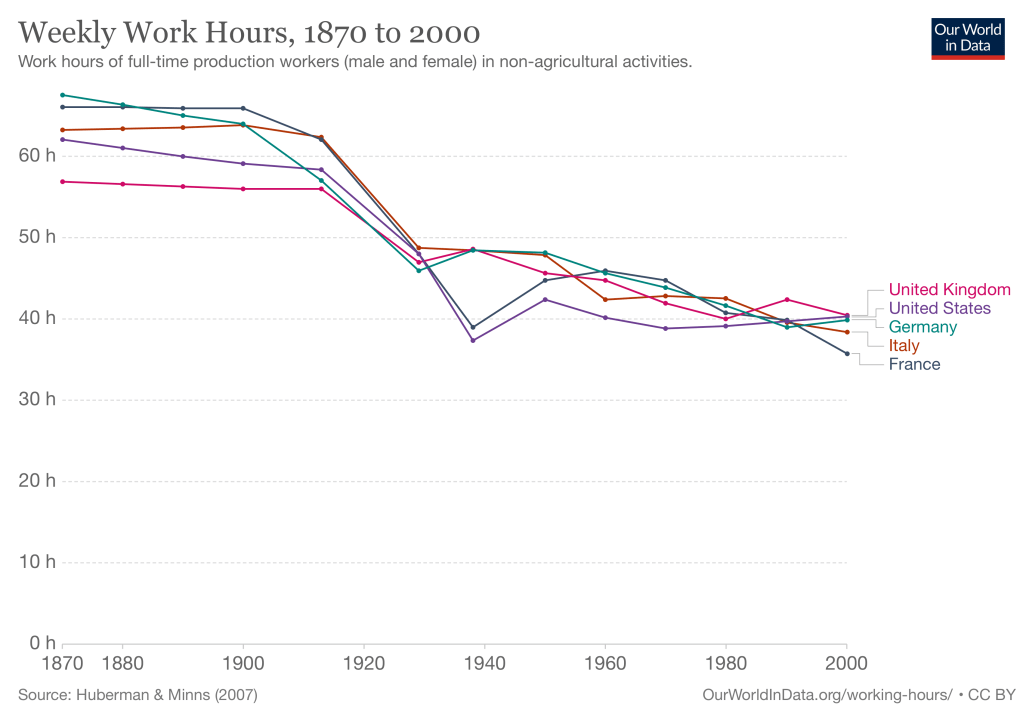
With all the growth in GDP and GDP per capita, the average weekly work hours per person has dropped.  This is also the case if you look at household work with the advent of the dishwasher, washing machine and drier, the oven, the vacuum cleaner, etc.

Figure 10-5

The death rates from pollution per 100,000 people have declined, as with homicide deaths, disease related deaths, deaths from other health conditions and traffic related deaths.

Figure 10-6

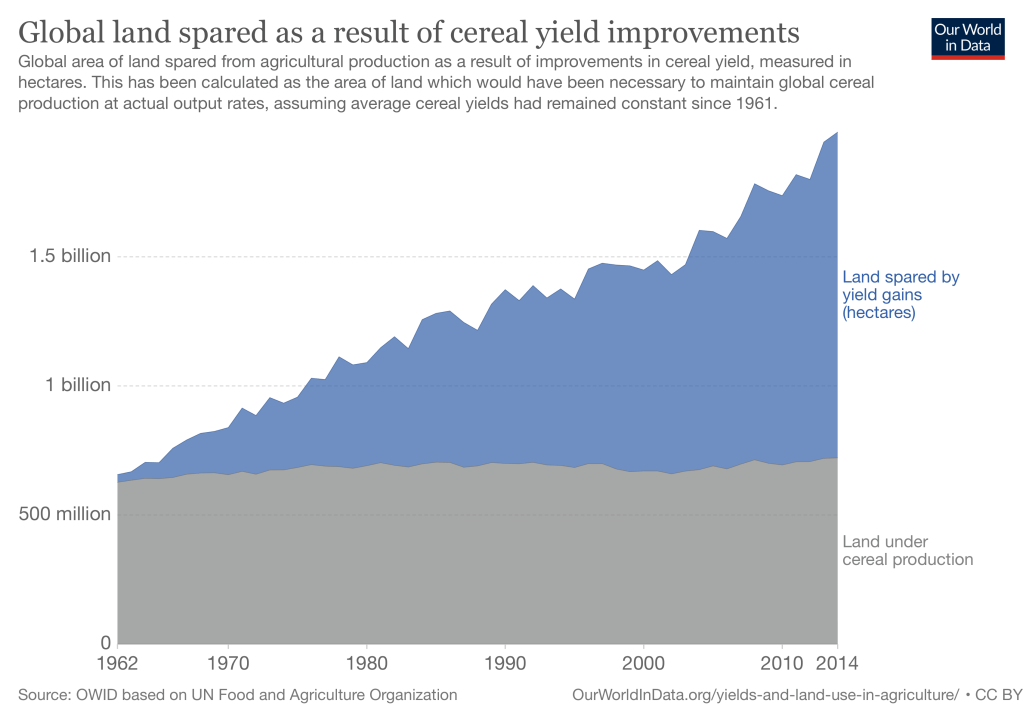
Cereal yield improvements have almost fully offset the need for additional land from the growth of the population since 1962 from 5.15 billion to the 2014 level of 7.3 billion people (we are now at about 7.8 billion people) and improvements in income per person which has driven growth in calorie intake.

Figure 10-7

If you want to really study this, I suggest Steven Pinker’s book ‘Enlightenment Now’ as a good place to start.  The other source to look at is www.ourworldindata.org which was founded by Max Roser.  

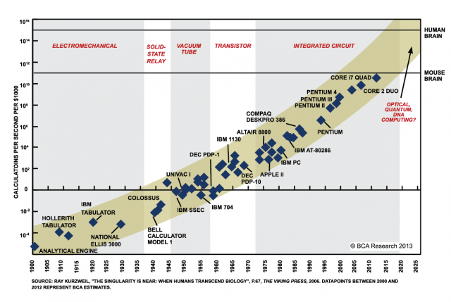
With the ability to create improvements across the world through learning, process improvements, focusing on reducing waste and development and use of new technologies, we should be systematically looking at how to improve all parts of a business. It may not all be on the Moore’s law curve that we see for computing power ( Figure 10-8) or a perfect experience curve. 

Why have I called this technology, innovation and design?  Technology is the availability of a new capability that has the potential to create an impact.  The common thinking of technology progression is Moore’s Law.

Moore’s Law is the observation that the number of transistors in a dense integrated circuit doubles every two years. Figure 10-8

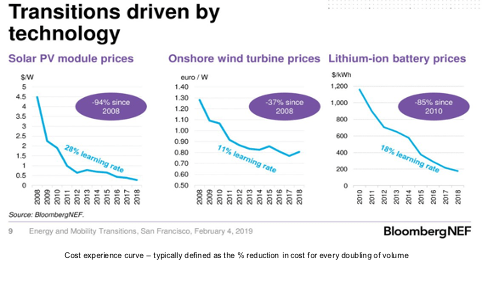
Innovation is the conversion of a capability into a specific application to enhance or transform the value of a product or the performance of a business.  In the example below, are examples of how technology has driven down the cost-performance ratios of key products which open up large new market opportunities.

Figure 10-9

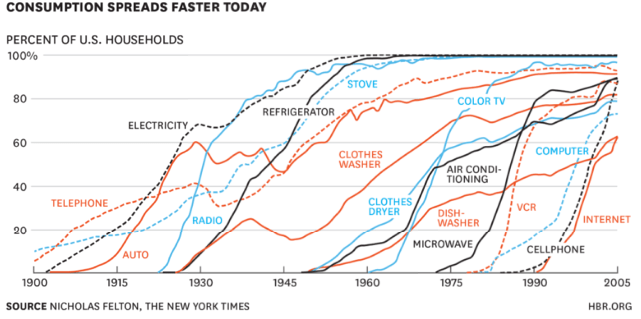
Design is the conversion of an application specific innovation into a product or service to drive adoption.  Without adoption of an innovation, no value is created.

Figure 10-10

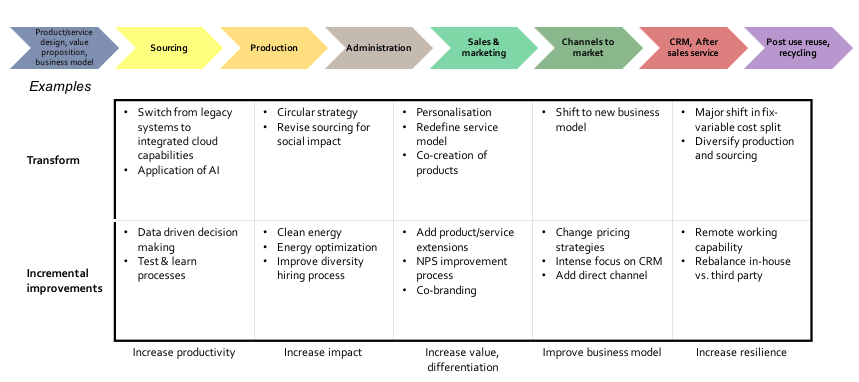
What are the implications for business and strategy?  Everything!  What is the strategy to transform customer value, reach new customers, improve productivity, employ capital more productively, reduce costs, reduce resource use and reduce CO2 emissions?  A committed focus on innovation should drive medium and long term performance for shareholders, and improve alignment with key other stakeholders.  The opportunities go well beyond just product.  

Figure 10-11

Here are some 5 key areas to think about.  

  1. A continuous focus on understanding your customer in terms of how they make a decision to buy, how they buy a product and how they use the product and finding out where the business falls short will drive improvements across a whole business.
  2. Put as much data around decision making as possible.  De-average your analysis and decision making to help eliminate waste, improve safety and privacy, personalise, find new innovation opportunities and remove unproductive activities.
  3. Put in test and learning processes across your business – in service, in production, in administration, in technological innovation and in new product development.  Create a culture of continuous improvement.
  4. Explore getting the right mix of in-house vs. outsourced capabilities.  This could be efficient access to expert power where it would be hard to create internally.  Alternatively, it could also be outsourcing of non-mission critical activities to groups that are much more efficient.  In addition, it could also link to shifting to third party cloud based systems to de-risk, variabilise costs, reduce technical debt, and let experts innovate new functionality.  
  5. Find the right balance of focusing on continuous improvement vs. finding opportunities to create step changes; for example, from new technology or changing your business model. 

In summary, if you don’t keep moving forward you will be passed. In a rapidly changing world, integrating technology, innovation and design in the operating DNA of the business is mission critical.