
In the last blog, I explored the need for societies to be citizen centric and not government or corporate centric. In addition, the need for a clear social contract was defined. I now want to explore the role of a democratic government in a citizen or individual centric society.
I will take the liberty to deviate a bit from this topic just to reflect on the state of democracy after the unbelievable showing in Washington on January 6. I am still amazed at how the Trump supporters were able to infiltrate where all the key Federal representatives, except for the President, were sitting to finalise the announcement of Joseph Biden as the next President. Clearly, there are challenges in a democracy as there is in any political structure. It reminds me of Winston Churchill’s quote in 1947, “Many forms of Government have been tried, and will be tried in this world of sin and woe. No one pretends that democracy is perfect or all-wise. Indeed it has been said that democracy is the worst form of Government except for all those other forms that have been tried from time to time.…”.
The rise of democracy has stalled (Figure 4-1). We have seen rising populism and the growing visibility of authoritarian leadership including Xi Jinping, Vladimir Putin and Recep Tayyip Erdogan. In the background, we have also seen a rapid growth in government run tech operations groups, such as in Russia and China, manipulating social media news in democratic countries to influence and discredit the democratic process.
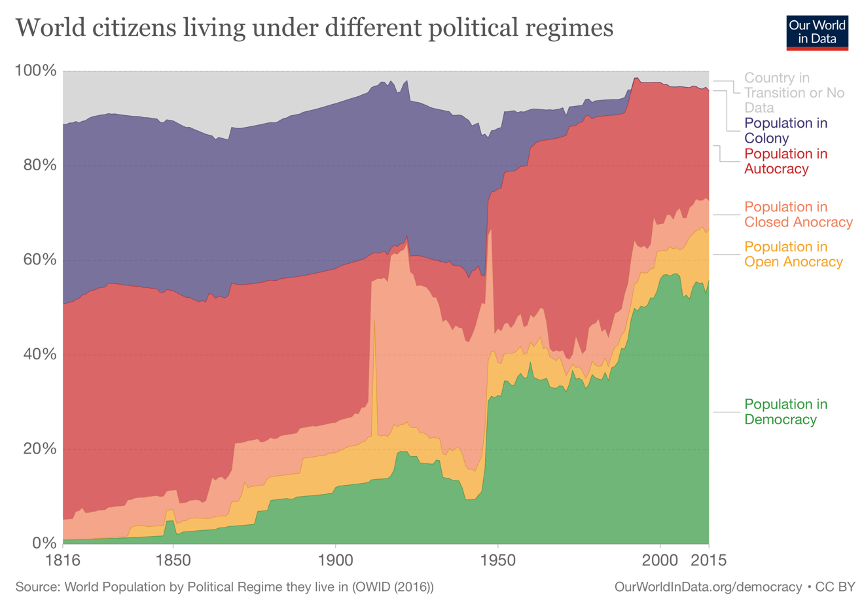
In the US, thankfully we have hopefully seen the end of Trump’s authoritarian style attempt to thwart of the role of democracy. In the New York Times, 11 December 2020, Michael McFaul, the U.S. ambassador to Russia under President Barack Obama, described the president’s “refusal to accept the results of the election” as “his parting gift to autocrats around the world.”
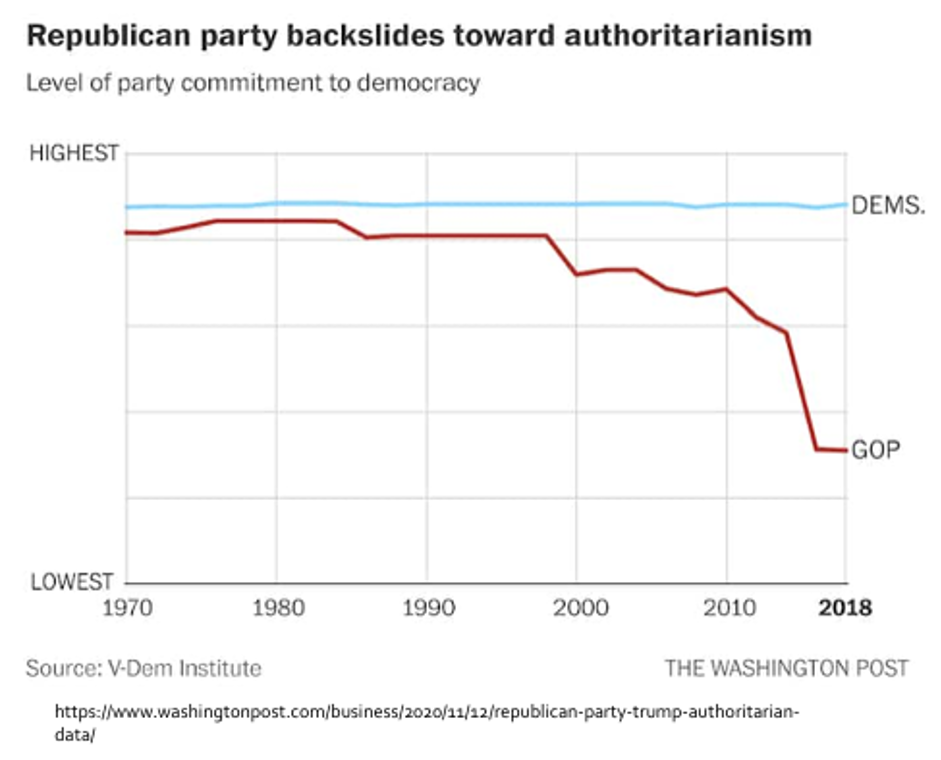
The V-Dem Institute attempts to assess the commitment of political parties to democracy around the world. They use 600 political scientists to help them with these assessments. According to them, the US Republican party has been on the slide since just before 2000 (Figure 4-2). This is reflected by the growing partisan gap that the party’s actions have been largely responsible. Trump has taken it to another level and this was before the latest refusal of his to accept the election results and the subsequent impeachment process related to the insurrection activities on Capitol Hill.
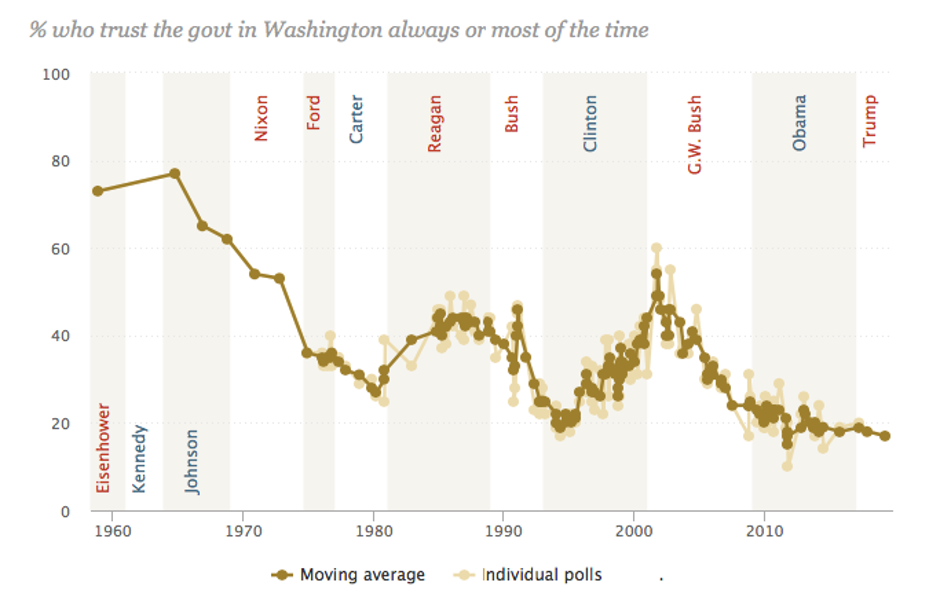
This partisanship in America is unlikely to go away anytime soon. In the US, we can see that from the 1960’s, there has been a massive decline in overall trust from above 75% trust at the Federal level to below 20% (See Figure 4-3). This compares with about a 38% average trust level in OECD governments in 2014. Surely, this decline must also be related to the increasing partisanship of politics in the US in the last 20 years. The legitimacy of a government comes from the people. With declining trust comes declining legitimacy. This is the importance of having a clear view on the social contract the government needs to deliver against for legitimacy.
The social contract “North Star” that was defined in the last blog had 5 components. The first three components were linked to the themes of basic needs, well-being and decent work. The fourth component was the right to live in a climate and environmentally sustainable world. The fifth component included the right to privacy (including digital privacy) and access to facts and truth.
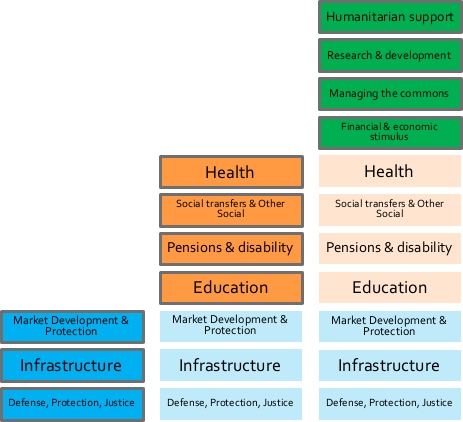
The role of government has evolved over time. There are responsible for three categories of activities (Figure 4-4). Firstly, core roles linked to the basic functioning of a country. Secondly, the delivery of public services. Thirdly, contributing to economic development and stability, and the sustainability of society and its environment. It has also included to a lesser extent the management of multi-lateral and long term issues such as climate and environment, humanitarian issues, cyber and nuclear security.
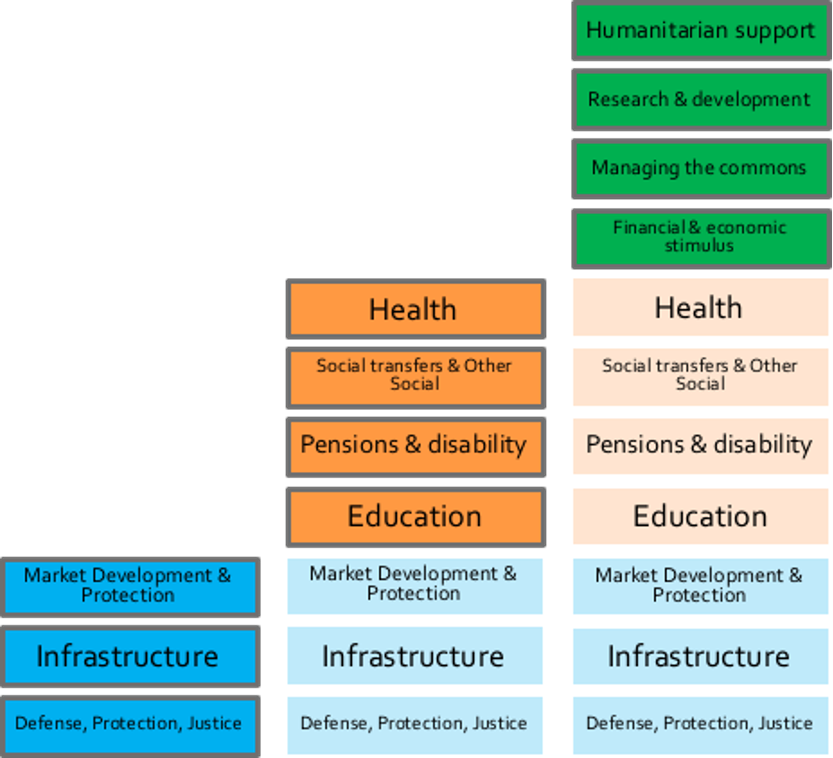
Firstly, the core requirements for a country include:
- Defense, protection and justice
- Infrastructure for transport, energy, water access, sanitation, etc.
- Market development and protection – the creation of a market based economy
These factors are the most essential areas of investment of government for the basic functioning of a society. The maintenance of borders and safety of citizens; a justice system for both social order and ownership of assets; infrastructure for basic health, such as clean water and sanitation, and for the distribution of goods; and, a market system to create economic growth. I will talk more about the government in its role in a market economy in the next blog.
The second phase of services are very much focused on public services for the citizens. These include education, health and the full range of social security services including unemployment, pensions and disability coverage. The top countries focus on education and health is a national issue, and their goal is inclusivity and quality for all. Finland has now been regarded as a top country for education for a long time. They combine high rankings with only a narrow performance difference between the top schools and the weakest performing schools. The leading countries also extend their thinking to affordable education for all in post secondary/high school and an emphasis on reskilling of workforces over time to maintain employment and mobility.
In the US, the local tax intake very much drives the quality of education and the facilities within the school. Wealthy communities have schools that access the best teachers and have the best facilities. The US is also renowned for the prohibitive cost of university and the lack of access to the key universities which are vital for strong job opportunities. Cost is an access and fairness issue. The level of debt from education in the US exceeds all credit card debt and for many locks them in the poverty cycle. The university participation rate of the lowest decile of income is about 20% vs. the highest decile where participation is at 90%.
In health, Singapore is often identified as a strong model for low cost – high quality Universal Healthcare. They blend the understanding of how some paying for services drives efficient use with a primarily employment funded health system. Their health costs per person are about one quarter of the US and are fully inclusive.
For social services there are many different models. The key factors seem to be an employment system that pays fair wages, understands the need for increasing mobility within the workforce, and the need for proper income protection between jobs. They also understand the need for gender balance in wages, maternity/paternity time off, and pensions which is a growing need as populations age.
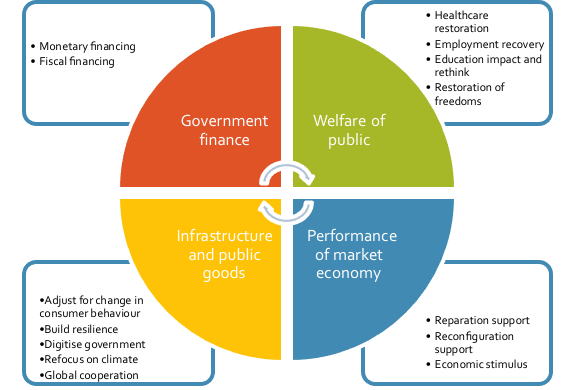
The third category of state involvement is contributing to economic development and stability, and the sustainability of the society and its environment. Unfortunately, these challenges are not declining over time. Historically, the thinking has been that economic spend by the government should be counter cyclical in order to smooth out economic cycles in the private sector. The 2008 great recession, or sub-prime crisis, required unprecedented levels of quantitative easing. The current pandemic has required economic interventions at levels in excess of 20% of GDP so far, as well as massive interventions in health delivery, education and freedom of movement. Overall, there has been a growing trend of material disruptions to society over time from a mix of sources including climate, health, economic and cyber.
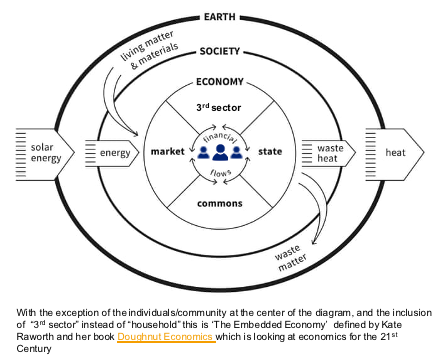
One of the areas overlooked within society are the commons. The commons are the resources that should be accessible to all members of a society including clean air and water, and a habitable earth. These resources are held in common and not owned privately. Government investment in electric mobility, and wind and solar energy, is linked in to the managing of the commons. The critical right of society to live in a sustainable environment drives the need to deal with climate change, biodiversity destruction and growing levels of pollution. This requires urgent attention, investment and multi-lateral coordination.
Another part of the commons that has developed over the last 20 years is the need for ubiquitous access to the internet as a great leveller. This means full quality coverage of the internet across all countries and fair access and use (including the need for devices such as smart phones). The internet has already proven to be a great economic enabler in developing countries and the pandemic has reinforced the value of the internet for the economy and also for remote health services and education.
The other part of driving economic growth and societal development is government role in research and development. The private sector that is understood to being the source of great innovation, such as we see coming out of Silicon Valley, has not been the core source for research which has driven new waves of growth, such as the internet. Government investment dominates the discovery of new technologies and early stage market applications. The private sector tends to drive the innovations once there are visible timelines of economic returns from new technologies (Figure 4-5).

In the US, Federal Government R&D expenditures was a as high as 2% of GDP in the mid 1960’s and now has dropped to about 0.6% of GDP. The US is no longer the dominant leader in cutting edge research in many areas. China is increasingly the leader in a number of areas of research that drive economic growth, and are expected to become the overall leader in research output in the next decade.
Overall, the total R&D expenditure as a percent of GDP in the US was 2.84% in 2018. This compares to Japan and Germany who spend 3.26% and 3.09% respectively and South Korea which spends 4.81% of GDP.
Research spend in the US, underpinned by the government, has generated the internet, and been a major contributor to the nanotech, biotech and the clean energy sectors. Almost all the core technologies behind the Apple smart phone have started with government spend. Core government spend has been driven through focused agencies in the US such as DARPA (Defense Advanced Research Projects Agency), ARPA-E (Advance Research Projects Agency – Energy) and the NIH (National Institutes of Health) which is the largest biomedical research agency in the world.
Mariana Mazzucato through her book ‘The Entrepreneurial State: Debunking Public Vs. Private Sector Myths’ and through her work at the UCL Institute for Innovation and Public Purpose, has been championing mission oriented innovation such as the US has historically been doing. Mission oriented innovation combines research and development expenditure, funding and tax incentives. This approach is taking shape in the UK and EU. A great example of this currently is in Denmark, who has become a world leader in offshore wind energy generation and is now the lead external partner helping China cement their position as the largest offshore wind energy market in the world with a capacity goal of about 450 times that of Denmark.
Aligned to, and integrated with research spend, is the overall need for governments to step up in addressing key global and national issues such as climate change, inequality and digital privacy. Governments provide the essential leadership on these factors to drive coordinated responses, urgency, risk mitigation, continued economic development and appropriate social protections. The current state of market economies, and capitalism, on their own have not and will not solve these issues without the right market sector frameworks and economic opportunities visibly in place. Government policies, regulations, legislation and economic incentives create the conditions to solve them. The private sector then has the scale, impact and innovative capacity to deliver the bulk of any major solution.
As an example, in November 2020 the UK government announced a 10 point plan to move onto the next phase of addressing climate change towards a 2050 Net Zero target. This program will mobilise £12bn in government investment and is expected to generate 3 times the amount from private sector investment.
With the current pace of technological innovation and monetization of it, we are seeing major cracks around the collection and use of private data. The social concerns linked to the gathering and use of personal data, especially by the dominant technology companies, will only get bigger as everyone is increasingly tracked and manipulated in real time. The abuse of data can only grow as you add genetic, neurological and increasing levels of contextual data as technology becomes embedded in our lives. The moral and ethical parameters of technological innovation and privacy of information protected through regulations should be have been dealt with a long time ago. Slow reactions driven by growing social unrest related to privacy cannot be the answer.
The final area in this category is humanitarian/development aid without which many countries cannot address specific crises and create the initial momentum required to create economic growth. It is also an essential component of addressing the UN Sustainable Development Goals and the Paris Climate Agreement.
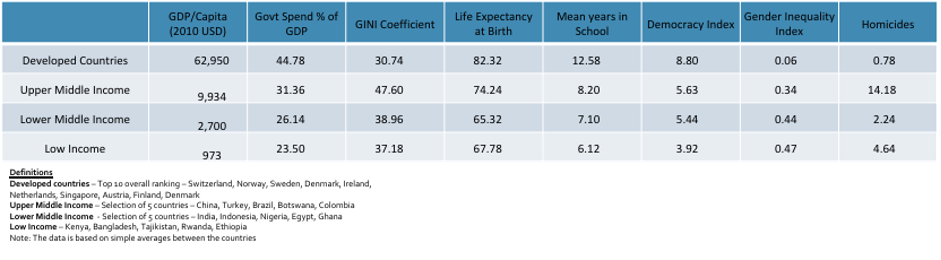
With these responsibilities it is no wonder the best performing countries tend to have higher government involvement in society, and higher taxes, than lower performing and less developed countries (Figure 4-6). As countries develop, they are able to finance the provision of additional services. There is clearly a strong relationship between economic prosperity and the three categories of government activities – core requirements, public services, and economic resilience and growth.
Despite the cynics view that the government is a necessary evil and they are bureaucratic and inefficient, the governments play a critical role in the welfare and wealth creation in a society. Strong infrastructure, a well educated and healthy society, good social services, the right to work, economic support in down cycles, and research and development investment all contribute to drive economic growth and well being. Critical questions relate to whether the services are inclusive and fair; is there proper control over the dark sides of capitalism and freedom for the strengths it provides; and, are the services delivered in an efficient way. And, overall is there progress towards delivering the “North Star” social contract.
The market economy, and capitalism, may contribute to some of these requirements; but, they don’t solve them against societal requirements. It is a myth that for example outsourcing services to the private sector is always more efficient than direct delivery of services by the government. The US healthcare system which is the most privatised healthcare system of the leading countries is by far the most inefficient healthcare system of the successful economies in terms of cost per person and overall health outcomes. There are many examples of efficient infrastructure and public services systems run by governments. Of course, that is not to say that there aren’t many opportunities to improve what is done, just as there are in most companies.
In the UK, privatisation of many of the public service sectors has only caused higher prices, reductions of service levels and imbalanced delivery of services across the whole of society. The motivations of private companies are not aligned to the needs of society. Unprofitable customers are ignored or excluded from service provision. Investors add significant debt to their companies causing high interest costs and then also take significant dividends before any reinvestment. The short-term time horizons of investors do not match the long-term thinking required for the development of infrastructure or public service delivery. The UK government privatised sectors without creating the proper rules and regulations for inclusiveness and fairness, price control, and the right number of service providers to get the benefits of free markets. Finding the right balance of involvement of the private sector in infrastructure and public service delivery is not an easy equation; but, having a principle of outsourcing where ever possible is certainly not the right answer.
Operating a government well to deliver on their social contract and creating the right conditions for a highly vibrant market economy to drive economic growth is a quantum more complex than running a company; especially, with companies primarily with a short term profit optimisation focus. Solving the financing of government service delivery is also a complex issue with many views on fiscal and financing policies. Getting the right balance of legislation and regulations, funding and fiscal policies to move a society forward is a game of continual adjustments interlaced with political agendas. This complexity is then also exacerbated by all the globalisation, multi-lateral issues and the geopolitical challenges that need addressing. There will never be one model to do this; however, that does not preclude looking for best practices to help on the journey forward.
In the next blog, I will explore in more detail the role of the market economy. It is the dominant part of an economy and is the engine for innovation and economic growth.
#public sector #privatisation #democracy #insurrection #Trump #Biden #populism #political regimes #government trust #UN SDGs #paris climate agreement #DARPA #ARPA-E #NIH #DFID #FCDO




 REBOOT