but the most responsive to change”, Charles Darwin
To address the three challenges, that I identified in the last blog – decarbonisation and biodiversity regeneration, inclusivity and fairness, digital privacy and collective truth – it is worth understanding where we are starting from. Looking at the components of successful countries and societies is a good place to start. Most comparisons of countries are focused on GDP per capita, the growth of GDP per capita, and the unemployment rate. I think we all know that there is much more to life and a society than just these factors. Income is important but there is also health, education, happiness, safety, freedom, fulfilment and purpose.
Lyndon B. Johnson said, ”The Great Society is a place where every child can find knowledge to enrich his mind and to enlarge his talent… It is a place where the city of man serves not only the needs of the body and the demands of commerce but the desire for beauty and the hunger for community…It is a place where men are more concerned with the quality of goals than the quantity of their goods”. The language may not be gender appropriate for today, but the idea of what makes a society is captured.
Yet, as we sit here and watch what is happening around us we know it is even deeper than this. It is the ability of someone being able to go to church or to teach a class and not have any risk of being attacked. It is the ability of someone of BAME origin or any gender to have equal respect, equal opportunity and equal justice. It is the ability of a young woman to be able to travel unintimidated on public transport late at night. It is the feeling that you are safe at home and that your job is secure even though you may different political views. It is not just freedom of thought but also freedom of speech.
In my analysis, I tried to look at successful countries and societies based on a simple composite ranking across a set of factors including GDP/Capita, Exports as a % of GDP, GINI coefficient, life expectancy, mean years in school, democracy index, gender inequality, homicides, and CO2 emissions per capita. On a GDP per Capita basis, the USA is 9th; and surprisingly, from a composite rank perspective, 25th out of the top 25 countries with the highest GDP per Capita (populations over 4 million people). This jars with the American narrative we have been fed over generations; although perhaps not, when we watch with amazement the reducing presence of America globally, the polarisation of the country and its massive decline in global respect, especially in the last four years. More specifically, this is reflected by America’s withdrawal from the Paris Climate Agreement and the World Health Organisation, the levels of social division, the growing gap between the haves and the have nots, the implicit caste system that still to some extent exists, the rapid rise of the public buying of arms and munitions through fears for their own safety and the conduct of the US Presidential Election. Xi Jinping, Putin, Erdogan et al. are salivating as they watch the main symbol of democracy and prosperity in disarray and broadcasted around the world.
The common thread across the top 25 countries in GDP per Capita is that they all have market economies and 23 of the 25 (excluding UAE and Kuwait) have democratic forms of government. It is also worth noting that looking across other countries, there are no strong and progressively developing economies that don’t have market economies.
The top 10 countries (Switzerland, Norway, Sweden, Denmark, Ireland, Netherlands, Singapore, Austria, Finland and Germany) based on the composite ranking outperform as a result of having a much more balanced society. As well as a high GDP, they have less inequality and higher levels of upward mobility, a higher life expectancy, a more educated population, a more effective democracy, better gender equality, lower homicide rates and are more environmentally friendly. I would argue that these countries have been able to create an overall better balance between the role of the market economy and the state, and how they together contribute to the well being of their citizens.
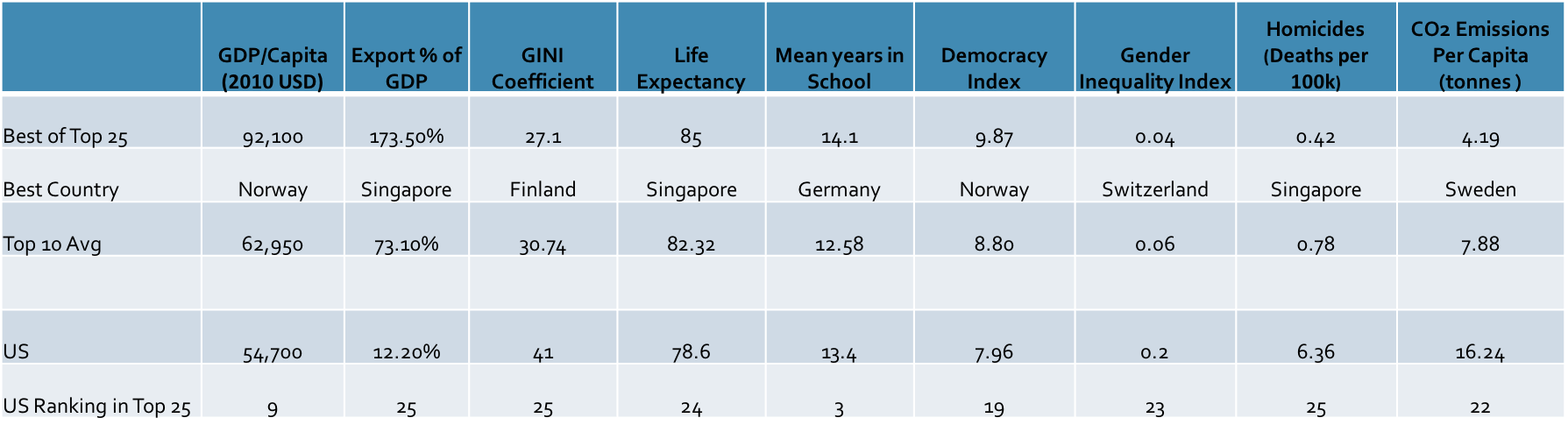
These top 10 countries also outperform across all measures (except CO2 emissions) vs. groups of upper middle income, lower middle income, and low income countries. It should be no shock that these dimensions are all intertwined to create more prosperous and sustainable societies.

Developed countries – Top 10 overall ranking – Switzerland, Norway, Sweden, Denmark, Ireland, Netherlands, Singapore, Austria, Finland, Denmark
Upper Middle Income – Selection of 5 countries – China, Turkey, Brazil, Botswana, Colombia
Lower Middle Income – Selection of 5 countries – India, Indonesia, Nigeria, Egypt, Ghana
Low Income – Kenya, Bangladesh, Tajikistan, Rwanda, Ethiopia
Note: The data is based on simple averages across the countries
If you look at government spend as a percent of GDP across the country groupings in Figure 2-2, small government involvement in the economy is not a characteristic of advanced economies. More advanced economies do have higher rates of taxation and larger investments in the delivery of public services than less developed countries. Looking across the most advanced economies, there is no apparent clear model of the optimal involvement of a government. Most of us intuitively believe that a well functioning market economy should create more opportunities, innovate faster, grow more quickly and therefore have more potential to create a better society across a range of dimensions. Perhaps less intuitive, is that strong delivery of public services and the creation of a well balanced society also appears to be an important contributor to economic performance.
So, what is the role of the government to help create a well functioning society. Lee Kwan Yew, Prime Minister of Singapore from 1959 to 1990, stated, “the ultimate test of the value of a political system is whether that society establish conditions that improve the standard of living for the majority of its people.” He always stated that the proof is in the pudding; rising incomes for the broad middle class, health, security and economic opportunity. Today, I would argue that there should also be a concept of ‘no one left behind’ and an opportunity for all; which would be encapsulated by ensuring that there aren’t rising levels of inequality and there are increasing levels of mobility within a society. In addition, most people would also add responsibility to ensure that society operates in a climate and environmentally sustainable way.
Arguably the primary fuel behind the growth of the standards of living has been the development of market economies and the driving force of capitalism. The personal rewards of taking risks and succeeding and of hard work has accelerated progress and built strong economic foundations to many economies.
Yet, capitalism without frameworks has never worked sustainably. Unstructured accumulation of wealth and power leads to self destruction of a free market economy, exploitation of the masses, environmental damage, and inevitably social instability. Since the 19th century, combinations of legislation, regulations, other frameworks and tax policy have been required to manage against the creation of monopolistic powers and the retention of competitive market sectors. Legislation has been required to deal with slave and child labour and to institute the concept of minimum wages. Rules and requlations have had to be put in place to deal with city air pollution, water pollution, land waste, environmental destruction, the erosion of the ozone layer. Extensive regulations have also had to be put in place to control financial markets. Finally, consumer protection has required regulations and legislation for food and drug safety, minimum product warranties, mis-selling and misuse of personal information.
So, let’s not kid ourselves that unbridled capitalism is in a societies interest. The real question is – what is the right combination of the freedoms of a market economy and the participation of the government. A lighter touch is always ideally preferred; however, in most countries we are still a long way from having the right balance. To move in the right direction and prioritise actions it is vital that there is clarity on what the social contract is within a society. Societies are complex systems and there are no simple solutions. Any individual initiative by either the market economy, the government or the public will inevitably have trade-offs and shortcomings. The UN Sustainable Development Goals illustrate this complexity in living colour with 17 areas of focus and 169 subsidiary goals!
Looking at the most successful societies gives us insights into what they have done and where they have been successful in creating their broad based societal success. R. James Breiding’s book “Too Small To Fail” which focused on the innovative approach of smaller successful countries provides a number of good examples. Examples include Finland’s transformation of their education system, Singapore’s low cost-high quality inclusive healthcare system, Denmark’s leadership in renewable energy, Israel’s building of a Silicon Valley style ecosystem, and the Nordic story on leading in gender balance. These are best practice examples that give guidance on better ways to move forward. The challenge is to move towards these best practices globally and then well beyond.
The three challenges are steeped in the historic practices of our take-make-waste culture, the singular focus on the maximisation of short term profitability and minimally regulated use of technology and data at the expense of the citizen. Each country sits in a different place on the continuum of progress to solving these issues locally. But we should not forget that all three challenges need to be solved also at the global level. Isolated examples of progress against climate will not solve this existential crisis! The context for progress is also now different. There is urgency. There is a recognised need for a unified approach to tackling these issues. There must be an accelerated development and adoption of critical technologies. And, there is a need, and a demand from the public, for a fundamentally more purpose driven, values driven and sustainability focused approach to how we live and how our societies operate.
In the next blog, I want to talk about a framework for solving these issues and the social contract.
#climate change #global warming #decarbonisation #biodiversity #species extinction #regeneration #rewilding #carbon sequestration #inequality #inclusivity #fairness #privacy #digital trust #cyber #mass manipulation #truth #social contract #Too Small To Fail @James Breiding #Sustainable Development Goals #SDGs #Paris Climate Agreement #WHO #take make waste

 REBOOT