Categories
REBOOT World View

Digital Privacy and Collective Truth

“Big brother is watching you”, George Orwell, 1984

Tim Cook, CEO of Apple, said that privacy is “one of the top issues of the century” and that it’s important to put “deep thinking” into that to figure out how to “leave something for the next-generation that is a lot better than the current situation.” Cook said privacy “should be weighted” like climate change, another huge issue the world is facing.

This is the third of what I call the three big challenges. The first being ‘Decarbonisation and Biodiversity Regeneration” and the second is “Inclusivity and Fairness”. “Digital Privacy and Collective Truth” sits among these challenges; but, it is the third priority. It is also a priority that would not be agreed with across the world, in particular in non-democratic countries. This challenge is not captured among the UN SDG’s, however, it is captured in the World Economic Forum Global Risks Report 2020 on both technological and societal dimensions.

We are living in a surveillance world.  Something you will have read in George Orwell’s “1984”, or watched on “Black Mirror “ or some other dystopian science fiction movie or box set.  That world where virtually everything you do is tracked, monitored and then attempts are made to adjust your behaviour either by governments or corporates.

The most advanced mass infringement of personal privacy is China’s Digital Social Credit system.  Based on a cultural norm of monitoring individuals the Chinese have now turned to digital as the means for this.  The focus is on measuring trustworthiness of an individual and then rewarding or punishing them for trust violations.  Trust ranges from financial and legal trust to how you behave in public (eg. jaywalking, playing loud music, make reservations at restaurants and not showing up, etc.) and what you say.  You can lose points or gain points on your starting score and you can benefit or lose freedoms depending on your overall score.  As an example as of June 2019, 27 million air tickets and 9 million high speed rail tickets had been denied to citizens deemed dishonest.  It also affects your access to certain jobs and your children access to certain schools.  China leads this trend to monitoring; but, other countries are moving in this direction as governments get more and more access to personal information through governmental ID cards and digital records, and corporate data cooperation.

In the democratic world, the level of data gathering is no less.  It is just the use, and abuse, of the data is different.  As well as potentially overreaching use by governments, there is a massive issue in the corporate use of information for profit.  The leaders in the data gathering, use and abuse of information are Facebook and Google.  Facebook and Google are the companies whose income is dominated by advertising revenues.   For Facebook about 97.9% of their revenues comes from ad revenue, and for Google it is about 83%.  They will only be successful longterm if they are able to help change your behaviour – shopping, travel, entertainment, socialising, voting and all other behaviours that might have an economic value to a company, government, organisation, group or individual. If digital advertising revenues are their engines for profitability then personal data is their fuel.    

Given that Facebook and Google’s core business models are built off customer data and their core source of their profitability is from taking advantage of the data they collect, what really are their strategies. Is Facebook’s mission to “Give people the power to build community and bring the world closer together”.  Is Google’s mission “To organize the worlds information and make it universally accessible and useful”.  Why do they need all this customer data and why do they need to do it without you knowing the extent of their data gathering, use and sharing.  The answer is that these aren’t really their strategies.  Both of their core strategies are to dominate the world of personal information and to maximise the profitability of that information – clearly this is not a publishable strategy for the public. It is the idea that the winner in the data race on consumers will achieve an unassailable position of power, control and profitability. They both just come at this from different positions as set out by where they started from.   

If you look more closely at them, their real executional strategies are:

  1. Be a witness to everything in as close to real time as possible.
  2. Collection of all data of everyone, and their context, that allows perfect (real time or delayed) predictability of any combination of individual, group and society based behaviours and actions.
  3. Addiction based, dopamine generating, continuous generation of information and interaction.
  4. Create consumer products to enable data collection that are ubiquitous, become essential and are irreplaceable. These include search, maps, social communities, marketplaces, mail, calendar, contacts.
  5. Optimize the opportunities for profit through individual and group behavioural modification achieved either directly or through the sale of information.
  6. Lock in competitive position by building asymmetry of knowledge, authority and power over all stakeholders; including, getting governments dependent on their data.
  7. Retain trust and legitimacy by Privacy of Intent through misdirection, misinformation and swarming (overwhelming the truth with alternative information).

At its core, this is a strategy of misleading users, data exploitation without user knowledge, and the theft of individual privacy and freedoms.  This will be their achilles heel! 

Microsoft, Amazon and Apple aren’t innocent; but, their dependence on advertising revenues is at a fraction of Facebook and Google.  Apple, led by Tim Cook, is the first of the big five tech companies to change their strategy on data.  This appeared to start around the time of the 2016 US election and the Facebook/Cambridge Analytica affair.  I expect Microsoft and Amazon to sheepishly, or hopefully boldly, also change their strategies.  Bold strategies from the three of them will help reset the agenda on data privacy within the tech and internet based world.  If not, let’s hope that it will be done by the attrition of GDPR (General Data Protection Regulation) and equivalent legislation, the escalation of lawsuits, multi-billion dollar fines and stakeholder revolt.  

The EU leads the way on privacy and hopefully other parts of the world will follow. The EU GDPR was a big step in moving in the right direction. Implemented in May 2018, it is a legal framework that sets guidelines for the collection, processing and use of personal information. The EU has set a maximum fine of €20m or 4% of annual global turnover – whichever is greater. This couples with the right to be forgotten or right of data erasure. In the US, progress has been slow and primarily driven at the state level, with California leading the way.

In January 2021 at the Computer, Privacy and Data Protection Conference (CPDP 21), Tim Cook in the opening speech said, “As I’ve said before, if we accept as normal and unavoidable that everything in our lives can be aggregated and sold, we lose so much more than data, we lose the freedom to be human.”  He also then said, “Together, we must send a universal, humanistic response to those who claim a right to users’ private information about what should not and will not be tolerated.”  He laid out four core principles for privacy – data minimisation, user knowledge, user access, data security.  The first three of these are at odds with current practices of virtually all companies with significant customer data.

Core elements of Apple’s shift include increased privacy protection through Safari, Maps, Photos, iMessage and Facetime, and Apple Pay.  In addition, they have just introduced App Tracking Transparency and App store privacy labels in the  IOS 14.5 operating system for smart phones.

Facebook CEO, Mark Zuckerberg said, during the company’s recent earnings call that “Apple has every incentive to use their dominant platform position to interfere with how our apps and other apps work, which they regularly do to preference their own. This impacts the growth of millions of businesses around the world, including with the upcoming IOS 14 changes, many small businesses will no longer be able to reach their customers with targeted ads.”  Mark Zuckerberg’s comments about targeting are fallatious.  Customer targeting does not require egregious collection and use of data.  Reasonable and transparent collection and use of data can be highly effective in reaching customers with targeted ads.  

An invasive and exploitive model of data collection and use looks something like what I have outlined in Figure 9-1. The level of knowledge that is gathered and interpreted from video, audio and text is completely intrusive. The only way to collect this information is without your full knowledge. It is the idea that if you dominate data collection, then you should be able to dominate behavioural change and therefore also profitability.
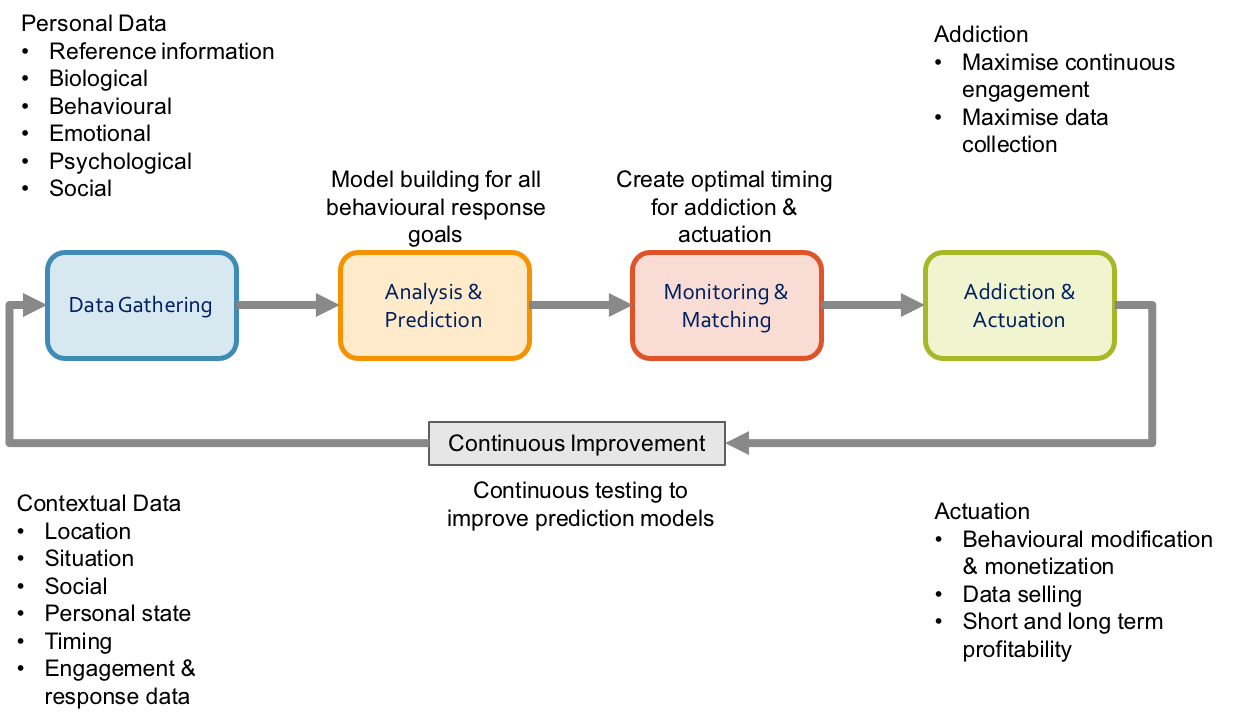
Figure 9-1

Both Facebook and Google, through combinations of their websites, links to other websites, ad platforms, technology integrations with other websites, web crawling, analytics, and other sources can collect an extraordinarily high level of all your behaviour across the web and they take information off the files on your computer. They also have other activities such as Google street mapping, where they have been caught downloading home information and computer files as they map your home. There will be many other sources such as information gathered from satellites and other third party sources.  

If you want to understand this more, I suggest you watch two movies, “The Great Hack” and “The Social Dilemna”.  For a simple description, there is Apple’s April 2021 recent communications called “A Day in the Life of Your Data – A Father-Daughter Day at the Playground”. There are also two interesting books, “The Age of Surveillance Capital” by Shoshana Zuboff, and “Privacy is Power” by Carissa Véliz.  These sources also talk about the issues of fake news, which I have dubbed the need for collective truth.

Collective truth, as I have defined it, is the need for the dominance of a common base of facts for all key societal events and activities where lies, misinformation, noise and conspiracy theories can materially affect decision making. This requires giving, and if necessary regulating, real responsibilities to all potential sources of mass dissemination of information.

Fake news is not new.  For decades, communist and fascist countries have created and controlled false narratives of life at home and life in other countries.  With the rise of the digital age, for these countries the opportunities for surveillance and control are much higher; however, there is also the need for more comprehensive generation of the narratives to in many cases overwhelm the truth.

One area where micro-targeting and fake news are used is in elections. Since 2016 the number tech ops groups from countries that have a mandate to help disrupt the election processes in countries has grown dramatically.  Vladimir Putin, in particular, has a clear focus on damaging the credibility of democracies by, among other things, influencing the outcome of elections.  Their involvement in the 2016 US Presidential elections being the prime known example.  

Clearly fake news is also not new in democracies.  With mass media and journalist requirements to validate the news they provide, historically it has in large been that the truth has risen to the top and overwhelmed the lies.  However in the US in 1987, the US FCC (Federal Communications Commission) abolished the Fairness Doctrine.  The Fairness Doctrine was a policy that required the holders of broadcast licenses to present controversial issues of public importance in a manner that was honest, equitable and balanced.  This abolishment paved the way for Rush Limbaugh to build his conservative radio station focused on entertainment, not truth, and established an enormous audience of 20 million listeners per week at his peak . The scale of his influence helped drive the partisan strategy of the Republicans and spawn the success of Fox News. 

Digital technology and social media companies have taken partisanship to new levels. The dangerous combination of micro-targeting and fake news has combined to help disrupt elections and fuel populism.  The movie documentary, “The Great Hack” illustrates how data mining and algorithms can be used to undermine individual liberty and democracy.  The ability to build alternative versions of the ‘truth’ through individualised and ideologically based uncensored newsflow is removing the ability to have voting from the same base of facts.  We can see the turmoil this created in the US 2020 Presidential elections.

Facebook and Google/Youtube are two of the critical platforms used to manipulate and change the behaviours of large groups of people, one person at a time.  Government and stakeholder pressure is mounting for these groups to behave in a socially responsible manner  – including blocking fake news where there can be material impact, eliminating all forms of hate speech and the ability to incite violence, and the blocking of foreign groups ability to interfere in elections through troll accounts.  Social media groups have been slow to respond; although, more recently as an example we have seen Donald Trump’s Twitter, Facebook, Instagram, Snapchat and Youtube accounts were disabled during and now post the 2020 US Presidential election.  

Governments are responding to this threat as they see fake news as a potential national security threat and a clear and present danger to social harmony.  They are increasingly focused on holding these companies accountable based on the editorial control of what information is pushed to individuals.  The companies are being asked or forced in some jurisdictions to identify and close troll accounts, to monitor, block and remove inappropriate content, and to abide by strict rules of information dissemination surrounding elections.  Once again, the EU is leading the way on regulating the behaviour of the tech industry. They introduced draft legislation in December 2020 proposing fines of up to 6% of turnover if they do not do more to tackle illegal and harmful content and reveal more about advertising on their platforms. The social responsibility requirements of these social media companies will only increase going forward.

Other stakeholders including employees, consumers and the court of public opinion are also forcing change.  Both Facebook and Alphabet have to regularly deal with their employees, or employee union in the case of Alphabet, and manage the public consequences of their statements.  They also have to engage with civil rights groups, hearings before government committees and public interest groups.   The topics range from collaborating with repressive governments, providing assistance to intelligence services, dealing with hate speech and incitements to violence, BLM and false information related to elections, to inappropriate sale of data and use of social platforms for mis-selling. 

The toxic combination of over collection and abuse of private information and fake news for any profit has to be addressed to provide the human right of digital privacy and the need for collective truth.  Without addressing this with some urgency the loss of privacy and allowance of the destructive use of fake news will become institutionalised and too complex to reverse.  The power of big tech not harnessed for social good is dangerous.  It is easy to forget the enormous economic and market power of Facebook and Google.  For Facebook the total number of active user accounts across their four platforms (Facebook, WhatsApp, Instagram, Facebook Messenger) is 7.3 billion.  Google on top of their 92% global market share of search have 2.3 billion YouTube active users. It may well be that anti-trust action by the EU and US focused on the potential break up or curbing of monopolistic powers of Facebook and Google may also affect their data domination strategies.

Addressing these combined challenges of digital privacy and collective truth is complex.  At the heart of digital privacy is the return of ownership and control of personal data back to the individual.  This is a fundamental part of the social contract that should be expected by the individual.  

GDPR and the right to data erasure in the EU is good progress but does not go far enough.  What really needs to happen to respect the fundamental right to privacy is that the control of personal data that is being used is put in the hands of the individual. This as much as anything is a technological challenge to create a model of data control that governments can then enforce.  

Tim Berners-Lee, the inventor of the world wide web, is now working on this.  He understands the dark side of surveillance capital and is focused on taking the internet and personal data to a sustainable place and remove the invasive data harvesting by governments and corporations.  He refers to this as “data sovereignty” which is to give individuals the power to control their data.  He has set up a company, Inrupt, to create a solution based on a technology, Solid, for organising data, applications, and identities on the web.

Inrupt plans to do this through a new system called “pods” – personal online data stores.  Pods work like personal data safes. By storing their data in a pod, individuals retain ownership and control of their own data, rather than transferring this to digital platforms. Under this system, companies can request access to an individual’s pod, offering certain services in return – but they cannot extract or sell that data onwards.

I do believe that the combination of Apple, Microsoft and Amazon could not only help build a system that worked but they have the combined necessary market power to drive the adoption of a true data privacy solution.  The addition of a proactive Google of course would make a massive difference as they with Apple effectively manage the app world.  Governments would have to be involved to oversee all the related issues of monopolistic power.  

The ambition of collective truth has its own complexities.  The core objective of this is to arrest the increase in partisan behaviour related to groups of people with their ‘own versions of the truth’ and the use of fake news or disinformation to poison effective discourse on material issues.  Post the US 2020 Presidential election, we are still in the position where the majority of Republicans believe the election was stolen!  The effectiveness of a democratic system is violated by voting based on lies.  Individual governments need to ensure public trust in the government and the political system.  As such, appropriate rules, regulations and monitoring of the conduct of elections is essential; and, part of this is solving how to ensure the integrity of information that voters rely on and use to decide how to vote.  To a large extent, this requires real focus on social media companies where the combination of individual targeting with the provision of fake news has been allowed.  Social media companies, are clearly media companies given that they push information to their consumers though algorithms.  They need to be held to account, along with all other major violators, for the mass provision of fake news. In February 2021, India set out guidelines to large social media companies like Facebook, Google and Twitter which will require them to remove any content flagged by authorities within 36 hours and set up a robust complaint redressal mechanism with an officer being based in the country. The pressure to solve this is building rapidly.

Collective truth is intertwined with the rights of freedom of speech and expression.  There are already many limitations and boundaries relating to libel, slander, obscenity, pornogragphy, incitement, classified information, copyright violation, trade secrets, food-labelling, non-disclosure agreements, the right to privacy and dignity, the right to be forgotten, public security and perjury. The justifications are linked to the principle of ‘harm’.  

This hornets nest of trying the get the optimal balance of the right to free speech and the limitations based on the principle of harm is not helped by a cancel culture. Limitations on research, discource and debate, and the narrowing of acceptable views, especially in University environments, will only slow down our progress. Restrictions need to be judged by looking at the combination of harm and materiality.

Actions must be taken on both digital privacy and collective truth before it becomes overly complex to reverse; and, governments have become too reliant on all the data access they have with the large tech companies. This is fundamental to the social contract with citizens and the effectiveness of the democratic form of government. Failure to address these issues can only be damaging in terms of loss of trust in the government and political process, increased social instability and rising partisanship.

In my tenth and final blog of this series, I will talk about the importance of appropriate policies and incentives to get beyond words to achieve financial commitment and action with urgency to hit targeted deadlines. The Paris Climate Agreement and the UN Sustainable Goals are bold and there is an enormous target of what needs to be achieved by 2030 to be successful.

Categories
REBOOT World View

The Social Contract

“Respect for human rights is not social work; it is not merely an act of compassion. It is the first obligation of government and the source of its legitimacy”, Ronald Reagan

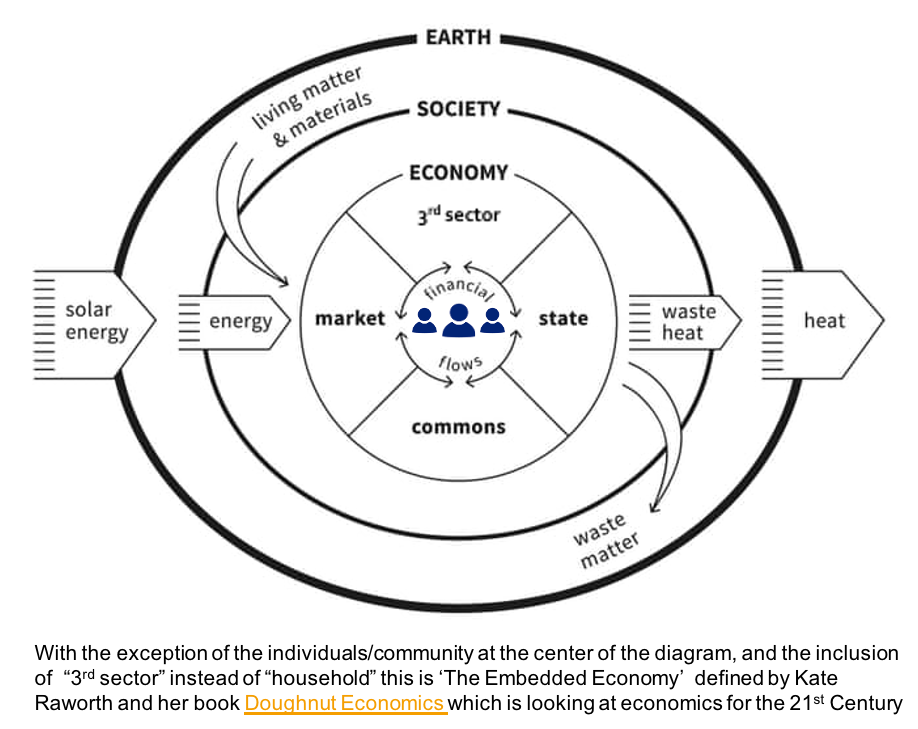
Kate Raworth’s diagram of the Embedded Economy (Figure 3-1), with my adaptation, is a useful framework to think systemically about the global context in which we live and critical interconnections related to our economies, societies and the environment.  This model shows the key components of the global system with the individual in the centre, surrounded by the components of the economy, which sits within a society and reside in the global ecosystem.  This is not a fully closed system as the earth is fuelled by the sun and it also dissipates heat.  There is also consumption of scarce resources by society and generation of waste that goes back into the environment.  This is the framework or macro-ecosystem that we need to get in balance to be sustainable.

Figure 3-1

Our current system is not in balance! In this Anthropocene era, we are increasing the heat of the planet which is affecting the living world. At the same time, we have been changing land use, displacing and causing the extinction of fauna and flora, depleting finite resources and then disposing of waste matter in unecological ways. We have taken the world out of its most stable 12,000 year period, which has been the period of great human development, into an unsustainable cycle.

This model for driving sustainability does not have the state in the centre as in the case of command economies such as Russia and China with individuals as participants in a state led system.  It also does not have free markets and capitalism sit in the centre, as it does currently in the Western world with the overwhelming focus on capitalism and corporates, with the individual or citizen secondary.   This also is not a plutocracy model, which as Nobel Laureate economist Joseph Stiglitz describes America moving to a government “of the 1%, by the 1% and for the 1%”. 

You just have to look at your life to realise that society has not been properly oriented on citizens. There are occasional exceptions, such as war and the current pandemic, with generate some small rebalancing.  A perfect example of this corporate centricity is the public bailout of the financial sectors misdemeanours in the 2008 Great Recession.

This lack of primary focus on the individual is apparent in a myriad of ways.  The unequal delivery of public services such as health and education to individuals. The reduction of services levels, or raising of prices, when public services are outsourced. The use of public funds to bail out failing corporates and financial institutions. The inadequacy of financial and legal consequences for currency manipulation, interest rate manipulation and mis-selling by financial institutions. The weak governmental response to pollution and environmental damage. The declining levels of personal privacy.

The primacy of the corporation over the individual also manifests itself in what appears to be small ways; but, are cumulatively substantial. We have virtually no control over our personal information on the web. We are served terms by websites in order to use them that are unintelligible, onerous and leave us no choice but to accept.    We see subscriptions from companies that cause term based commitments; yet, companies are able to change their terms of the contract throughout the period.  With regulated companies, such as telecoms, we see that it easy to sign up to new services on the web, yet it is incredibly difficult to cancel services and it needs to be done through their understaffed call centers. And the list goes on.  

Proper protections for consumers would not allow this corporate behaviour, and it would provide material enough penalties to the corporates that they would not repeat offend.  The only way to create a sustainable model is to focus how we operate to be citizen centric and not corporate or government centric.

Individuals are consumers, employees, voters, environmental stakeholders and members of communities.  If we are to build a better model of how we operate then we need to define what the social contract that societies should be striving to provide.  This provides the moral compass for where we are trying to get to.  The other components in the society, in particular the state, the market economy and the financial markets need to be aligned and incentivised to deliver against this target social contract.

The target social contract is the “North Star”, it defines that the individual consents to surrender some of their freedoms, participate in and abide by the rules of the society and submit to the authority (in the case of a democracy to the decision of a majority) in exchange for the protection of their remaining rights, personal safety and security, maintenance of social order, access to employment to earn income, and provision and access to public services.  The social contract that I am referring to is the set of expectations that a member of a society should be able to have that is consistent with building a strong, fair and sustainable society for future generations.  

The rights of an individual start with the UN Declaration of Human Rights that was signed in 1948 and was adopted by a vote of 48 in favour, 0 against and 8 abstentions.  Today there are 193 member states of the UN, all of whom have signed on in agreement with the Universal Declaration of Human Rights (UDHR)  by signing at least one of the nine binding treaties influenced by the Declaration, with the vast majority ratifying four or more.  Currently, 79 of the countries have independent National Human Rights Institutions that comply with International Standards.

The rights include 30 basic human rights. The foundation of the Declaration are the principles of dignity, liberty, equality and brotherhood.  Sitting on these principles are the rights of individuals; the rights of the individual in civil and political society; spiritual, public and political freedoms, and social, economic and cultural rights.  

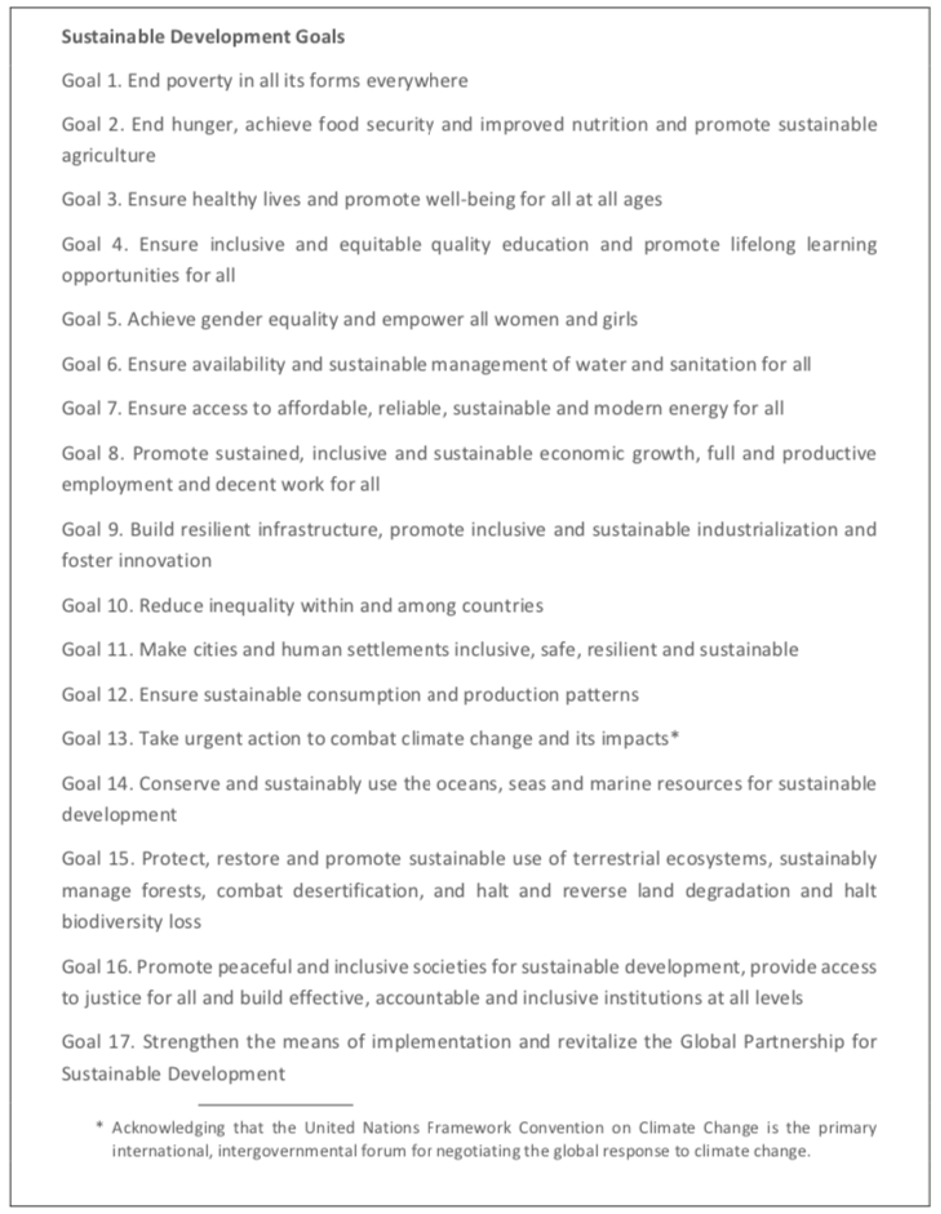
The 17 UN Sustainable Development Goals (SDGs), see Figure 3-2, take these concepts of human rights and add further specificity.  Over 90 percent of the goals and targets of the SDGs correspond to human rights obligations.  These SDGs defined in 2015 and agreed by over 190 countries, have an agenda and targets set for 2030.

Figure 3-2

It is important to note that across many of the SDGs is the key phrase “for all”.  This is a big shift in thinking on what is expected from a society and how the thinking behind the delivery of services is changing.  The shift has been from average and median thinking to heterogeneous thinking and focus on the importance of inclusivity, or the elimination of exclusion, and overall fairness.  A. Philip Randolph captured this when he said, “A community is democratic only when the humblest and weakest person can enjoy the high civil, economic, and social rights that the biggest and most powerful possess”. It is the focus on ensuring that the world we live in is less plutocratic.

Inclusivity and fairness thinking is not socialist thinking and does not exclude wide ranges of income between people.  It does contemplate that everyone has some minimal rights and a right to fair treatment.  SDG’s are not the enemy of capitalism; rather they are foundations of compassionate and responsible capitalism which in the medium and longterm will be dramatically more sustainable than short term zero-sum-gain thinking.  As I showed in my previous blog, the most prosperous countries are also the most well balanced.  Fair compensation, high levels of employment, good health, education and strong social security have multiplier effects on the prosperity of a society.  

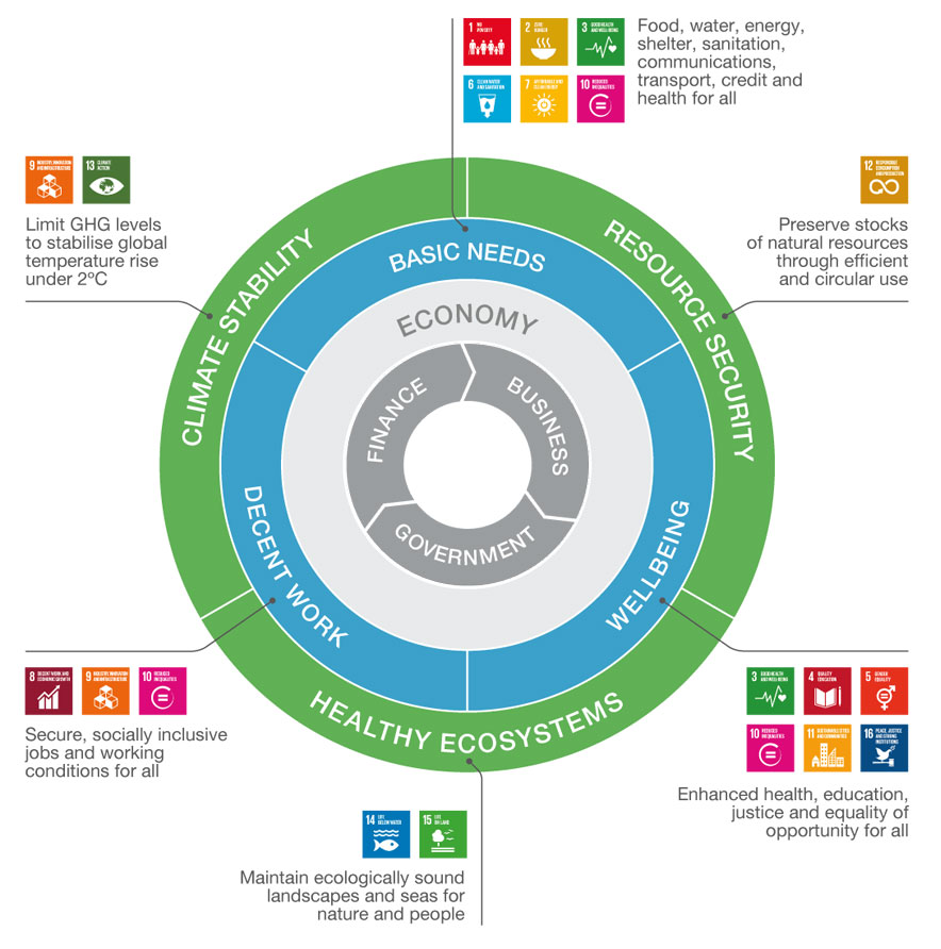
The Cambridge Institute for Sustainable Leadership, has linked the SDGs into three broad social ambitions and three environmental ambitions (Figure 3-3).  These social ambitions revolve around basic needs, decent work and wellbeing.  

Figure 3-3

These three needs are vital components of the target social contract; but, there are also additional components required. The pervasive digital gathering and use of data attacks privacy. This capability combined with the proliferation of communications and the ability to personalise and deliver fake news to mislead, misinform and misdirect behaviour is a real societal problem. These real and tangible issues relate to Articles 12 and 19 defined in the 1948 Declaration of Human Rights (Figure 3-4). 

Figure 3-4

At the time these were written it would not have been possible to predict the impact of technology.  As I noted in my first blog of this series, even now it is almost unfathomable how much data on each person is being gathered and how it is being used.  This along with the personalised delivery of communications which can be either true or fake news is creating real cracks in societies.  The 2016 and 2020 US presidential elections have provided a real magnification of what can happen.  How can a country become so polarised and how can 70% of the Republican voters truly believe there has been massive fraud no matter what the courts say or even what the people who have managed the elections say?  The answer is that the information they watch, read and have been fed is different.  In democratic countries with only mass media, it used to be that the truth would rise to the top and there would be a common set of information.  In most countries, there were also rules on the accuracy and balance of information that was provided to voters to help them make their decisions. False information was filtered out by reputable media and there were rules on the truth of advertising messages.  Social media has bypassed this with the ability to push personalised communications that can be either true or fake, and algorithms that reinforce the personalised messages, so there is no longer a common set of facts that all people will see.  Is it possible to maintain an effective and stable democracy without a common set of information and facts from which citizens cast their votes?

There is also a fundamental bias of information driven by both mass media and social media.  We are increasingly seeing that the public view of what is happening in the world is severely distorted from reality.  Figure 3-5 illustrates this distortion perfectly.  If this is the case on a subject such as causes of death, imagine the levels of distortion of reality of other relevant topics to the individual.  If we believe that transparency, data and facts, and truth is paramount to the individual who is a consumer, an employee, a voter and a member of a society, then this is a fundamental social contract issue that must be solved.  

Figure 3-5 

Inevitably the ability to increasingly personalise can be both positive and negative.  Providing more relevant information or advertising more relevant products and services for consumption can have real value to the individual.  However, having information on race, gender, sexual orientation, disability, health, income, etc. can also allow for discriminatory behaviour and pricing for exclusion or to take advantage of an individuals circumstances.  With increasing use of AI, which relies on historical data this can help to reinforce old practices.  We have seen an example of this in 2018 when Amazon was innocently trying to make their recruitment more efficient and found that because of historical data they continued to reinforce gender bias.  The more disturbing use of data is when it provides a company asymmetric knowledge vs. the consumer and they then exploit this opportunity.  Asymmetry of knowledge and power has been an age old problem with financial and pharmaceutical companies exploiting their situation making customer the big losers.  This problem now has arguably crossed the line with how social media companies and other tech giants exploit consumers and their data to enhance their business and keep out competition.  The collection of data is continuing to gather steam and will explode further with the penetration of IoT based devices and the growing levels of information from biotech and neurotech applications.  Privacy control must be one of the fundamental rights of an individual going forward.  

We are seeing the progressive escalation of concern on the power of the large tech companies, in particular the GAFA group – Google, Apple, Facebook and Amazon – with respect to both privacy, anti-trust and misinformation.  The GAFA have between them faced anti-trust challenges and investigations in multiple regions including the US, EU (including individual countries within the EU), India, Canada, Australia, and Japan. Even though fines have been in the billions of dollars this is pocket change for these companies.  The focus on getting the tech giants under control will only escalate. 

Meanwhile some progress has been made with the GDPR (General Data Protection Regulations) that went into effect in May 2018 in the EU and is helping to set the standards that other countries will move towards. The GDPR regulations do have some privacy related rights related to data deletion, previously known as “the right to be forgotten”; but, this is incomplete.  This may be a big step for corporations; but, it is only a small step from an individual’s perspective on rights to privacy.  

So, to conclude there are five categories of components of a social contract to create an individual and citizen centric society that can thrive and prosper going forward.  As identified above by the SDGs and CISL, there are the three requirements of basic needs, well-being and decent work. The basic needs involve minimum levels of availability and access to food, water, shelter, energy, sanitation, communications, credit and transport for all.  It is vital to note that availability and access also included fair pricing.  In terms of wellbeing, there is affordable healthcare and education, and equal access to justice, safety and security.  Healthcare needs to be comprehensive and should not result in gaps as big as 10 years expected length of life differences at birth depending on which side of the street you were born.  The nature of access to education, is about narrowing the gap to affordable and high quality education to provide life and mobility opportunities.  This education includes K to 12, University and apprentice/applied educational programs and reskilling. The third requirement is decent work.  Decent work comprises living wages, social security programs to assist in managing through out different work situations, being disabled and pension arrangements.  Access to ongoing education to provide mobility will be increasingly important as the fourth industrial revolution, particularly with respect to AI and robotics, becomes increasingly pervasive.  

Wrapping these three requirements is the fourth component, which is the right to be living in a climate and environmentally sustainable environment.   The climate and environmental challenges are both global and local issues.  Due to the climate urgency and the potential implications of missing the Paris Climate Agreement target of not more than 2 degrees Celsius increase in average temperature, overall this is the most important component of the social contract.  We know we are tracking to hit over a 3 degree increase in temperature.  This has critical consequences for different countries including liveability, the local economy, access to food and water, and massive inter-country issues such as environmental refugees. Environmental refugees are also inevitably linked into both economic and political refugees.  The refugees crisis can only increase from its current estimated level of 80 million of which 46 million are internally displaced people according to UNHCR.  Predictions of 200m or more climate migrants by 2050 are not uncommon.  The ripple effects of this should not be underestimated in terms of human cost, economic cost, rising populism and societal destabilisation. 

The fifth component comprises the core human rights of privacy, access to facts and the truth, and the interlinked rights of freedom of information and freedom of speech. At the heart of privacy is personal control over all the personal information that is gathered, generated and used in the public arena of the internet and other networks of information.  Collective access to data, information and the truth has to be essential.  This means that fake news needs to be clearly identified, be managed in its distribution, and restricted in critical areas such as advertising and the social media push of content.  Social interaction and discourse needs to have common ground based on truth for societies to operate effectively.  Finally, freedom of access to information and freedom of speech is fundamental.  The debate around this is rightly growing and becoming increasingly complex with developing factors such as the growth of ‘fake news’,  the social media driven and algorithmic based delivery of content, the emerging “cancel culture”, and the growing voice of a full range of minority interests.  

Being definitive on the requirements of each of the components of a “North Star’ social contract is complex; but, excusing ourselves and not progressing on them is irresponsible.  Each country will need to define their specifics behind a common set of principles for all countries. The vital thing is that we become individual and inclusive centric to how we ‘reboot’ to create more sustainable societies and a more sustainable collective world.  

At the heart, the social contract is about solving inclusivity and fairness, which is the solution to the problem of inequality. We can see the urgency to address the growing issue of inequality in many countries. Yet in context, Branko Milanovic, an expert on global inequality, assesses that about 80% of inequality is across countries as opposed to within countries (Branko Milanovic, “Global Inequality – A New Approach For The Age of Globalisation”). Solving multi-lateral problems is exponentially more complex than country problems. I will explore this and inequality in more detail in later blogs.

In my next blog, I will looking in more detail at the role of the government in a democratic society.

#social contract #climate change #global warming #Universal Declaration of Human Rights #inequality #inclusivity #fairness #privacy #digital trust #cyber #mass manipulation #truth #Global Inequality #SDGs #Sustainable Development Goals #Paris Climate Agreement #UNHCR #UDHR #refugees @Kate Raworth @ Joseph Stiglitz @Branko Milanovic @CISL @Google @Apple @Facebook @Amazon

Categories
REBOOT Strategy

REBOOT Business Strategy

“Innovation is seeing what everyone has seen and thinking what nobody has thought”, Dr. Albert Szent-Györgyi (discovered Vitamin C)

Blog 9 of the Business Strategy Series

The natural subject to follow on from customer – product fit is to explore business models.  The business model definition in the context of this discussion is, the economic model for profitability that joins the value proposition to the target customers with the delivery model of resources and processes that need to be combined to meet the customer need, and to build and grow the business.

It is critical to understand that the three components, the value proposition, the set up to deliver the value proposition and the economic model are all intertwined. As an example, in the US you might ask how does everyone seem to own a car and regularly get a new car. Surely, with the level of debt in America, most people don’t have the available cash to buy a new car!  The answer is that if you combine lease financing with a car you can expand the market by reaching a whole set of customers with limited or no savings, who can make payments out of their monthly pay.   In the case of General Motors (GM), you have GM the car manufacturer and GM Financial the lease provider.  The combination of the two provides the value proposition of a new car based on monthly payments and drives the overall profitability of GM from both product margins and financial margins from the  leases.  

A more modern example is AirBnB who are the biggest providers of rooms for short term accommodation.  They do this without owning any real estate.  They have crowd sourced the rooms, they then pay for them and resell them on a variable cost basis. AirBnb effectively then takes an intermediary margin to drive the economics of their business.  Both of these examples show how the economic model is an integral part of the value proposition and also dramatically affects the scale opportunity for the business.  Business model innovation, with innovation within the economic model, is a critical component in the development of new successful businesses.

There are five key economic dimensions of the business model that I will explore.  The first dimension is who pays. Is it the customer who pays for the product or service or does someone else pay – these are direct or indirect models.  One of the earliest versions of the indirect model is a newspaper or magazine that is free, and all the revenues are made from ads placed in that media.  The companies placing the ads are indirect beneficiaries of the consumer business if the ads generate revenues for the advertiser.  

Today two of the FAANGS (5 prominent American technology companies – Facebook, Apple, Amazon, Netflix, Google) have a core model that the consumer does not pay.  They are Facebook and Google.  These two companies make most of their money from the placement of ads in the web pages of their consumers.  In these digital models there are also opportunities to make money off the consumer data that they collect.  The reality of these economic models, although it may not be obvious, is the user of the service is the product and the economic customer is the advertiser or purchaser of consumer information.   The internet spawned a large movement towards this model; although, many companies have found that ad revenues alone are not enough and a hybrid model is usually required.

The second dimension is the economics of revenue growth.  There are two fundamentally different types of revenue focus, product focused (transaction oriented) and customer relationship driven.  The economics of the two models are very different and best suited for different situations.  In the transactional model, the sales, marketing and service costs related to the sale are covered within the profit margins of the product/service sold.  In the economic profile of a customer relationship focus, the upfront costs of finding a customer are often expensive; however, as long as you capture customer information and are able to market to them subsequently the follow on marketing and sales costs to a customer can be very low.  If this is matched with a product offer that you have reasonable expectations you can generate recurring revenues, and ideally growing revenues over time, then you would be willing to lose money on the first purchase and make the profit up in subsequent purchases.  

In the early days of Amazon, there was always wonder at how the economics of Amazon made sense as they were unprofitable for years. If you look at it from a customer relationship perspective it was clear that when you have a high growth curve your focus is on new customer acquisition and each new customer at the beginning of their relationship is a loss maker.  Jeff Bezos clearly believed from books and then adding new product categories that the lifetime economics of a customer would be positive and this was a critical part of his economic model.  

The third dimension is revenue payment model.  There are a number of payment timing approaches in a model which include individual purchase, periodic purchases (unstructured buying over time) and subscription payments.  

Figure 9-1

These three dimensions are captured in Figure 9-1.  The indirect model of who pays is captured in the ‘Free’ column.  In the free column, if a customer never makes a payment then the revenues for the organisation needs to be collected from interested intermediaries.  In the grid, you can see that for digital companies that involve high frequency of use, often the right model is customer focused and subscription payments.  In contrast for non digital, companies such as FMCG companies and physical retailing where it is difficult to capture a name and efficiently use it, they will tend to be product focused.  Many of them try to become more relationship oriented by adding a loyalty program to a standard offer.

Often, there are companies that use a freemium model in the digital world.  A freemium model of a no cost low specification software application can often be an effective way to create a low cost of customer acquisition by offering a free trial product and then by watching their behaviour to trigger opportunities to upgrade the customer to a paying version of the product.  Spotify uses a variation of this model, where you can use Spotify for free if you are willing to put up with a regular flow of irritating adverts.  To get rid of this negative experience and then enjoy the full benefits of Spotify you take on a subscription.  From a Spotify perspective the ad revenues for a free customer is an offset to the customer acquisition costs for creating a subscription customer.  Spotify understands the large network benefits of having as many customers as possible using their service, so freemium pricing is a critical component of their strategy to be a leader in this sector.

This matrix, product vs. customer focus, and the revenue payment model are the two standard ways that most companies look at their business model.  

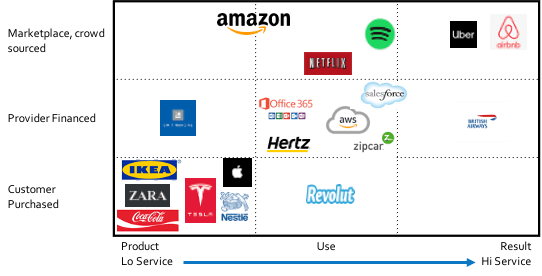
Many companies are now adding additional dimensions to their thinking about what the right proposition is to the customer and how the financial models works for the business.  The fourth dimension relates to how the product/service to the consumer is financed in relationship to the payment from the customer.  In this dimension, the standard approach is that the consumer pays the full value of the product or service at the time of purchase.  In this context, the company needs working capital financing for the product until a customer comes along.  

At the other end of the spectrum, the company will build up a product offer for the market by working as an intermediary effectively selling other peoples products.  The company may pre-buy inventory for resale, or crowd source product (eg. AirBnB) where they only buy a product or service when there is a need.  Crowd sourcing is a working capital and asset light model and the key is to solve how to add value in the middle as an intermediary.  Many people will refer to these businesses as market platform businesses. 

The final approach within this financing dimension, is what I have call provider financed.  In this case, the company has financed the asset and then provides the product as a service so the company only gets full financial coverage on the asset from multiple uses and/or multiple customers.   This can help significantly expand the market by taking out the affordability issue in the use of the product or service.    This is also known as an asset sharing model. 

With the focus now moving towards climate and environmentally friendly businesses, business models that are focused on high asset utilisation should have an important role in our lives going forward.  One of the sectors, where this is often talked about is the auto industry.  It is clear that cars are used only a small fraction of the time that they are available for use.  It is thought that if cars were in a high asset utilisation model, then we might only need about 10% of the cars currently in circulation.  This movement may also accelerate with the shift to autonomous driving vehicles.  

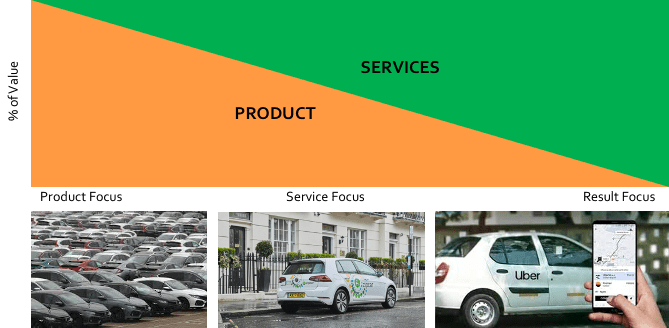
This leads us to the fifth and final dimension within business model that I want to focus on.  With the drive towards making businesses climate friendly, and the growing recognition that asset sharing is an interesting opportunity  for both the customer and the asset owner, there is a growing movement away from asset ownership towards ‘use’ and ‘result’ focused business models.  

Once again within the automotive industry, we can see examples of each of these three models (Figure 9-2).  At the product focus end of the spectrum are the automotive manufacturers which include Toyota, VW, BMW, Mercedes, GM, Ford, Fiat, Renault, Peugot and the new entrant Tesla.  In the service focus part of the market, there are all the rental car companies and then new entrants such as Zipcar.  Zipcar is a highly convenient rental service to use the car as you want.  The service features include highly convenient pick up and drop off, a clean car, a full tank of gas/petrol, insurance and simple payment with all inclusive pricing.  Many consumers in urban environments are shifting to not owning a car and just paying per use.   At the results focus end of the spectrum, you have taxis and more recently Uber, and equivalent crowdsourced point to point personal transport service providers.   

Figure 9-2

If you were a large car manufacturer today, or a major player in the supply chain, facing a shift to electric cars, all the climate pressures, the emergence of crowd sourced / asset sharing companies, and in the medium term the growth of autonomous driving vehicles, what would your strategy be?

The mapping of the asset financing dimension and the product-service dimension provides and interesting look at the strategies of different companies (Figure 9-3).  An interesting business model to look at is Microsoft Office 365.  Microsoft has shifted from selling Work, Excel and Powerpoint as individual products or bundled as one off purchases to a subscription model with additional bundling of other services. This has helped to transform their business and economics.  They now have a product suite that is an integral part of their ‘cloud first’ strategy that provides a steady monthly flow of income, plus conversion to high proportion of direct sales to capture margins and only nominal additional marketing costs per existing customer for further potential sales.  This model also helps to open up additional innovation and cross selling opportunities off their cloud platform.  Uber and AirBnb in the marketplace and result box in the grid were able to build multi-billion dollar businesses by leveraging off other peoples assets and driving very simple user experiences.

Figure 9-3

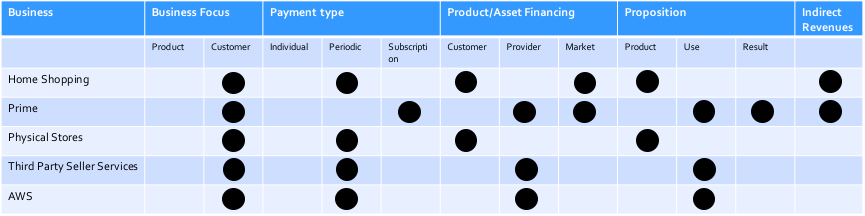
One of the masters of business model innovation is Amazon.  Amazon has built a business fortress with innovative use of business models (Figure 9-4). Amazon uses different combinations of business model components for each business. They go well beyond just looking at simple business models and create advantage from multi-factor business models.

All their businesses are customer relationship oriented and collect customer data.  The B2B businesses have leveraged off and enhanced the home shopping infrastructure.  Each business has carefully focused on how to drive drive growth, optimize the use of cashflow, and generate the long term profitability requirements of the business with a compelling customer proposition.

Figure 9-4

Going forward, it will be very difficult for anyone to compete directly against Amazon.  They have a relentless focus on customers and on how to drive continuous growth and improvement in the relationship they have with them, and they are innovation and execution obsessed.  Finally, they know how to use their scale with data, with the range of product and services they provide, and the efficiency of their infrastructure to their advantage.  It is no wonder that there is talk about the monopolistic market position that Amazon sits in.  

Clearly, there are other factors to explore that drive a business model, including different types of pricing, such as freemium and yield management pricing, and the selection of channels to market, which also have an impact on market size and growth potential, pricing and the cost structure of the business.

There is a real trend of businesses to move from simple business models to multi-factor business models. Different combinations of dimensions will create a business model with different financial characteristics and different market size and growth opportunities. The models create different financial profiles in terms of:

  • Upfront cash to get the business started and operating
  • Ongoing working capital and growth financing
  • Time to self sustaining economics
  • Resilience – reliability and predictability of future revenue streams, ability to handle economic disruptions, etc.
  • Market size and market growth potential

From a climate and impact perspective it is also critical to identify a sustainable business model. It is essential to explore models that will reduce waste from the traditional product delivery model of take – make – waste, towards a no waste model of being focused on maximising the life of a product/service and optimising the utilisation through reselling, remanufacturing, asset sharing, and finally optimised recycling.

Exploring different business model components is an essential piece of the innovation focus within a business. Creatively looking at whether adding further dimensions to the business model, as Amazon have, or fully switching to a different model, as Microsoft with Office 365 have, is a vital part of business strategy.