Blog 1 on Post Covid Disruption, Resilience and Innovation
Sept 2020 – We have not yet emerged from the Covid 19 pandemic. Depending on whose narrative you are listening to and where you live, we are either towards the end of the first wave or at the beginning of the second wave. Most countries in the northern hemisphere are expecting it to come back stronger as we move into the autumn and winter season. Vaccine progress is encouraging and treatments are apparently improving as we learn more. We are starting to build our experience on how to live with Covid and some countries are doing better than others at this. In any event, we will be at the least learning to live with Covid 19 until we have a vaccine that has been widely distributed. If we solve Covid 19, we will need to hope a mutation or other virus does not show up for a long period of time.
In my view, we need to expect that we will be living with periodic disruptions from pandemics. Just look at our past as illustrated in Figure 1-1 . Of course, the data shown on Covid 19 is not up to date; as of 6 September there were over 887 thousand deaths (www.worldometers.info/coronavirus/). Since 2000, we have had SARS, Swine Flu, MERS, Ebola and now Covid 19.
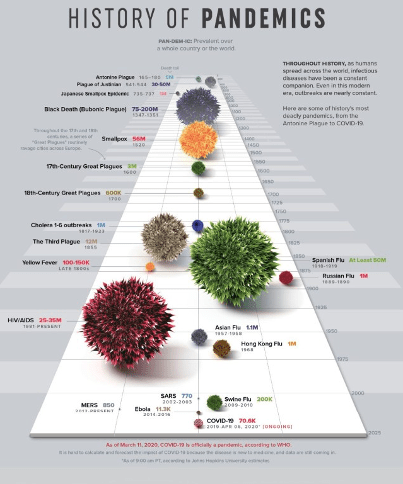
Figure 1-1
What we do need to do is dramatically improve our management of viruses through being prepared, responding quickly by understanding the difference between exponential and linear, track and trace, have a coordinated multi-country response to manage and cure the virus, and have much better coordinated social and economic responses. We can only hope that there will be proper analysis of our current situation so that lessons will be learnt; and, the learnings will be applied to continuously improve how we manage pandemics.
In my second blog on Business Strategy, I provided an early view on how we were doing globally, and this was my assessment (Figure 1-2).
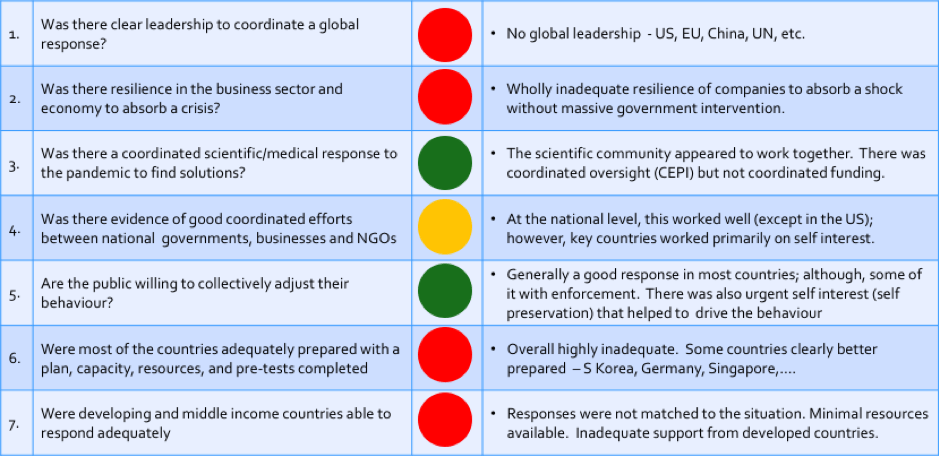
I would have hoped that over time the assessment on how we have been managing would potentially have underestimated how we were doing; unfortunately, if anything, the rating is generous. We have seen the US fully withdraw from the WHO (World Health Organisation) and not work as part of a coordinated medical response. On the other hand, we have seen the EU agree to a €750m recovery fund to help EU countries respond to the pandemic. Both the virus management, including overall health management, and economic management analysis of our performance at the global, national, and local levels will provide a lot of lessons for the future! Few nations have escaped unscathed and our interconnectedness economically has affected all nations.
So what will change going forward in how we live our lives, how we work, how we socialise, how we learn, what we consume and what we do for entertainment?
New experiences, new realities, new understandings and new real or perceived fears change us. For many our economics have also changed. Millions of jobs have been lost or are at risk. Tens of thousands of companies have collapsed and more will collapse from shortage of financing and a too slow rebound of busines. As with most challenging situations, there have also been some winners who have been in the right place at the right time, or responded and were able to benefit from the situation.
Once again, as with most crisis, inequality comes up as a major issue. Those who can work remotely – office workers, financial sector workers, those in the technology sectors, managers, executives – can largely isolate themselves from the health risks; whereas, those on the front line – doctors, nurses, transport workers, home delivery workers and those in essential sectors – take on the health risks and allow many of us the ability to isolate. It is also a group of people that have a lower overall income profile to those who stay at home and they do not have the same financial capacity to live through a lock down. Even worse, in the lower income countries the governments do not have the capacity to respond with relevant financial assistance to workers and companies as well as having inadequate health care systems for the majority of the population. We know that in many of these countries significant proportions of the population survive day to day or week to week and lockdowns put themselves and their families in front of other health risks such as starvation.
The important role of technology has been made even more visible. Whether for home working, home schooling, home shopping or for entertainment we have seen the power of technology. We have all witnessed the accelerated adoption of technology in each of these areas. Some say that we have moved forward 5 years in the last 6 months in terms of technology adoption. We have moved into a position where the perceived risk of not adopting certain new technologies, and new ways of doing things, is more risky to our livelihood than sticking to status quo. This is new!
Our life of living with Covid 19, or post Covid 19, does not sit in isolation. Integrated with this situation is the financial crisis, evolving geo-political tensions and challenges, other man-made challenges, and most importantly the need to address climate change and biodiversity, and the challenges of inequality. The way forward needs to incorporate all these realities.
To add a bit more context to the two key longer term challenges, it is useful to refer to Kate Raworth and her book Doughnut Economics which is looking at economics for the 21st Century. The basic premise of a long term sustainable world is that society must sit between a minimum basic social foundation for all and live within an ecological ceiling as depicted in Figure 1-3. This is the Doughnut.
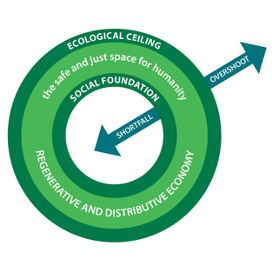
Figure 1-3
If you then evaluate where we are across a set of dimensions for the social foundation and the ecological ceiling, you find that we have a lot of work to do to establish a fair social foundation for all and live within our environmental boundaries. From Kate Raworth’s Doughnut Economics she has reflected the situation within Figure 1-4. This depiction is linked to and consistent with the 17 UN Sustainable Development Goals, which I have discussed in earlier blogs as the best Global consensus of what we need to accomplish by 2030 and then beyond.
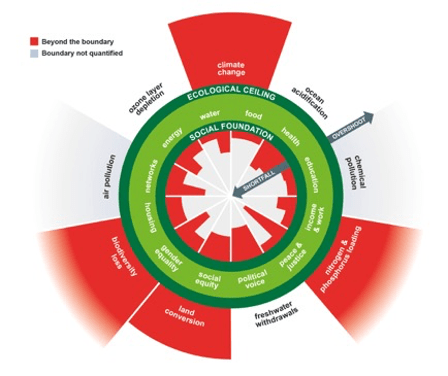
Figure 1-4
The climate and environmental issues will be familiar; although, perhaps not the extent to which we are well beyond the science based limits of climate change, biodiversity loss, land conversion and nitrous and phosphorous loading.
In my view the social foundation components all link into the theme of inequality. The inadequate access to minimum acceptable levels of food, shelter, water, energy, health and peace and justice for all. The inequality of access to quality education and networks (internet, etc.). The inequality of opportunity in terms of income and work, gender equality (#MeToo), social equity (#Black Lives Matter) and political voice.
This set of blogs although focused on living with Covid 19, and post Covid 19, necessarily has to incorporate these other pressures and disruptions that we are facing. The blogs will explore likely shifts in consumer behaviour, the impact on businesses and certain sectors and how they need to react, and some views on the role of the government and how it needs to change. Overall, the topics are covering managing in disruptive times, creating resilience and the critical requirement for continuous innovation.
Once again, please share this material, share your views, push forward the discussion.
#Covid 19 #pandemic #post Covid #strategy #disruption #resilience #innovation #WHO #sustainable development goals #UN SDGs #WEF #Doughnut Economics @Kate Raworth
 REBOOT