Categories
REBOOT Strategy

REBOOT Business Strategy

Blog 13 of the REBOOT Business Strategy Series

This is the first blog discussing a new strategic framework relevant for the world we now live in.  To date, I have covered off some background on how the world is getting increasingly complex from a societal, environmental, technological and disruption perspective; and the implication of this is a need to look at business strategies from a system based perspective so that business are aligned with economic, society and environmental goals.  Critically, linked to this are that the general consensus on these goals globally are best defined by the 2015 UN Sustainable Development Goals for 2030, which also link in with the 2015 Paris Climate Agreement.

The next section then went on to cover off 8 gaps in traditional strategic thinking that need to be covered off for a strategy in the 21st century.  These gaps were driven by deep interconnections of a business with their environment, which is not just their business sector.  These interconnections are vital to understand as there is continuous change and ongoing disruptions that are and will be affecting a business.  These factors include societal and economic factors as we can see now with the Covid 19 pandemic and ‘Black Lives Matter’ movement, the impact of new technologies, and most importantly the need to globally address the challenges of climate change and other key environmental issues. 

This new framework tries to create a shift in how we think about our business, away from just profitability for shareholders to goals that are also aligned other stakeholders including the public, consumers, suppliers, communities and governmental interests.  It is worth noting that investors are now requiring this shift given that the long term interests of businesses are for a sustainable world and they can see real business risks on the horizon from climate change.

The traditional stand alone thinking (Figure 13-1) can be summarised by, firstly, a virtually exclusive focus on the shareholder as Milton Friedman had summarised,”the social responsibility of business is to increase its profits”. Secondly, an industry and competitor analysis as defined by Michael Porter’s five forces analysis matched to an understanding of the business’ internal capabilities.  Thirdly, profit and market based key metrics.
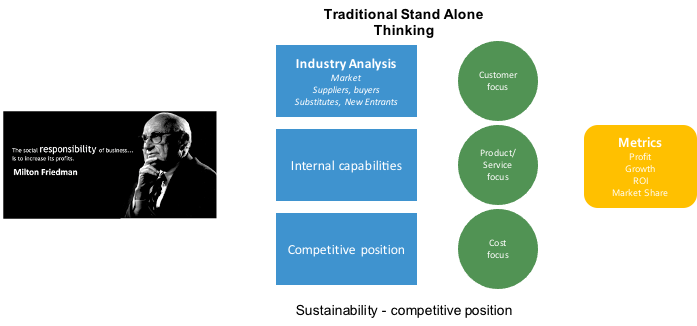
Figure 13-1

A  new system based framework needs alignment from the business through to the economy, society and to the environment (Figure 13-2).
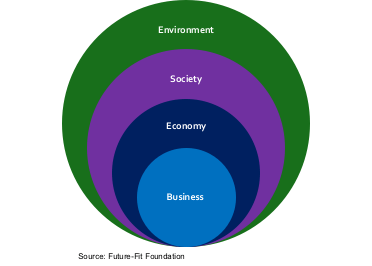
Figure 13-2

To create alignment a business needs meaningful purpose that aligns with the business on delivering against both its own economic goals as well as creating impact (Figure 13-3).  This is the challenge of strategy design, to cover the needs of both profitability and impact.  

Figure 13-3

Clearly, this can add complexity as the performance measures are now broader; however, it also creates opportunity and new ways of differentiating and competing.  For deeply entrenched players in the market who have adverse impact on the climate/environment, they are going to have to think about how they will use their resources and market position to evolve to a new sustainable strategic position and focus.  For the younger and nimbler companies, they will need to think about how to use their speed and flexibility to create a stronger positioning ahead of their key competitors.  If you are already there, then take advantage of your position.

A key part of this system-based framework is that it is relevant for all types of organisations whether in business, government or as an NGO.  Clearly, each type of organisation, as with each business, has to be clear on their economic model and what their impact targets are in order to get clear on what delivery model they need.  In the government and with NGO’s, they will have very different sources of funds; but, in any event they need to solve a sustainable financial model to survive rather than to make a profit.  A governments whole raison d’être should be impact; although, for many of us it may well be that their targets and metrics of achievement are unclear!  

Surrounding these triangles are three components that need to be full addressed within a strategy (Figure 13-4).  Firstly, having a clear view of the key stakeholders of the business.  Secondly, the business must be built to last – it must be sustainable.  This means the business must be able to continuously deliver value to it customers, it must deliver the right economic performance for investors, and it must provide the appropriate impact for other stakeholders. And, the business must be able to adjust, adapt and move forward in a way that this continues over time.

Thirdly, the business must be resilient and thus have the capability to withstand and manage through different scenarios of disruption from the 5 types of macro forces – societal, environmental, economic, technological, and geo-political – to the core challenges specific to the   
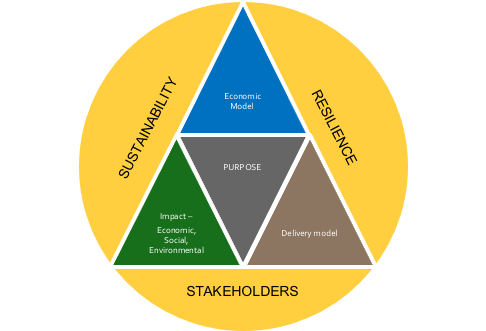
Strategic Framework
Figure 13-4

There are six tests of a business strategy:

  1. Is the business Purpose Driven?
  2. Can the business create real differentiated value for its target customers over time?
  3. Can the business perform at a level to attract and retain investors?
  4. Does the strategy integrate generating economic, social and environmental impact at ambitious levels for key stakeholders?
  5. Does the business strategy create sustainability and resilience?
  6. Does the strategy have ambitious and achievable triple bottom line metrics covering profit and impact targets?

At the heart of a business lies its purpose.  It is the driving force and acid test of all business decisions.  It is what attracts and retains employees, customers, other participants in the supply chain and investors.  Sitting above the strategy are three components Vision, Mission and Values.  There are a lot of different views about how to define vision and mission, and sometimes they are combined; so to clarify, I have created definitions that fit with this strategic framework.
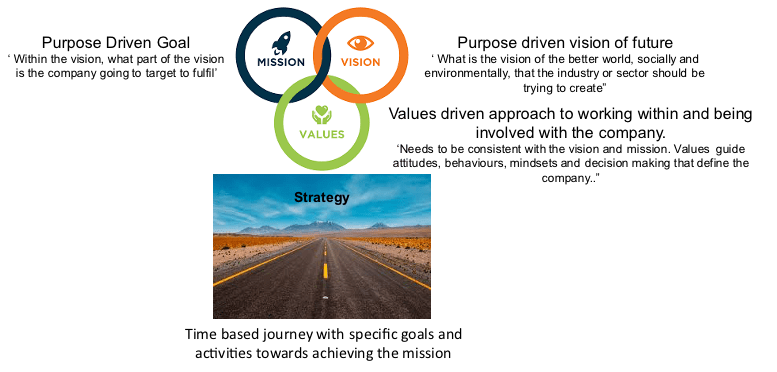
Figure 13-5

Within this strategic framework, the purpose defines how the world will be a better place as a result of the business.  The first component of the purpose is the Vision.  The Vision is the business’ view of the better world that the industry or sector will contribute to.  The Mission is the part of the vision that the company is targeting to fulfil.  I like to describe the Mission as the North Star that the company wants to be continuously moving towards.  Finally, the Values defines behaviourally how the Company‘s operates – what drives it, what motivates it, and how it will behave with its employees, customers, suppliers, communities, society and environment.  The combination of the vision and mission should be something that engages, and gains agreement from, all key stakeholders.

Here are some examples of the vision and mission, or a combined statement, for purpose driven companies.  

Orsted

Our vision is a world that runs entirely on green energy.

Mission: “We want to be a company that provides real, tangible solutions to one of the worlds most difficult and urgent problems.”

This is a Danish Company that started life as a state owned organisation focused on coal and oil.  Most recently it has been recognised as ….

Within this strategic framework, the purpose defines how the world will be a better place as a result of the business.  The first component of the purpose is the Vision.  The Vision is the business’ view of the better world that the industry or sector will contribute to.  The Mission is the part of the vision that the company is targeting to fulfil.  I like to describe the Mission as the North Star that the company wants to be continuously moving towards.  Finally, the Values defines behaviourally how the Company‘s operates – what drives it, what motivates it, and how it will behave with its employees, customers, suppliers, communities, society and environment.  The combination of the vision and mission should be something that engages, and gains agreement from, all key stakeholders.

Here are some examples of the vision and mission, or a combined statement, for purpose driven companies.  

Orsted

Vision: “Let’s create a world that runs entirely on green energy.

This is a Danish Company that started life as a state owned organisation focused on coal and oil.  Their current primary focus is on offshore and on shore wind farms. Most recently it has been recognised as the most sustainable company in the world in the Corporate Knights 2020 Global 100 Index.

Novo Nordisk

Our purpose is to drive change to defeat diabetes and other serious chronic diseases such as obesity and rare blood and endocrine disorders. We do so by pioneering scientific breakthroughs, expanding access to our medicines and working to prevent and ultimately cure disease.

How many other pharmaceutical companies have a missions to ultimately cure diseases where it derives all its revenues from?

Unilever

Vision – “to make sustainable living commonplace.

Mission – “To add vitality to life. We meet everyday needs for nutrition, hygiene and personal care with brands that help people feel good, look good and get more out of life.” 

Tesla

Mission: “To accelerate the world’s transition to sustainable energy

We all know Tesla for it’s pure electric vehicles; however, it now has a full suite of energy products that incorporate solar, storage and grid services.

Ikea

Vision: “To create a better everday life for the many people”

“Our business idea supports this vision by offering a wide range of well-designed, functional home furnishings products at prices so low that as many people as possible will be able to afford them.”

Microsoft

Mission: “To empower every person and every organization on the planet to achieve more”

“Our platforms and tools make small businesses more productive, multi-nationals more competitive, nonprofits more effective and governments more efficient. They improve healthcare and education outcomes, amplify human ingenuity, and allow people everywhere to reach higher.”

Patagonia, an outdoor clothing company, has had a sustainable mission since the beginning and has self imposed an earth tax of 1% of revenues for support activities to save the planet.  It has a very broad mission, “we’re in business to save our home planet”

It has defined it values in a different way to most companies that state the obvious ones of honesty, integrity, etc.  Their values are more action oriented, very honest,  and I think much more engaging:

Build the best product – Our criteria for the best product rests on function, repairability, and, foremost, durability. Among the most direct ways we can limit ecological impacts is with goods that last for generations or can be recycled so the materials in them remain in use. Making the best product matters for saving the planet.

Cause no unnecessary harm – We know that our business activity—from lighting stores to dyeing shirts—is part of the problem. We work steadily to change our business practices and share what we’ve learned. But we recognize that this is not enough. We seek not only to do less harm, but more good.

Use business to protect nature – The challenges we face as a society require leadership. Once we identify a problem, we act. We embrace risk and act to protect and restore the stability, integrity and beauty of the web of life.

Not bound by convention – Our success—and much of the fun—lies in developing new ways to do things.”

With a broader awakening of Boards and executive teams, as well as investor pressure, we should expect an increasingly rapid shift to much more purpose driven vision, mission and values? The companies not moving in this direction will inevitably be left behind.

The overall strategic framework tries to achieve 3 core objectives. Firstly, to ensure the business is systemically integrated into its economic, social and environmental situation context. Secondly, provide absolute clarity that the business is also focused on impact as well as profit to meet the needs of all key stakeholders. Finally, to have a true longer term perspective that considers both resilience and sustainability.

In the next two blogs, I will fill out the other components of the framework.

Categories
REBOOT Strategy

REBOOT Business Strategy

“Innovation is seeing what everyone has seen and thinking what nobody has thought”, Dr. Albert Szent-Györgyi (discovered Vitamin C)

Blog 9 of the Business Strategy Series

The natural subject to follow on from customer – product fit is to explore business models.  The business model definition in the context of this discussion is, the economic model for profitability that joins the value proposition to the target customers with the delivery model of resources and processes that need to be combined to meet the customer need, and to build and grow the business.

It is critical to understand that the three components, the value proposition, the set up to deliver the value proposition and the economic model are all intertwined. As an example, in the US you might ask how does everyone seem to own a car and regularly get a new car. Surely, with the level of debt in America, most people don’t have the available cash to buy a new car!  The answer is that if you combine lease financing with a car you can expand the market by reaching a whole set of customers with limited or no savings, who can make payments out of their monthly pay.   In the case of General Motors (GM), you have GM the car manufacturer and GM Financial the lease provider.  The combination of the two provides the value proposition of a new car based on monthly payments and drives the overall profitability of GM from both product margins and financial margins from the  leases.  

A more modern example is AirBnB who are the biggest providers of rooms for short term accommodation.  They do this without owning any real estate.  They have crowd sourced the rooms, they then pay for them and resell them on a variable cost basis. AirBnb effectively then takes an intermediary margin to drive the economics of their business.  Both of these examples show how the economic model is an integral part of the value proposition and also dramatically affects the scale opportunity for the business.  Business model innovation, with innovation within the economic model, is a critical component in the development of new successful businesses.

There are five key economic dimensions of the business model that I will explore.  The first dimension is who pays. Is it the customer who pays for the product or service or does someone else pay – these are direct or indirect models.  One of the earliest versions of the indirect model is a newspaper or magazine that is free, and all the revenues are made from ads placed in that media.  The companies placing the ads are indirect beneficiaries of the consumer business if the ads generate revenues for the advertiser.  

Today two of the FAANGS (5 prominent American technology companies – Facebook, Apple, Amazon, Netflix, Google) have a core model that the consumer does not pay.  They are Facebook and Google.  These two companies make most of their money from the placement of ads in the web pages of their consumers.  In these digital models there are also opportunities to make money off the consumer data that they collect.  The reality of these economic models, although it may not be obvious, is the user of the service is the product and the economic customer is the advertiser or purchaser of consumer information.   The internet spawned a large movement towards this model; although, many companies have found that ad revenues alone are not enough and a hybrid model is usually required.

The second dimension is the economics of revenue growth.  There are two fundamentally different types of revenue focus, product focused (transaction oriented) and customer relationship driven.  The economics of the two models are very different and best suited for different situations.  In the transactional model, the sales, marketing and service costs related to the sale are covered within the profit margins of the product/service sold.  In the economic profile of a customer relationship focus, the upfront costs of finding a customer are often expensive; however, as long as you capture customer information and are able to market to them subsequently the follow on marketing and sales costs to a customer can be very low.  If this is matched with a product offer that you have reasonable expectations you can generate recurring revenues, and ideally growing revenues over time, then you would be willing to lose money on the first purchase and make the profit up in subsequent purchases.  

In the early days of Amazon, there was always wonder at how the economics of Amazon made sense as they were unprofitable for years. If you look at it from a customer relationship perspective it was clear that when you have a high growth curve your focus is on new customer acquisition and each new customer at the beginning of their relationship is a loss maker.  Jeff Bezos clearly believed from books and then adding new product categories that the lifetime economics of a customer would be positive and this was a critical part of his economic model.  

The third dimension is revenue payment model.  There are a number of payment timing approaches in a model which include individual purchase, periodic purchases (unstructured buying over time) and subscription payments.  

Figure 9-1

These three dimensions are captured in Figure 9-1.  The indirect model of who pays is captured in the ‘Free’ column.  In the free column, if a customer never makes a payment then the revenues for the organisation needs to be collected from interested intermediaries.  In the grid, you can see that for digital companies that involve high frequency of use, often the right model is customer focused and subscription payments.  In contrast for non digital, companies such as FMCG companies and physical retailing where it is difficult to capture a name and efficiently use it, they will tend to be product focused.  Many of them try to become more relationship oriented by adding a loyalty program to a standard offer.

Often, there are companies that use a freemium model in the digital world.  A freemium model of a no cost low specification software application can often be an effective way to create a low cost of customer acquisition by offering a free trial product and then by watching their behaviour to trigger opportunities to upgrade the customer to a paying version of the product.  Spotify uses a variation of this model, where you can use Spotify for free if you are willing to put up with a regular flow of irritating adverts.  To get rid of this negative experience and then enjoy the full benefits of Spotify you take on a subscription.  From a Spotify perspective the ad revenues for a free customer is an offset to the customer acquisition costs for creating a subscription customer.  Spotify understands the large network benefits of having as many customers as possible using their service, so freemium pricing is a critical component of their strategy to be a leader in this sector.

This matrix, product vs. customer focus, and the revenue payment model are the two standard ways that most companies look at their business model.  

Many companies are now adding additional dimensions to their thinking about what the right proposition is to the customer and how the financial models works for the business.  The fourth dimension relates to how the product/service to the consumer is financed in relationship to the payment from the customer.  In this dimension, the standard approach is that the consumer pays the full value of the product or service at the time of purchase.  In this context, the company needs working capital financing for the product until a customer comes along.  

At the other end of the spectrum, the company will build up a product offer for the market by working as an intermediary effectively selling other peoples products.  The company may pre-buy inventory for resale, or crowd source product (eg. AirBnB) where they only buy a product or service when there is a need.  Crowd sourcing is a working capital and asset light model and the key is to solve how to add value in the middle as an intermediary.  Many people will refer to these businesses as market platform businesses. 

The final approach within this financing dimension, is what I have call provider financed.  In this case, the company has financed the asset and then provides the product as a service so the company only gets full financial coverage on the asset from multiple uses and/or multiple customers.   This can help significantly expand the market by taking out the affordability issue in the use of the product or service.    This is also known as an asset sharing model. 

With the focus now moving towards climate and environmentally friendly businesses, business models that are focused on high asset utilisation should have an important role in our lives going forward.  One of the sectors, where this is often talked about is the auto industry.  It is clear that cars are used only a small fraction of the time that they are available for use.  It is thought that if cars were in a high asset utilisation model, then we might only need about 10% of the cars currently in circulation.  This movement may also accelerate with the shift to autonomous driving vehicles.  

This leads us to the fifth and final dimension within business model that I want to focus on.  With the drive towards making businesses climate friendly, and the growing recognition that asset sharing is an interesting opportunity  for both the customer and the asset owner, there is a growing movement away from asset ownership towards ‘use’ and ‘result’ focused business models.  

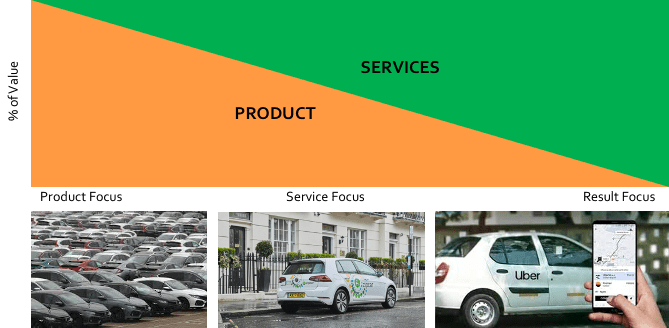
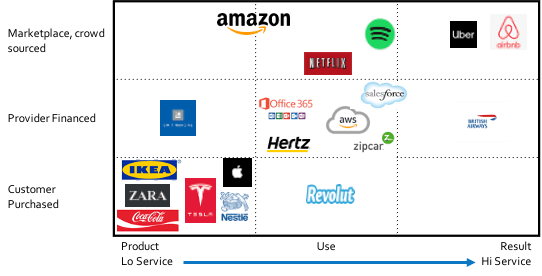
Once again within the automotive industry, we can see examples of each of these three models (Figure 9-2).  At the product focus end of the spectrum are the automotive manufacturers which include Toyota, VW, BMW, Mercedes, GM, Ford, Fiat, Renault, Peugot and the new entrant Tesla.  In the service focus part of the market, there are all the rental car companies and then new entrants such as Zipcar.  Zipcar is a highly convenient rental service to use the car as you want.  The service features include highly convenient pick up and drop off, a clean car, a full tank of gas/petrol, insurance and simple payment with all inclusive pricing.  Many consumers in urban environments are shifting to not owning a car and just paying per use.   At the results focus end of the spectrum, you have taxis and more recently Uber, and equivalent crowdsourced point to point personal transport service providers.   

Figure 9-2

If you were a large car manufacturer today, or a major player in the supply chain, facing a shift to electric cars, all the climate pressures, the emergence of crowd sourced / asset sharing companies, and in the medium term the growth of autonomous driving vehicles, what would your strategy be?

The mapping of the asset financing dimension and the product-service dimension provides and interesting look at the strategies of different companies (Figure 9-3).  An interesting business model to look at is Microsoft Office 365.  Microsoft has shifted from selling Work, Excel and Powerpoint as individual products or bundled as one off purchases to a subscription model with additional bundling of other services. This has helped to transform their business and economics.  They now have a product suite that is an integral part of their ‘cloud first’ strategy that provides a steady monthly flow of income, plus conversion to high proportion of direct sales to capture margins and only nominal additional marketing costs per existing customer for further potential sales.  This model also helps to open up additional innovation and cross selling opportunities off their cloud platform.  Uber and AirBnb in the marketplace and result box in the grid were able to build multi-billion dollar businesses by leveraging off other peoples assets and driving very simple user experiences.

Figure 9-3

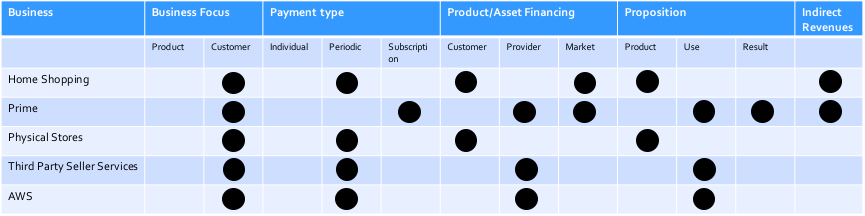
One of the masters of business model innovation is Amazon.  Amazon has built a business fortress with innovative use of business models (Figure 9-4). Amazon uses different combinations of business model components for each business. They go well beyond just looking at simple business models and create advantage from multi-factor business models.

All their businesses are customer relationship oriented and collect customer data.  The B2B businesses have leveraged off and enhanced the home shopping infrastructure.  Each business has carefully focused on how to drive drive growth, optimize the use of cashflow, and generate the long term profitability requirements of the business with a compelling customer proposition.

Figure 9-4

Going forward, it will be very difficult for anyone to compete directly against Amazon.  They have a relentless focus on customers and on how to drive continuous growth and improvement in the relationship they have with them, and they are innovation and execution obsessed.  Finally, they know how to use their scale with data, with the range of product and services they provide, and the efficiency of their infrastructure to their advantage.  It is no wonder that there is talk about the monopolistic market position that Amazon sits in.  

Clearly, there are other factors to explore that drive a business model, including different types of pricing, such as freemium and yield management pricing, and the selection of channels to market, which also have an impact on market size and growth potential, pricing and the cost structure of the business.

There is a real trend of businesses to move from simple business models to multi-factor business models. Different combinations of dimensions will create a business model with different financial characteristics and different market size and growth opportunities. The models create different financial profiles in terms of:

  • Upfront cash to get the business started and operating
  • Ongoing working capital and growth financing
  • Time to self sustaining economics
  • Resilience – reliability and predictability of future revenue streams, ability to handle economic disruptions, etc.
  • Market size and market growth potential

From a climate and impact perspective it is also critical to identify a sustainable business model. It is essential to explore models that will reduce waste from the traditional product delivery model of take – make – waste, towards a no waste model of being focused on maximising the life of a product/service and optimising the utilisation through reselling, remanufacturing, asset sharing, and finally optimised recycling.

Exploring different business model components is an essential piece of the innovation focus within a business. Creatively looking at whether adding further dimensions to the business model, as Amazon have, or fully switching to a different model, as Microsoft with Office 365 have, is a vital part of business strategy.

Categories
REBOOT Strategy

REBOOT Business Strategy

“It’s your reaction to adversity, not adversity itself that determines how your life’s story will develop.”
― Dieter F. Uchtdorf

Blog 7 of the Business Strategy Series

‘From risk monitoring to business resilience’.   How many companies had put pandemics as a risk factor in their risk register and were well prepared?  This is despite infectious diseases being logged as a medium likelihood and a high impact risk in the World Economic Forum’s Annual Global Risks report.  And, since the beginning of this new millennia, in the last 20 years, we have had Sars, Swine Flu, Mers, and Ebola.  Clearly, there were not many companies prepared or we would not have needed government economic support of up to 15% of GDP in wealthy nations.  

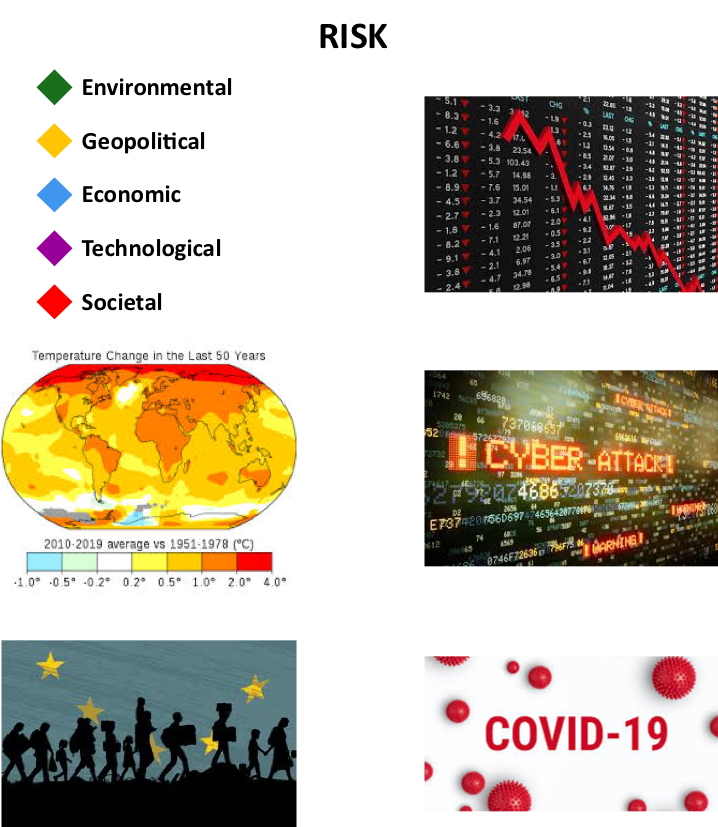
In addition, how many companies were prepared for the financial crash in 2008, have fully considered the risks from global warming, the challenges of political, economic or climate based refugee movements, or the full range of risks from different forms of cyber attacks?  This discussion follows on naturally from the previous blog on the need for macro modelling beyond traditional industry analysis.  

The first area of attention is to add macro risks with multi-horizon views into the risk monitoring (Figure 7-1)

Figure 7-1

As the world is getting more complex and more interlinked, the likelihood of an event occurring increases.  In addition, the risk and impact of an event is increasing due to inherent trends that we are facing.  These trends include climate change, population growth, increasing reliance on technology and data, increased population concentration in cities, globalisation and increased levels of debt per capita.  The optimistic view is that behind each of these trends should also be some great opportunities and this is where the great companies will be focusing.  Rigorous analysis should help to identify opportunities out of a risk assessment.  

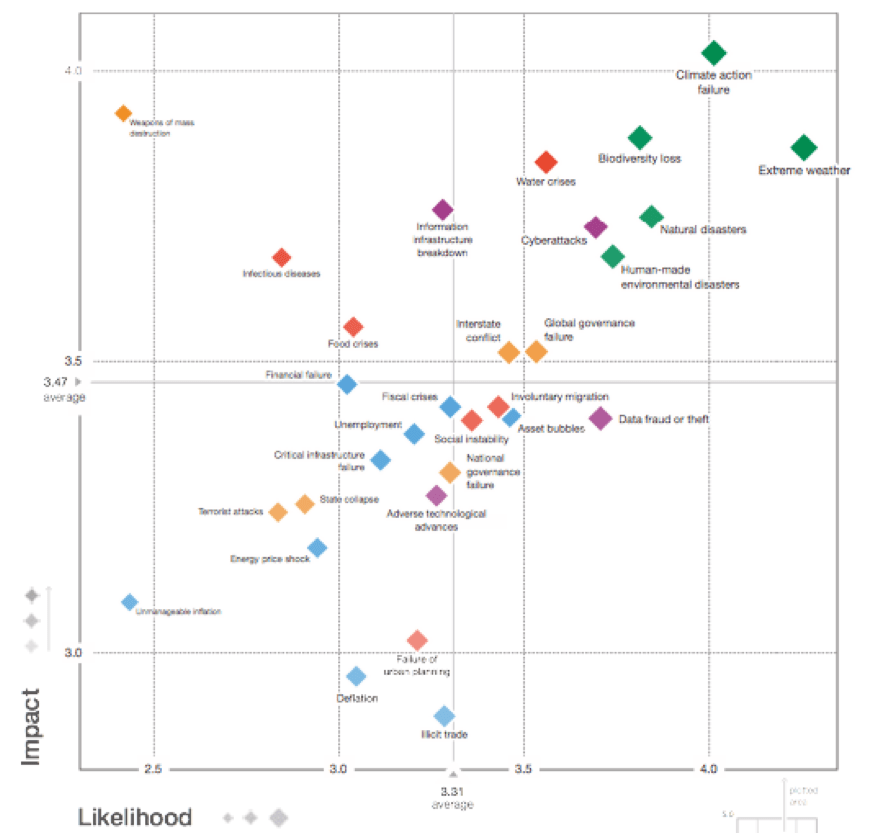
In the World Economic Forum’s Global Risk Report 2020, they have surveyed their member base to get their view of the likelihood of a risk occurring and its potential impact on a scale of 1 to 5.  The higher risk and likelihood events are listed in Figure 7-2.   

Figure 7-2

The outcome of this survey is set out in Figure 7-3 which shows the set of risks with a combination of high likelihood and high impact.  You can see the clustering of environmental concerns in the top right quadrant.   It is interesting to note that infectious diseases/pandemics were not ranked as high; although, still seen as serious.  

Figure 7-3

The perceptions of risk are not static over time with some of the perceptions being influenced by events that are occurring at the time, such as the 2008 financial crisis.  Since 2007, there are 2 visible trends. Firstly, the escalation in the risk levels related to climate and environmental issues.  Secondly, a growing view of risk levels on the technological front.  The good thing to take away from this risk assessment is that this indicates a growing understanding and view of the risks of climate change and environmental degradation.

Another interesting aspect of this report is that they compare the views of the WEF members against their Global Shapers Community which is the WEFs network of young people driving dialogue, action and change.  In most cases the Shapers see a higher likelihood of an event occurring and in virtually all cases a higher potential impact.  

What is not fully evident, and not addressed in the report, is the extent of government and business response in light of these risk assessments.  You would think that this could be one of the productive outcomes of the WEF Davos Meeting that happen annually.

For a specific business, the ratings of the risks would be affected by a combination of the sector and geography where they are involved.  Business risks can be divided into two broad categories of risk, direct risks (Figure 7-4) and macro, or indirect, risks (Figure 7-5).

Figure 7-4

Behind the direct risk, is the ongoing risk of one of the events occurring and the potential impact of that risk; however, there is also an implementation risk that occurs on an activity when you are undertaking a material action that is new and within your plan, or you are taking a substantive action to either mitigate a risk or respond to a risk that has occurred.  

Similarly, with Macro Risks, there is the physical risk which is the fallout related to the specific event. This would include second and third order effects as we have seen with the current pandemic.  However, there is also a transition risk which involves a fundamental change to the operating environment of the business; and, in these cases there are risks related to the period of change to a new environment.  Examples of transition risk are the risks arising from a transition from our current energy provision to a clean energy sector or a transition from a linear economy to a circular economy in a specific sector. 

Figure 7-5

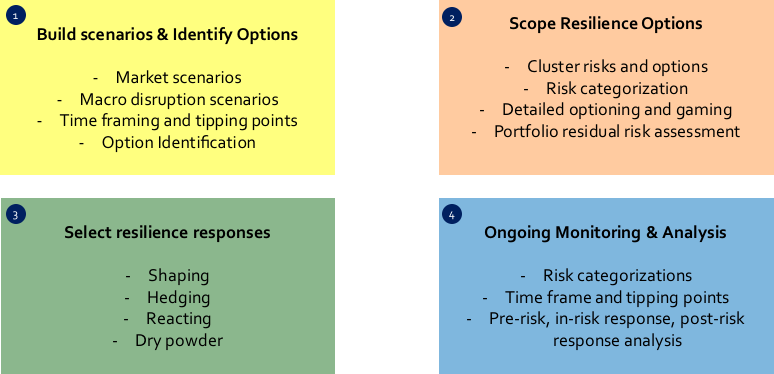
Against these risks, the management and their boards clearly need to think through how to build resilience.  Resilience strategies can take several forms.  Firstly ‘Shaping’, the company could eliminate or at least partially eliminate risk by boldly implementing a plan upfront. This approach would also be deployed where there were also business opportunities.  An example of shaping, would be a technology company building a second manufacturing facility outside of China due to geopolitical concerns and trade risks. This approach is clearly bolder and requires more upfront investment; and if there is a market opportunity involved it may well be the right approach.  Another interesting example of this is IBM, who started as a mainframe computer business, then separately invested in mini computer business in case the market took off; and then finally, did the same thing with the micro-computer market.  

 Secondly ‘Hedging’, the company could build a specific risk mitigation response capability that would be pre-planned and tested.  This would include optioning, if there are a set of discrete scenarios that would require quite diverse responses.  The goal is to limit the upfront expenditure, but keep the company in the game and help accelerate the speed of response if required; thereby, mitigating the risk.  Thirdly ‘Reacting’, a company could build the information and systems requirements that would give better pre-risk warnings, improve in-risk analysis to help the response, and provide post occurrence monitoring.  Finally ‘Dry Powder’, is to ensure that you have the financial capacity to react to any residual risks including known risks with unknown outcomes and unknown risks. 

In addition to defining risks in terms of likelihood and impact, it is important to categorise the risk.  There are effectively three risk categories.  The first risk category is ‘Clear Outcome’.  An example of this would be the binary decision of a competitor to build a new plant in a key market that would significantly affect the supply – demand dynamics.  

The second category is ‘Range of Outcomes’. In this case there are a set of different scenarios that could describe the future.  In some of these situations, it may link to scenarios of the outcome and timing of regulations related to a sector.   The third category is ‘Unknown Outcomes’.  In these situations, they are known risks but no true understanding on the likely scope of outcomes.  An interesting example of this would be during the development of the electric car market. In 2010,  I think it would be safe to say that the categorization of the development of this market and its implication on diesel and fuel cars would be ‘Unknown Outcomes’.  In 2016, Norway agreed to ban all conventional cars by 2025 and then other countries and cities started announcing bans in 2017.  By this time the risk category in the EU had turned to ‘Range of Outcomes’ and it was just a question of when the bans would be enforced by country across the EU.  Clearly, different types of risk need different option evaluation approaches.  Doing additional research and analysis to be able to shift to a clearer set of outcomes can add significant value.  

Linked to evaluating resilience responses, a business should be able to see that certain actions can create resilience against several, and often unrelated, risk types. This is clustering.  For example, having two manufacturing facilities in two countries rather than a single facility could mitigate risks for floods, fires, geopolitical trade risks and foreign currency risks. Another example would be, moving to an environmentally friendly strategy would help mitigate the risks from changing consumer purchasing behaviour, reduce employee retention risks, get the company ahead of potential new regulations, and reduce the potential of brand and reputation damage from climate action groups. 

The other side of resilience response is to evaluate whether or not risk reduction can be coupled with a new business opportunity. Pressure test your resilience thinking to see if you can turn some of the needed activities into opportunities to create deeper strategic advantages and further customer differentiation. A simple example of this, has been the Covid 19 based rush of many retailers to build an online channel for remote ordering and home shopping.  Many of these retailers somehow missed understanding that adding a home shopping channel market is a basic requirement today and should have been part of their strategy long ago to grow sales anyway.

These different components can be pulled together into an overall approach to resilience management (Figure 7-6).

Figure 7-6

There are a number of ways to build resilience. The most important starting place is to have the right leadership and team in place that have the knowledge and the capacity to build resilience, and rapidly and effectively respond to risks.  This pandemic has shown some stark differences in country and company abilities to respond to risk and significant differences in speed and effectiveness of response.  

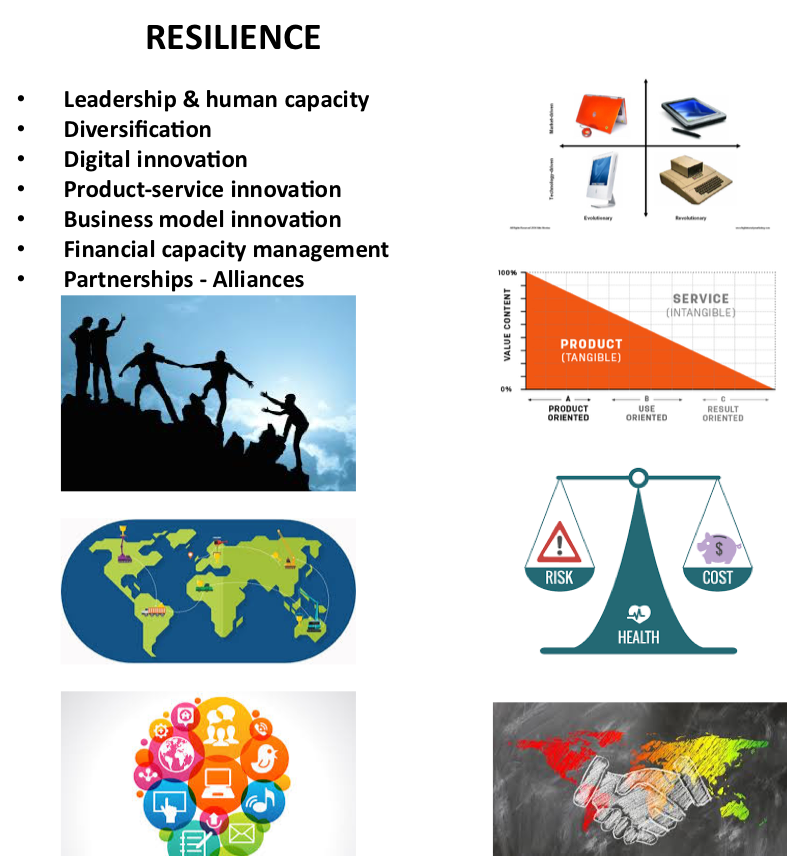
There are different ways to think of building resilience and some of them are noted in Figure 7-7  Firstly, diversification is a classic way of reducing risk.  Points of potential diversification would include raw material sourcing, manufacturing locations, distribution channels, data centre locations, geographic focus, and product range. Secondly digital innovation, which would include adding the ability to work remotely, home shopping, using cloud based systems, remote servicing.  Thirdly, product service innovation which would include having a more diversified set of products; but, also being able to rapidly change and adjust products and services for example as new regulations are put in place, software language use changes, and responding to disruptive new entrants into the market.  Fourthly, business model innovation is becoming increasingly important to look at.  We are now seeing a shift in some areas from single product purchasing models to locked in monthly payment models such as with digital news services vs. daily purchases of a newspaper.  Building reliability in revenue flows is a also critical part of resilience. 

Figure 7-7

Next is financial capacity management. In times of crisis, a strong balance sheet always wins.  It is increasingly hard to insure against all potential risks so residual risk may need to be covered off by a stronger balance sheet.   Just like at home, a business needs a cushion for a rainy day!  A strong balance sheet is also critical if a company is seeing increasing volatility of revenues and/or increasing seasonality of the business.  Private equity owned companies that are tightly financed and highly levered are particularly susceptible to small changes in trend lines.  I think everyone would agree that believing that the last line of defense of a business is a rescue by the government is not something worth relying on.

Finally, having partnerships-alliances or reliable third party support to help deal with, or be on call for, certain crisis types is usually a core part of a resilience strategy.  In technology based risks, having a specialised help to deal with cyber attacks is a common use of a third party.  They can help help reduce the risk of an attack succeeding as well as helping to respond to a threat that occurs.  Other examples could include having back up manufacturing capacity and some outsourced service capacity.  For many companies, having your data and software in the cloud results in the cloud supplier (eg. AWS, Google, Microsoft) providing the resources and skills to deal with a cyber attack risk.

Against this whole discussion of risk and resilience, it should be clear that resilience is a core component of strategy.  As noted in a 2016 HBR article, The Biology of Corporate Survival, companies are disappearing faster than ever before. “Public companies have a one in three chance of being delisted in the next five years, whether because of bankruptcy, liquidation, M&A, or other causes. That’s six times the delisting rate of companies 40 years ago.”  If you are focused on long term sustainable performance in a complex and rapidly changing world, resilience, speed, agility and innovation capability will outperform a low cost strategy.   

Source:  McKinsey wrote an excellent article in the HBR that helped shape some of this thinking.  “Strategy Under Uncertainty”, Harvard Business Review, November-December 1997

Categories
REBOOT Strategy

REBOOT Business Strategy

“The future depends on what we do in the present”, Mahatma Ghandi

Blog 6 of the Business Strategy Series

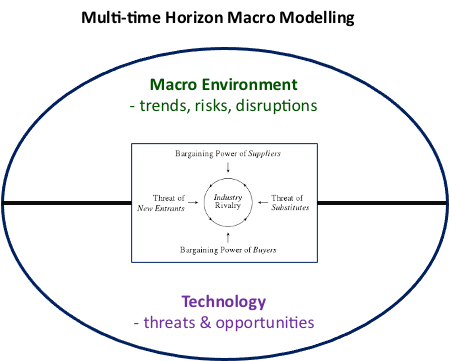
‘From Michael Porter’s Five Forces to macro-models’.  In the last blog, we talked about the need to shift from a shareholder perspective to a stakeholder perspective.  In this article, I want to cover off the importance of overlaying onto Michael Porter’s 5 forces industry analysis two factors (Figure 6-1).  Firstly, an understanding and integration of what is happening in the macro environment into the strategic thinking and planning for a business.  In broad terms, these macro factors can be put into one of 5 categories – Economic, Environmental, Geopolitical, Societal and Technological.  Secondly, a detailed analysis and assessment of the threats and opportunities that could come from technology.  

Both of these factors need to be looked at from a multi-time horizon perspective. The external dynamics impacting a company can be significant on all these horizons; therefore, scenario modelling on each of these horizons is essential. As examples, in the short term, we are seeing how a pandemic can have dramatic effects on our business. In the medium term, the movement of a technology into a growth phase of rapid adoption could have a signficant effect on a competitive environment and customer purchasing dynamics. In the longer term, climate change is affecting most businesses and sectors, and may affect longer term investment decisions. Superior understanding about how an industry could be affected provides a real opportunity to outperform and improve business sustainability.

Figure 6-1

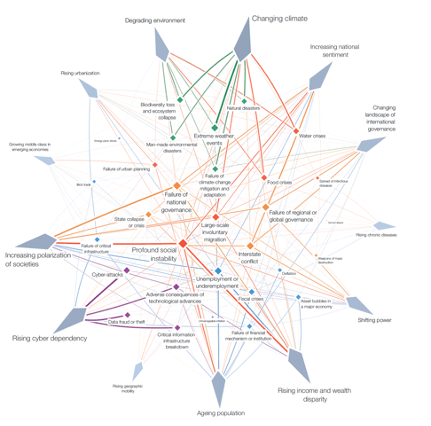
Starting with the macro environment, the World Economic Forum ‘Risk Trends Interconnection Map’ (Figure 6-2) illustrates well the range of macro factors that a business may need to watch and monitor. This will help a business decide how to adjust its strategy as these factors and their interconnections wax and wane over time.  

Figure 6-2

Just since February 2020 and the emergence of Covid 19, businesses are having to deal with a combination of many factors including the need for remote working, limited ability to make sales, massive financial pressures from the financial crisis, a collapsing oil price, increasing trade tensions between the US and China, increasing national sentiment, potential implications of greater control being put on Hong Kong by the Chinese government, and in some sectors a heightened level of cyber attacks.  Do any of these have any bearings on your strategy going forward?  This level of challenge to a business will not go away and for many the issue of climate change will only create even more profound challenges.  Thinking about these potential risks in different scenarios over the short, medium and long term is vital.  The key is really to solve how to take advantage of the situation to strengthen the performance potential of the business and strengthen its competitive position.

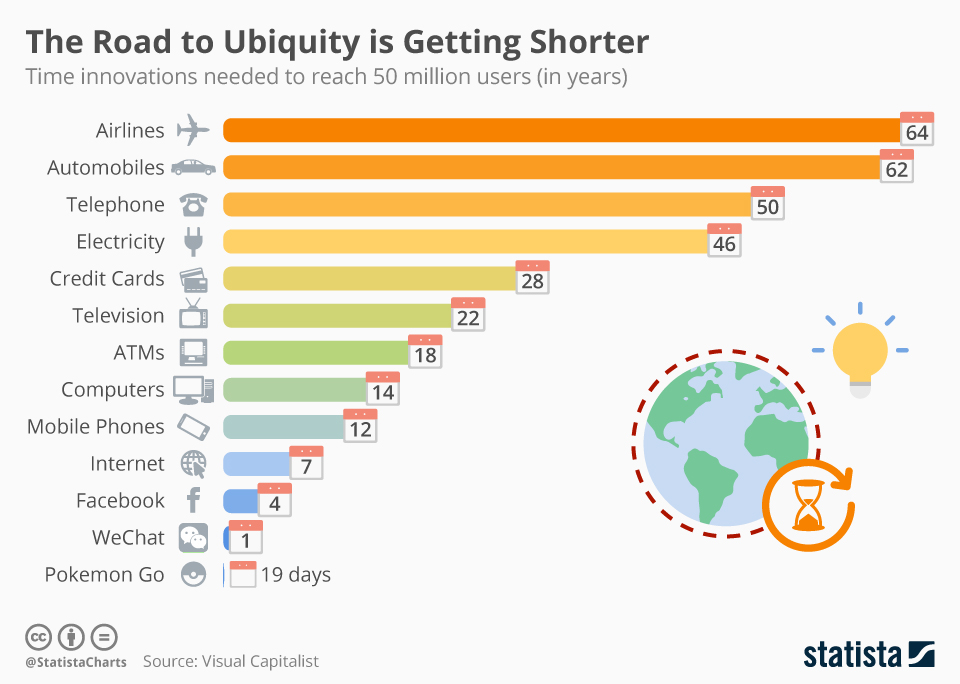
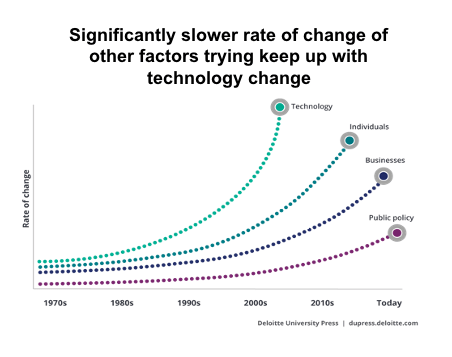
Secondly, it is vital to look at the threats and opportunities of technological change.  It is easy to forget the accelerating speed at which new technology is adopted at scale (Figure 6-3). For businesses, it affects what products and services can be provided, how businesses operate, which markets they can reach and focus on; and, it results in whole new market sectors being developed.

Figure 6-3

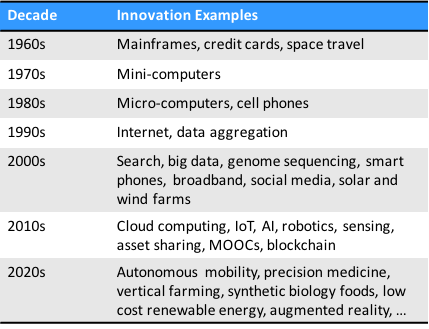
In addition, the speed at which new technologies are being developed and related products are being introduced is astonishing (Figure 6-4, 6-5).  In the research world, there are unprecedented levels of information sharing and collaboration coupled with increasing speeds of access to new research through digitization, open access and data sharing.  Over time, the profile of research is showing higher levels of collaboration and higher levels of cross border research cooperation.  As long as the world keeps opening up this will only accelerate; and in turn, continue the acceleration in the development of new technologies.  

Figure 6-4
Figure 6-5

The biggest challenge emerging from new technology being adopted to its full potential is the ability of individuals, businesses and governments to understand its potential and reap the full benefits (see illustrations in Figure 6-6, 6-7).  Increasingly we are also going to find that many high value applications involve the convergence and integration of multiple technologies. For example, an autonomous driving vehicle combines the use of recent and emerging technologies including AI, robotics, battery storage, big data and sensing.

Businesses need to be more focused than ever on understanding technology based opportunities and innovating new products and services. The old fashioned approach of driving leadership from focusing on primarily driving down its cost position or innovating within its existing knowledge and parameters will not survive. 

Figure 6-6
Figure 6-7

In the analysis of the potential impact of technology, a key factor to assess is the speed of adoption of new technologies.  Despite the potential for high speed adoption, this is not always the case. It is particularly important to analyse in sectors where there is a high concentration of market share among a few companies.  In these situations, there are two factors that affect the speed of change.  Firstly, for any of the key competitors is there a bigger profit opportunity in the short or medium term of adopting new technology?  If the business model of these competitors could be disrupted and their could be a leak of profitability then, depending on the level of competitor concentration, the adoption could be slowed significantly.  Secondly, once one of the big players makes an aggressive move to shift to adopt new technologies and adjust their business model, perhaps from shifting to a long term view of how they need to compete, then the rate of change in the industry is likely to change.  

This slowing down of the potential rate of adoption, was very prevalent in the research publishing sector with the likes of Reed Elsevier (now RELX plc) and Springer (now Springer Nature).  The rate of adoption of the real potential of digital technologies and its full implications to benefit the sector probably took at least 10 years longer than it could have.  Time bought them the ability to search for new sources of profitability before any core compression of performance in their core business. It would also be interesting to speculate what the energy sector would look like today if one of Shell, BP or ExxonMobil would have made a strategic commitment to commit to clean(er) energies say 15 years ago; after all, they knew about global warming in the 1980’s.  

Overlaying onto an industry analysis, how to take advantage of an increasing rate of technology introduction, understanding factors that may delay technology adoption, and managing continuously changing dynamics surrounding a market is fundamental to strengthening the performance potential and competitive postion of a business.

In the next blog, we will look at shifting from risk monitoring to business resilience.

Categories
REBOOT Strategy

REBOOT Business Strategy

Blog 5 of Business Strategy Series

In Blog 4,  I completed the brief discussion on the current global environment.

To summarise the key points I made in Blogs 2 to 4, the thread of the story was as follows:

  • Covid 19 exposes how little we are prepared for serious disruptive events
  • We live in a complex world with many interconnected factors that will affect our businesses
  • There are multiple types of events that can occur over time that can be highly disruptive to businesses
  • We must move from thinking businesses operate distinctly from the global ecosystem and should only be profit focused.
  • Businesses need to be part of the global ecosystem, and will be mandated to look this way, so strategy must be looked at from a system perspective.
  • The perspective of how we fit into a sustainable world is best reflected by the global consensus represented by the UN Sustainable Development Goals.

The nested circles below (Figure 5-1) illustrate that a business needs to not only build on their identified business opportunity but it must do so in a way that is aligned with the sustainability requirements from an economic, social and environmental perspective.

Figure 5-1

There are eight gaps in conventional strategic analysis and thinking that need to be integrated into system based business strategy. The next set of blogs are going to these eight gaps that are critical to strategic thinking going forward.  The eight gaps are:

  1. From shareholders to stakeholders
  2. From Michael Porter’s five forces to macro models
  3. From risk monitoring to business resilience
  4. From product-market fit to customer-product fit
  5. From simple to multi-factor business models 
  6. From product to company technology, innovation and design
  7. From profit focus to triple bottom line
  8. From medium term strategies to long term scenario based strategies

The place to start is ‘from shareholders to stakeholders’.  Some of the early thinking on shareholders, was discussed by the well known economist Milton Friedman.  In his 1962 book ‘Capitalism and Freedom”, he stated, “there is one and only one social responsibility of business—to use its resources and engage in activities designed to increase its profits so long as it stays within the rules of the game”.  This was linked to his view that the sole responsibility of management was to its shareholders.  

This Friedman doctrine, has been the driving force of thinking and management behaviour ever since.  Businesses are run with an intense primary focus on a mix of profitability, growth, and return on investment which are the critical drivers of shareholder wealth creation.  We see this every day in the stock markets and is the pervasive thinking in private equity.  If you look at the standard structures of incentives for CEOs and their management team, the core wealth generators for them are linked to financial performance and share price performance. This is coupled with the view that stock markets are focused on quarterly performance.

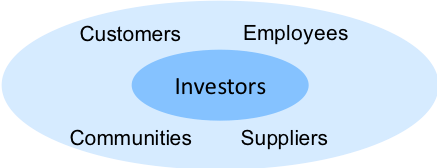
As the world has moved towards and into the 21st century, there has been a growing shift to increasing the view of stakeholders beyond investors to include other direct stakeholders (Figure 5-2).

Figure 5-2

This broader definition of stakeholders has to a large extent been at the core of many ‘family’ owned companies that have been around for decades.  It has also been a much more important part of the thinking of the companies situated in the EU and certain Asian countries.  The reality of these other direct stakeholders is that stronger relationships with each of them will create stronger and more sustainable economic performance. Alienating employees, not treating customers well to build customer retention, and having unstable relationships with suppliers tends to create financial and operating performance issues over time.  In a number of countries including Norway, Sweden, Germany and the Netherlands, company boards reflect the importance of a broader set of stakeholders by having specific representatives for the employees, unlike countries such as the US, Canada and the UK.

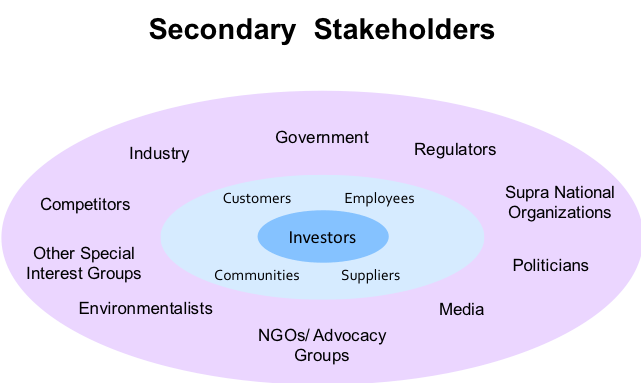
Through experience over the years, and as market and consumer behaviour has been changing, it has started to become clear to businesses that there is also a secondary set of stakeholders (Figure 5-3) that can also have a direct impact on the well being of a company and need consideration.

Figure 5-3

These impacts can come from a range of different groups and involve impacts such as regulatory challenges, acquisitions being blocked, government fines or additional taxes, and brand and reputation damaging press from advocacy groups or the media.  Clearly, strong relationships with these stakeholders can also have the opposite effects and open doors to opportunities.

Here are some examples that many of you will be aware of and I am sure there are many other examples that come to mind.

Figure 5-4

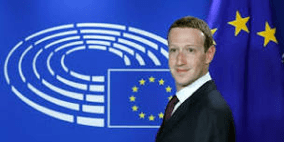
In May 2017, Facebook (Figure 5-4) received an EU $122m fine for the breach of anti-trust regulations, and then in 2018 the EU started  an action against Facebook for privacy breaches which had a potential fine of $1.6bn.  In 2019, the Federal Trade Commission imposed a $5bn fine for violating consumer privacy.  As well as the fine, the settlement order also required Facebook to restructure its approach to privacy from the corporate board level down, to establish strong new mechanisms to ensure that Facebook executives are accountable for the decisions they make about privacy, and that those decisions are subject to meaningful oversight.

Figure 5-5

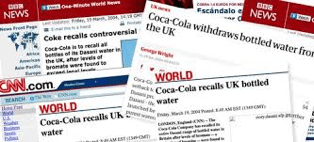
In 2004 Coca-Cola (Figure 5-5) launched Dasani, a leading bottled water brand in the US based on tap water, into the UK. The use of tap water and an ‘interesting’ marketing campaign caused a negative media frenzy, and then a Coca-Cola headquarters frenzy, and resulted in Dasani having to be withdrawn from the UK Market and cancelling planned launches of Dasani in certain other regions of Europe.  I will let you search this incident on the web if you have time for the more detailed and amusing story.

Figure 5-6

The Volkswagen emissions scandal (Figure 5-6) began in September 2015 linked to a violation of the Clean Air act in the US. This breach resulted in plans to spend €16.2bn in reparations and a $2.8 bn fine (source: Wikipedia – https://en.wikipedia.org/wiki/Volkswagen_emissions_scandal). Another example of the failure to meet regulatory compliance and the need to be on top of all regulations and potential new regulations.

Figure 5-7

We are all aware of the environmental movement (Figure 5-7) and the impact it is having on many companies resulting in damaged brands and reputations, boycotting, or brand switching to more ethical brands.  A lot of this pressure has come from a combination of activist groups, such as Greenpeace, naming and shaming companies involved in areas such as deforestation of the Amazon, and public protests including the activities of Greta Thunberg.

Understanding the relevance of these different stakeholder groups is an essential component of strategy.   Evaluating the power, risk, legitimacy and urgency  of these stakeholder groups will affect strategies, priorities, investment spend and programs for effective management of the key groups.

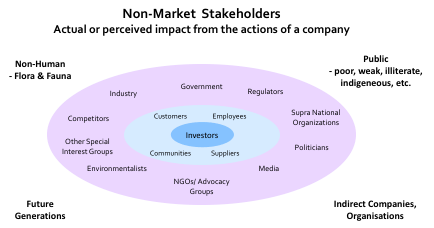
Fully understanding stakeholders, does not end with incorporating secondary stakeholders into your thinking.  There are non-market stakeholders (Figure 5-8) who are outside of the market of the company but can be indirectly deeply affected and therefore affect the company in return. 

Figure 5-8

As can be seen in Figure 5-9, these are examples of the types of corporate related activities that have had significant effects on non-market stakeholders.  There could be future generations that have severe health and well being problems as a result of nuclear or chemical disasters, or poor and indigenous groups that had been taken advantage of but now have rights.  It could be severe economic damage  to indirect businesses, such as in the 2010 Deepwater Horizon Oil Spill involving BP.  By 2018, it was estimated that this had cost BP $65 bn, including $4.5bn in fines.  Finally, with the environmental movement, damage to Flora and Fauna could also have consequences for a company.

Figure 5-9

We have outgrown, Milton Friedman’s view that the sole objective of a company was to increase its profits within the rules of the game.  He argued that the appropriate agents of social causes are individuals—”The stockholders or the customers or the employees could separately spend their own money on the particular action if they wished to do so.”  Today, charity does not solve the concerns of the secondary and non-market shareholders!  Thoughtful strategic integration of the needs of legitimate and valuable stakeholders is essential.  Effective management of all material stakeholders needs to be a fundamental part of managing a business.  In relation to climate change and the environment, we are already seeing that companies not focused on sustainability are losing access to finance, having trouble attracting and retaining talent, and losing customers.  We are only in the early stages of this movement!!

In summary, the landscape of stakeholders is broad and complex and their potential impact on businesses is continually evolving and changing.  Organisations not understanding this will have strategic and performance shortcomings, and be remiss in their responsibilities.