Categories
REBOOT Strategy

REBOOT Business Strategy

Blog 3 of Business Strategy Series

Now let’s talk about factors that affect our current global environment other than Covid 19.

Businesses sit within a complex ecosystem.   As long as all the factors in that ecosystem are relatively stable then running a business can be relatively straightforward, and if you have been able to build a strong competitive position then you have a good chance of maintaining your position.  However, once the number of dynamics affecting your business start growing the challenge can become exponentially more complex.  

These dynamics can come in many forms and from many sources, ranging from the development of new or existing technologies, to gradual changes in regulations, to activities that require a rapid response from events such as a pandemic, floods and fires, or a financial crash as in 2008.   To make it even worse a number of these dynamics could be happening simultaneously within a short geographic time frame.  Just in the last 9 months, we have had the severe fires that affected California and Australia, and now we have rolled into the Covid 19 pandemic that has also caused a financial crisis, a massive disruption to how we work, and there has been an oil price shock.  This is without looking in more detail into many countries where there will be whole sets of other ripple effects; such as, social instability being driven by lock down in low and middle income economies.

Figure 3-1

If you just look at the World Economic Forum 2020 Interconnections map below on macro risk factors, it is pretty clear that businesses will have to be continuously managing in an uncertain environment and they will need the flexibility and adaptability to deal with a broad set of challenges.

Figure 3-2

These events can require quick responses such as from cyber attacks/data fraud and the current pandemic, to medium term responses from factors such as changing trade relations, as is happening currently between US and China or with Brexit, to fundamental changes required for example in response to climate change.  

Another way to think about this is to look at what types of events can cause economic disruptions or create tipping points.  From this perspective, I am thinking of a tipping point as an event or set of events that drive a fundamental change in performance and/or require a material change in how you manage your business.  A historic straight line extrapolation of performance as an assumption of how to drive key decisions in a business can only looked at as an assumption of hope over reality.  Maybe you will get lucky!

These disruptions can come in many forms including those that are natural, man-made or health based.  As you can see from the graph below (Figure 3) on globally reported natural disasters, we are now in the range of 300 to 400 natural disasters per year vs under 100 in the 1970’s.  
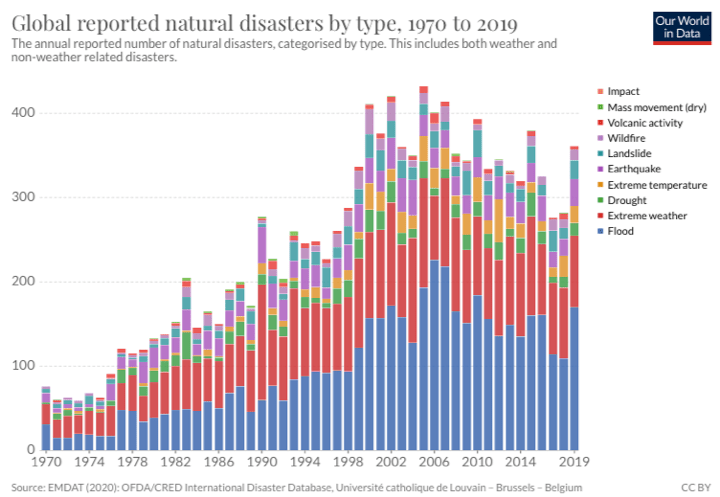
Figure 3-3

It is worth noting that most of these events are weather related.  The extensive science on climate change suggests that the frequency and scale of these weather related disruptions will only increase as the planet is warming.  It could also be argued that the economic disruption per event will also be increasing over time as the world is getting smaller from globalisation.  For example, our food supply chains reach to all parts of the world and material sourcing for our manufacturing comes from many parts of the world.  So a local natural disaster can disrupt businesses all over the world.

There are also multiple sources of potential man-made disruptions as noted in Figure4. 
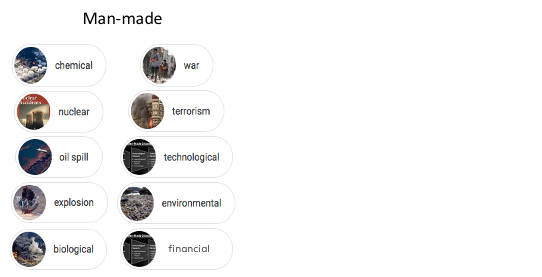
Figure 3-4

Not all disruptions are problems; although, with the wrong leadership they will be.  An oil spill maybe a problem for one company or an opportunity for another; or, low cost solar energy maybe be a problem for an oil company and an opportunity for clean energy focused companies.  In the digital space, there can be major disruptions from cyber attacks and ransomware, on the opportunity side a whole industry has arisen to help companies deal with these issues.

In 2007/2008 there was a convergence of a set of technologies/digital capabilities that would dramatically change how consumers would run their lives and how we could manage a business.  This was a tipping point.  The convergence included the ability to use computing power against big data, the emergence of cloud computing, the relatively ubiquitous availability of broadband, the launch of the first Apple smart phone and the large scaling of social media usage started by Facebook (only 58 million facebook users in December 2007).  Many companies have changed how they operate as a result of these combinations of technology and many new companies have emerged that are threatening older companies.

In health, this is not the first pandemic we have seen and will not be the last. As of 2 June 2022, we are closing in on 400,000 deaths from Covid 19 and we are still in the first wave.
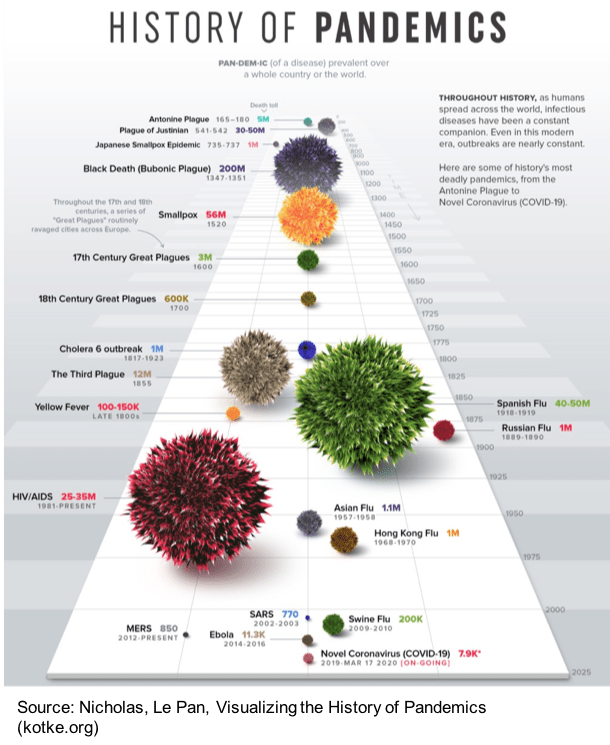
Figure 3-5

We all know this has also had serious consequences for our economies, how we socialise and our international mobility.  We have no idea how long this will economically affect different sectors and how it will shift consumer and purchasing behaviour both temporarily and permanently.   

So in our environment, we can see an increasing frequency and scale of disruption, some of which are truly just temporary challenges and others that will question the strategy, structure and key operating assumptions about how a business operates. These disruptions may come as complete surprises, become visible with some element of time to respond or have a long term fuse but still need urgent attention, such as climate change.  They will also have different characteristics in terms of being solveable to requiring a fundamental change in the business model of companies that it is affecting.  The question for a business is are you going to deal with these disruptions as and when they occur, are you going to be prepared for certain disruptions and be able to rapidly respond to minimise the cost, or are you going to anticipate some happening and be ready to take advantage of them.  Recognizing that certain disruptions are really also tipping points and being able to react faster than others should be seen as a source of competitive advantage and a way to outperform in the marketplace.  

 In my view, business should consider ongoing disruptions as the ‘new normal’ business environment rather than stability as the normal situation. The potential benefits of resilience in a disruptive world may well be a better strategy than a tight manufacturing and supply chain that will be more efficient in a steady state world. More on this as we talk about risk and resilience in later blogs.

Categories
REBOOT Strategy

REBOOT Business Strategy

“When written in Chinese, the word ‘crisis’ is composed of two characters. One represents danger and the other represents opportunity.” John F. Kennedy

Blog 2 of Business Strategy Series

Current Global Environment

You can’t start any conversation on the current global environment without talking about Covid 19.

It is useful to look at the global response to the current Covid 19 response.  Here are a few perspectives on how we are doing so far. 

In my lifetime, this is a completely unique situation.  The whole world has been affected from both a health and economic perspective.  There is a potential threat to each person’s life and livelihood.  Even in the world wars, many countries were safe at the local level, especially in the Americas (excluding Pearl Harbour) and in large parts of Africa.  That is not to say that they did not send people to help in the wars.  The war on ISIS which involved over 70 allies to defeat ISIS did not have a short term personal threat to the public in most of the ally countries.  So, this is a global war against an invisible enemy with huge consequences on the lives and health of many and with massive economic consequences.  For the countries that can afford it, it looks like the cost to the governments will be about 15% of GDP from responses and programmes put in place today.  Perhaps, there will be more to come!

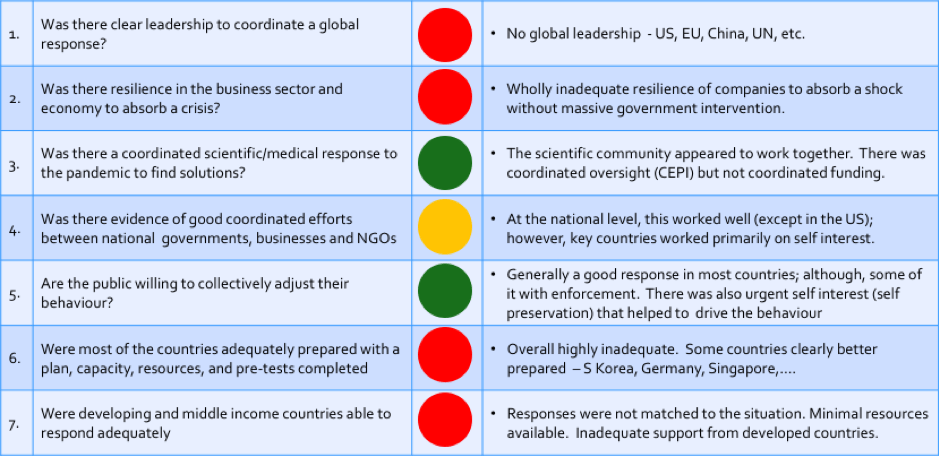
Given this is a global war on this pandemic, how have we responded?  Here is my take so far.  

A screenshot of a cell phone

Description automatically generated
Figure 2-1

On an overall basis, not particularly impressive!  Although, I would note that at the national level a number of countries (including South Korea, Germany, Vietnam), so far, have done well.  The problem is that we need a global solution if we are going to revert back to a similar life of massive mobility of people across borders. 

We should note that this ‘war’ has only just gone through its first phase.  How many more waves will there be?  Will we be able to defeat this virus, with a vaccine, or will we have to learn to live with it and effectively manage outbreaks? What will happen with mutations of Covid 19?  Are there other potential viruses that could come along? 

Perhaps, this isn’t a war; rather it is just a battle in what over time will be a war over lifetimes against pandemics. As an aside, we know that through the analysis of ice core samples, that with the melting of ice there could be a re-emergence of ancient bacteria and viruses that were not previously known to man.  From what I have read, the risks of further pandemics are growing.  This is unlikely to be a once in a century or once in a generation event.

There are still a lot of unknowns!  It is very unclear how this will play out over the next two or more years.  Almost certainly, geo-political tensions will rise unless there is a major shift in US policy after the coming elections.  I would think that we have to expect further economic ripples as the true cost and implications of Covid 19 add up and become clearer.

While we are dealing with this, we do need to face up to the need for action against climate change.  This Covid 19 report card also indicates there is a lot of work to do at all levels to have an effective response to climate change.

Back to Covid 19.  For businesses, if you created a similar business relevant report card, how did you perform?  Were you able to continue business or were you in the food lines to receive government aid to survive?  Did you look after your employees?  What further related economic ripples, or slow movement to a ‘new normal’, will cause you to take further drastic action or look for a bailout to survive?  

With the level of government assistance to businesses globally, it is clear that businesses in general have failed this resilience test.  The governments have had to step in as the lender, or funder, of last resort.  Many companies, if not most, have no rainy day financial capacity, supply chains have failed, retail sales for many companies have ground to a halt and it has not been possible for many companies to do remote working.  

So there are real resilience questions of leadership, financial capacity, preparedness for a disruption and speed and flexibility of response. Many companies will come out of this situation and realise resilience is a key component of strategic positioning, and if positioned properly out of crisis will come opportunities.

Categories
REBOOT Strategy

REBOOT Business Strategy

Blog 1 in Business Strategy Series

Introduction

Thoughts on an upgrade to strategy development for  performing in a sustainable world.

The wake up call has come!  Real leaders are already on the journey!

We are seeing immense upheavals across the world with Covid 19, growing levels of disruption from extreme weather events, increasing rates of technological change and threats,  great geo-political uncertainty, growing levels of public activism on the stewardship of our environment, and the real medium term implications of climate change which will be irreversible if we don’t start moving fast.

This is not a once in a hundred years, or even once in a generation, coincidence of events. This is a trend in this Anthropocene era.  These are systemic  interconnected issues that cannot be dealt with one by one.  We will be failing ourselves and future generations if we do not get on top of this.

We are not moving fast enough to deal with the cumulative effect of these changes. But, at least we are starting to move and gain momentum.  Central banks are engaged, governments are increasingly engaged, investors are also rapidly resetting their expectations of how businesses must be focused on social and environmental impact as well as driving strong investor returns.  

Businesses have not been well equipped in dealing with these unpredictable and emerging disruptions, and most businesses  still have to get there heads around how to engage and be able to perform with these changes and increasing stewardship demands by both the government, regulators and investors.

This is a view on how companies need to evolve their strategic thinking and planning, be much better equipped to perform in this changing world and be aligned with the social and environmental need for balance in our world.  As well as new thinking, this requires dramatically more purpose driven leadership, being able to manage with competing priorities, speed, agility and innovation – more on this separately.

I will be adding new content every week. These blogs will cover three core topics. Firstly, the scene setting of a quick view on the ‘Global Environment for Business’. Secondly, discussion of the ‘Key Components To Evolve Strategic Thinking’. Finally, ‘Strategic Framework For The Future’ will be a view on a practical framework for developing strategies. Each blog will cover off a piece of one of these sections and will be sent out in sequential order.