
Tim Cook, CEO of Apple, said that privacy is “one of the top issues of the century” and that it’s important to put “deep thinking” into that to figure out how to “leave something for the next-generation that is a lot better than the current situation.” Cook said privacy “should be weighted” like climate change, another huge issue the world is facing.
This is the third of what I call the three big challenges. The first being ‘Decarbonisation and Biodiversity Regeneration” and the second is “Inclusivity and Fairness”. “Digital Privacy and Collective Truth” sits among these challenges; but, it is the third priority. It is also a priority that would not be agreed with across the world, in particular in non-democratic countries. This challenge is not captured among the UN SDG’s, however, it is captured in the World Economic Forum Global Risks Report 2020 on both technological and societal dimensions.
We are living in a surveillance world. Something you will have read in George Orwell’s “1984”, or watched on “Black Mirror “ or some other dystopian science fiction movie or box set. That world where virtually everything you do is tracked, monitored and then attempts are made to adjust your behaviour either by governments or corporates.
The most advanced mass infringement of personal privacy is China’s Digital Social Credit system. Based on a cultural norm of monitoring individuals the Chinese have now turned to digital as the means for this. The focus is on measuring trustworthiness of an individual and then rewarding or punishing them for trust violations. Trust ranges from financial and legal trust to how you behave in public (eg. jaywalking, playing loud music, make reservations at restaurants and not showing up, etc.) and what you say. You can lose points or gain points on your starting score and you can benefit or lose freedoms depending on your overall score. As an example as of June 2019, 27 million air tickets and 9 million high speed rail tickets had been denied to citizens deemed dishonest. It also affects your access to certain jobs and your children access to certain schools. China leads this trend to monitoring; but, other countries are moving in this direction as governments get more and more access to personal information through governmental ID cards and digital records, and corporate data cooperation.
In the democratic world, the level of data gathering is no less. It is just the use, and abuse, of the data is different. As well as potentially overreaching use by governments, there is a massive issue in the corporate use of information for profit. The leaders in the data gathering, use and abuse of information are Facebook and Google. Facebook and Google are the companies whose income is dominated by advertising revenues. For Facebook about 97.9% of their revenues comes from ad revenue, and for Google it is about 83%. They will only be successful longterm if they are able to help change your behaviour – shopping, travel, entertainment, socialising, voting and all other behaviours that might have an economic value to a company, government, organisation, group or individual. If digital advertising revenues are their engines for profitability then personal data is their fuel.
Given that Facebook and Google’s core business models are built off customer data and their core source of their profitability is from taking advantage of the data they collect, what really are their strategies. Is Facebook’s mission to “Give people the power to build community and bring the world closer together”. Is Google’s mission “To organize the worlds information and make it universally accessible and useful”. Why do they need all this customer data and why do they need to do it without you knowing the extent of their data gathering, use and sharing. The answer is that these aren’t really their strategies. Both of their core strategies are to dominate the world of personal information and to maximise the profitability of that information – clearly this is not a publishable strategy for the public. It is the idea that the winner in the data race on consumers will achieve an unassailable position of power, control and profitability. They both just come at this from different positions as set out by where they started from.
If you look more closely at them, their real executional strategies are:
- Be a witness to everything in as close to real time as possible.
- Collection of all data of everyone, and their context, that allows perfect (real time or delayed) predictability of any combination of individual, group and society based behaviours and actions.
- Addiction based, dopamine generating, continuous generation of information and interaction.
- Create consumer products to enable data collection that are ubiquitous, become essential and are irreplaceable. These include search, maps, social communities, marketplaces, mail, calendar, contacts.
- Optimize the opportunities for profit through individual and group behavioural modification achieved either directly or through the sale of information.
- Lock in competitive position by building asymmetry of knowledge, authority and power over all stakeholders; including, getting governments dependent on their data.
- Retain trust and legitimacy by Privacy of Intent through misdirection, misinformation and swarming (overwhelming the truth with alternative information).
At its core, this is a strategy of misleading users, data exploitation without user knowledge, and the theft of individual privacy and freedoms. This will be their achilles heel!
Microsoft, Amazon and Apple aren’t innocent; but, their dependence on advertising revenues is at a fraction of Facebook and Google. Apple, led by Tim Cook, is the first of the big five tech companies to change their strategy on data. This appeared to start around the time of the 2016 US election and the Facebook/Cambridge Analytica affair. I expect Microsoft and Amazon to sheepishly, or hopefully boldly, also change their strategies. Bold strategies from the three of them will help reset the agenda on data privacy within the tech and internet based world. If not, let’s hope that it will be done by the attrition of GDPR (General Data Protection Regulation) and equivalent legislation, the escalation of lawsuits, multi-billion dollar fines and stakeholder revolt.
The EU leads the way on privacy and hopefully other parts of the world will follow. The EU GDPR was a big step in moving in the right direction. Implemented in May 2018, it is a legal framework that sets guidelines for the collection, processing and use of personal information. The EU has set a maximum fine of €20m or 4% of annual global turnover – whichever is greater. This couples with the right to be forgotten or right of data erasure. In the US, progress has been slow and primarily driven at the state level, with California leading the way.
In January 2021 at the Computer, Privacy and Data Protection Conference (CPDP 21), Tim Cook in the opening speech said, “As I’ve said before, if we accept as normal and unavoidable that everything in our lives can be aggregated and sold, we lose so much more than data, we lose the freedom to be human.” He also then said, “Together, we must send a universal, humanistic response to those who claim a right to users’ private information about what should not and will not be tolerated.” He laid out four core principles for privacy – data minimisation, user knowledge, user access, data security. The first three of these are at odds with current practices of virtually all companies with significant customer data.
Core elements of Apple’s shift include increased privacy protection through Safari, Maps, Photos, iMessage and Facetime, and Apple Pay. In addition, they have just introduced App Tracking Transparency and App store privacy labels in the IOS 14.5 operating system for smart phones.
Facebook CEO, Mark Zuckerberg said, during the company’s recent earnings call that “Apple has every incentive to use their dominant platform position to interfere with how our apps and other apps work, which they regularly do to preference their own. This impacts the growth of millions of businesses around the world, including with the upcoming IOS 14 changes, many small businesses will no longer be able to reach their customers with targeted ads.” Mark Zuckerberg’s comments about targeting are fallatious. Customer targeting does not require egregious collection and use of data. Reasonable and transparent collection and use of data can be highly effective in reaching customers with targeted ads.
An invasive and exploitive model of data collection and use looks something like what I have outlined in Figure 9-1. The level of knowledge that is gathered and interpreted from video, audio and text is completely intrusive. The only way to collect this information is without your full knowledge. It is the idea that if you dominate data collection, then you should be able to dominate behavioural change and therefore also profitability.
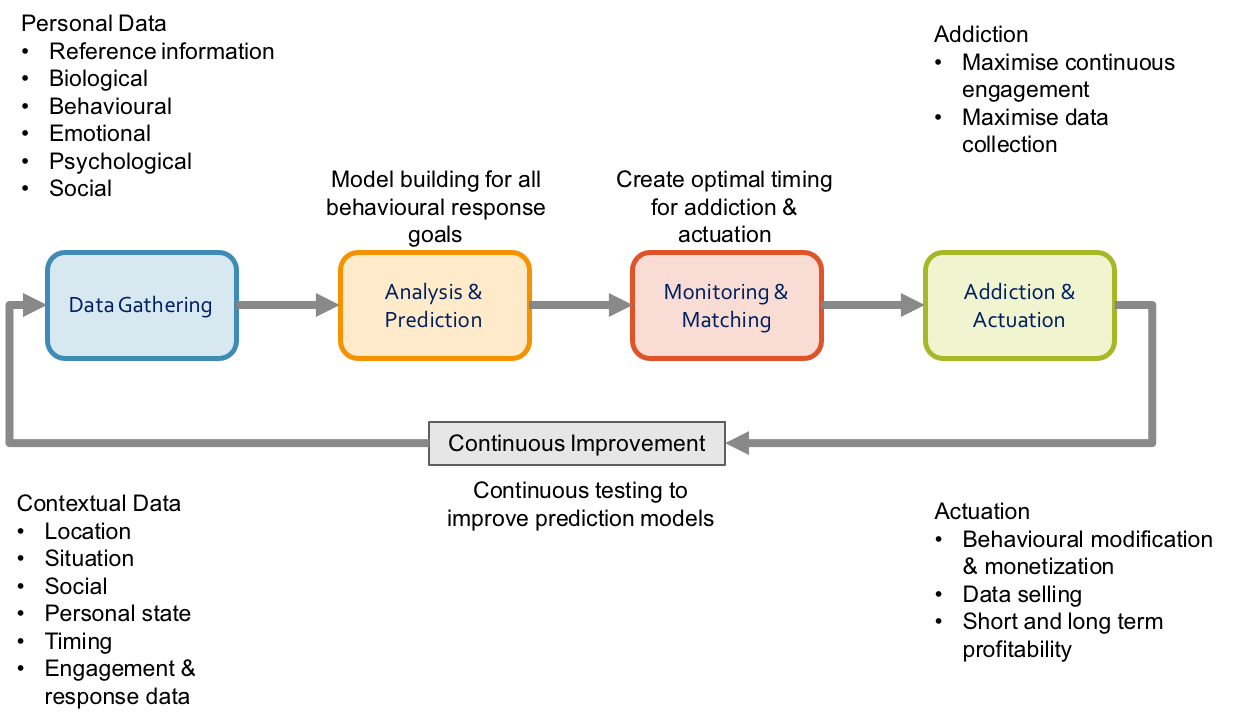
Both Facebook and Google, through combinations of their websites, links to other websites, ad platforms, technology integrations with other websites, web crawling, analytics, and other sources can collect an extraordinarily high level of all your behaviour across the web and they take information off the files on your computer. They also have other activities such as Google street mapping, where they have been caught downloading home information and computer files as they map your home. There will be many other sources such as information gathered from satellites and other third party sources.
If you want to understand this more, I suggest you watch two movies, “The Great Hack” and “The Social Dilemna”. For a simple description, there is Apple’s April 2021 recent communications called “A Day in the Life of Your Data – A Father-Daughter Day at the Playground”. There are also two interesting books, “The Age of Surveillance Capital” by Shoshana Zuboff, and “Privacy is Power” by Carissa Véliz. These sources also talk about the issues of fake news, which I have dubbed the need for collective truth.
Collective truth, as I have defined it, is the need for the dominance of a common base of facts for all key societal events and activities where lies, misinformation, noise and conspiracy theories can materially affect decision making. This requires giving, and if necessary regulating, real responsibilities to all potential sources of mass dissemination of information.
Fake news is not new. For decades, communist and fascist countries have created and controlled false narratives of life at home and life in other countries. With the rise of the digital age, for these countries the opportunities for surveillance and control are much higher; however, there is also the need for more comprehensive generation of the narratives to in many cases overwhelm the truth.
One area where micro-targeting and fake news are used is in elections. Since 2016 the number tech ops groups from countries that have a mandate to help disrupt the election processes in countries has grown dramatically. Vladimir Putin, in particular, has a clear focus on damaging the credibility of democracies by, among other things, influencing the outcome of elections. Their involvement in the 2016 US Presidential elections being the prime known example.
Clearly fake news is also not new in democracies. With mass media and journalist requirements to validate the news they provide, historically it has in large been that the truth has risen to the top and overwhelmed the lies. However in the US in 1987, the US FCC (Federal Communications Commission) abolished the Fairness Doctrine. The Fairness Doctrine was a policy that required the holders of broadcast licenses to present controversial issues of public importance in a manner that was honest, equitable and balanced. This abolishment paved the way for Rush Limbaugh to build his conservative radio station focused on entertainment, not truth, and established an enormous audience of 20 million listeners per week at his peak . The scale of his influence helped drive the partisan strategy of the Republicans and spawn the success of Fox News.
Digital technology and social media companies have taken partisanship to new levels. The dangerous combination of micro-targeting and fake news has combined to help disrupt elections and fuel populism. The movie documentary, “The Great Hack” illustrates how data mining and algorithms can be used to undermine individual liberty and democracy. The ability to build alternative versions of the ‘truth’ through individualised and ideologically based uncensored newsflow is removing the ability to have voting from the same base of facts. We can see the turmoil this created in the US 2020 Presidential elections.
Facebook and Google/Youtube are two of the critical platforms used to manipulate and change the behaviours of large groups of people, one person at a time. Government and stakeholder pressure is mounting for these groups to behave in a socially responsible manner – including blocking fake news where there can be material impact, eliminating all forms of hate speech and the ability to incite violence, and the blocking of foreign groups ability to interfere in elections through troll accounts. Social media groups have been slow to respond; although, more recently as an example we have seen Donald Trump’s Twitter, Facebook, Instagram, Snapchat and Youtube accounts were disabled during and now post the 2020 US Presidential election.
Governments are responding to this threat as they see fake news as a potential national security threat and a clear and present danger to social harmony. They are increasingly focused on holding these companies accountable based on the editorial control of what information is pushed to individuals. The companies are being asked or forced in some jurisdictions to identify and close troll accounts, to monitor, block and remove inappropriate content, and to abide by strict rules of information dissemination surrounding elections. Once again, the EU is leading the way on regulating the behaviour of the tech industry. They introduced draft legislation in December 2020 proposing fines of up to 6% of turnover if they do not do more to tackle illegal and harmful content and reveal more about advertising on their platforms. The social responsibility requirements of these social media companies will only increase going forward.
Other stakeholders including employees, consumers and the court of public opinion are also forcing change. Both Facebook and Alphabet have to regularly deal with their employees, or employee union in the case of Alphabet, and manage the public consequences of their statements. They also have to engage with civil rights groups, hearings before government committees and public interest groups. The topics range from collaborating with repressive governments, providing assistance to intelligence services, dealing with hate speech and incitements to violence, BLM and false information related to elections, to inappropriate sale of data and use of social platforms for mis-selling.
The toxic combination of over collection and abuse of private information and fake news for any profit has to be addressed to provide the human right of digital privacy and the need for collective truth. Without addressing this with some urgency the loss of privacy and allowance of the destructive use of fake news will become institutionalised and too complex to reverse. The power of big tech not harnessed for social good is dangerous. It is easy to forget the enormous economic and market power of Facebook and Google. For Facebook the total number of active user accounts across their four platforms (Facebook, WhatsApp, Instagram, Facebook Messenger) is 7.3 billion. Google on top of their 92% global market share of search have 2.3 billion YouTube active users. It may well be that anti-trust action by the EU and US focused on the potential break up or curbing of monopolistic powers of Facebook and Google may also affect their data domination strategies.
Addressing these combined challenges of digital privacy and collective truth is complex. At the heart of digital privacy is the return of ownership and control of personal data back to the individual. This is a fundamental part of the social contract that should be expected by the individual.
GDPR and the right to data erasure in the EU is good progress but does not go far enough. What really needs to happen to respect the fundamental right to privacy is that the control of personal data that is being used is put in the hands of the individual. This as much as anything is a technological challenge to create a model of data control that governments can then enforce.
Tim Berners-Lee, the inventor of the world wide web, is now working on this. He understands the dark side of surveillance capital and is focused on taking the internet and personal data to a sustainable place and remove the invasive data harvesting by governments and corporations. He refers to this as “data sovereignty” which is to give individuals the power to control their data. He has set up a company, Inrupt, to create a solution based on a technology, Solid, for organising data, applications, and identities on the web.
Inrupt plans to do this through a new system called “pods” – personal online data stores. Pods work like personal data safes. By storing their data in a pod, individuals retain ownership and control of their own data, rather than transferring this to digital platforms. Under this system, companies can request access to an individual’s pod, offering certain services in return – but they cannot extract or sell that data onwards.
I do believe that the combination of Apple, Microsoft and Amazon could not only help build a system that worked but they have the combined necessary market power to drive the adoption of a true data privacy solution. The addition of a proactive Google of course would make a massive difference as they with Apple effectively manage the app world. Governments would have to be involved to oversee all the related issues of monopolistic power.
The ambition of collective truth has its own complexities. The core objective of this is to arrest the increase in partisan behaviour related to groups of people with their ‘own versions of the truth’ and the use of fake news or disinformation to poison effective discourse on material issues. Post the US 2020 Presidential election, we are still in the position where the majority of Republicans believe the election was stolen! The effectiveness of a democratic system is violated by voting based on lies. Individual governments need to ensure public trust in the government and the political system. As such, appropriate rules, regulations and monitoring of the conduct of elections is essential; and, part of this is solving how to ensure the integrity of information that voters rely on and use to decide how to vote. To a large extent, this requires real focus on social media companies where the combination of individual targeting with the provision of fake news has been allowed. Social media companies, are clearly media companies given that they push information to their consumers though algorithms. They need to be held to account, along with all other major violators, for the mass provision of fake news. In February 2021, India set out guidelines to large social media companies like Facebook, Google and Twitter which will require them to remove any content flagged by authorities within 36 hours and set up a robust complaint redressal mechanism with an officer being based in the country. The pressure to solve this is building rapidly.
Collective truth is intertwined with the rights of freedom of speech and expression. There are already many limitations and boundaries relating to libel, slander, obscenity, pornogragphy, incitement, classified information, copyright violation, trade secrets, food-labelling, non-disclosure agreements, the right to privacy and dignity, the right to be forgotten, public security and perjury. The justifications are linked to the principle of ‘harm’.
This hornets nest of trying the get the optimal balance of the right to free speech and the limitations based on the principle of harm is not helped by a cancel culture. Limitations on research, discource and debate, and the narrowing of acceptable views, especially in University environments, will only slow down our progress. Restrictions need to be judged by looking at the combination of harm and materiality.
Actions must be taken on both digital privacy and collective truth before it becomes overly complex to reverse; and, governments have become too reliant on all the data access they have with the large tech companies. This is fundamental to the social contract with citizens and the effectiveness of the democratic form of government. Failure to address these issues can only be damaging in terms of loss of trust in the government and political process, increased social instability and rising partisanship.
In my tenth and final blog of this series, I will talk about the importance of appropriate policies and incentives to get beyond words to achieve financial commitment and action with urgency to hit targeted deadlines. The Paris Climate Agreement and the UN Sustainable Goals are bold and there is an enormous target of what needs to be achieved by 2030 to be successful.
 REBOOT