
Blog 4 of Business Strategy Series
In earlier blogs, we have talked about the broad range of externalities that can impact a business. We can see from our current experience of Covid 19 that a health crisis is an example of the depth of interconnected issues. Most key environmental, geopolitical, economic, technological or societal macro-factors have a heavy set of interconnections which can impact a business.
These factors range from events with little or no warning such as floods, pandemics and cyber attacks, to events that are somewhat visible and require a reasonably quick response such as Brexit, regulatory changes, different forms of financial crises, and at the other end of the spectrum factors that are visible and will require large fundamental changes such as climate change, and perhaps AI and robotics.
At the global level, the 2008 financial crisis and the 2020 Covid 19 crisis has shown real weakness in the overall resilience of companies and the reliance of massive government interventions to backstop the collapse of our economies and way of life through both monetary and fiscal policies interventions. However, it is important to note that the level of interventions that are taken are limited to the capacity of the government to assist. Many governments, especially in low and middle income countries, lack this capacity. For the affluent countries, it looks like that the cost of Covid 19 for the governments to keep the economy alive so it can recover will be up to 15% of GDP. There are many more examples at the national level where crisis have needed significant national and also. international responses. At the company level, too many companies, from multi-nationals to small companies, have not properly addressed the dealing of potential disruptions at the macro level within their strategies to sustain the viability and performance of their businesses.
Behind all these potential disruptions, the one issue that will not go away is environmental crisis. No issue is bigger, more complex, or requires more structural change than the current environmental crisis with climate change at the center of this. This challenge is going to last for decades, if not forever, and we should expect to have major disruptions requiring short term responses as well as longer term fundamental changes.
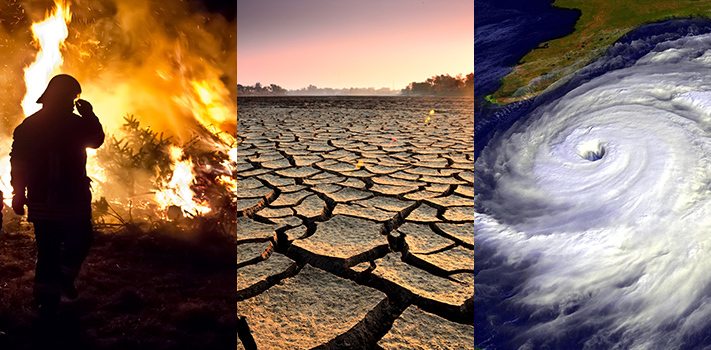
As most businesses have been in denial, are avoiding the issue, or not are not taking action with any urgency, we have seen international organisations, governments, investors, and the public start to demand systems thinking to deal with this issue of climate change and environmental damage. From the 2015 Paris Climate Agreement, 189 countries have signed up to individual targets as of February 2020. A number of countries are starting to commit to net zero carbon emissions targets, including Denmark targeting to reduce their CO2 levels by 70% by 2025 and the UK targeting to achieve Net Zero by 2050 along with a growing number of other countires. Behind these commitments there are/will be a set of policies, regulations, and incentives to achieve each countries targets.
There are also investors who represent $130tn (per Mark Carney) of money under management and central banks requiring climate impact reporting. In addition, a growing set of these investor, including major sovereign wealth funds and pension groups, are setting their own climate targets for their portfolio holdings and will be driving a shift in the investment and funding of companies depending on their climate and environmental impact strategies. Finally, we can all see the public movements on this issue and the consumer purchasing trends taking shape against the environmental issues.
Next to the environmental movement, there has been ongoing focus on social and economic responsibility. In 2015, the United Nations Sustainable Development Goals (SDGs) were announced that covered sustainability across environment, social and economic development. The goals covered 17 core areas of focus, each with a set of sub-goals (Figure 2). These SDGs were signed up to as a global consensus of most of the countries of the world. They are the best universal view of goals and targets that a sustainable world should encompass. These targets are effectively linked to the ESG (Economic, Social, Governance) reporting requirements for large public companies. It’s worth noting that corporates that are looking at their external impact seriously, such as FMCG companies and supermarket groups, have based their strategies on aligning with the SDGs and not just environmental targets and climate specifically.
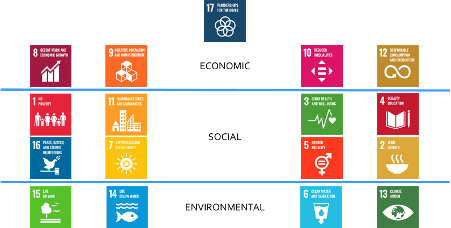
Figure 4-2
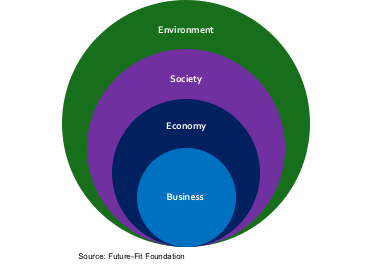
It is clear that companies are operating in a complex world that is disrupting the ideal steady state approach to doing business. Climate change was the big issue that everyone was talking about until we had a pandemic which also triggered our economic crisis. Instability is really the business environment that we need to be designing our businesses to work in. By definition, then strategy must be looked at from a system perspective integrating the externalities of our global economy, society and environment and solving a sustainable way forward. The best guiding light we have on sustainability and what we need to guide our system based strategy at this point in time are the UN Sustainable Development Goals. Businesses need to be designing their strategies integrated with and aligned to also creating external impact economically, at the societal level and environmentally (Figure 3).
 REBOOT